Home › Products › Pressure Instruments › Melt Pressure Transducers
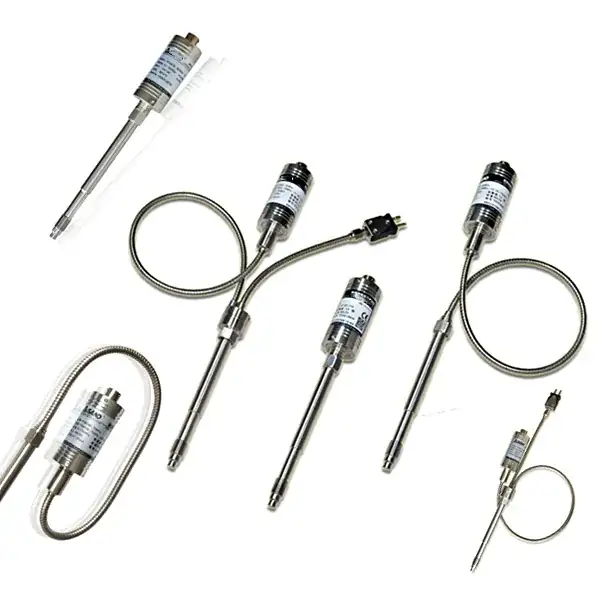
SI-PT Series Melt Pressure Transducers
An extruder barrel runs at 200 to 450 °C. That heat cooks an ordinary pressure transmitter in hours, so a melt sensor does two things differently: it puts a hardened stainless steel diaphragm directly in the melt stream, and it moves the strain gage element away from the hot zone on a rigid stem or a flexible capillary. The SI-PT series covers eight models built this way, from a plain screen-pack sensor to an intrinsically safe HART transmitter.
- Ranges: 0–3.5 MPa up to 0–200 MPa; PT292 to 0–30,000 psi
- Accuracy: ±0.25% FS on the best models
- Diaphragm ratings: 300 / 350 / 450 °C by model
- Outputs: mV/V, 0–5 V, 0–10 V, 4–20 mA, HART on PT292
- Interchange: PT124 and PT131 drop in for Dynisco, GEFRAN and RKC sensors
Melt pressure is the one process variable an extrusion line cannot run blind on. Pressure ahead of the breaker plate tells you when the screens are loading up. Pressure at the die inlet tracks product dimensions. Pressure at a melt pump inlet and outlet proves the pump is fed and not deadheaded. The SI-PT series measures all of these points with the diaphragm wetted by the melt itself, so there is no impulse line to freeze off with solidified polymer.
If your application is hot fluid in a pipe rather than melt in a barrel, look at our high-temperature pressure transmitters instead; they carry the cooling structure for that job.
Selecting the model
Eight SI-PT models cover this job. Match the line’s needs to a starting model here, then confirm the range, accuracy and diaphragm rating in the specification table below.
| Your situation | Start with |
|---|---|
| General extrusion, standard accuracy, best value | SI-PT111 |
| A 4–20 mA or voltage signal straight into the PLC, with no separate amplifier | SI-PT112 |
| Pressure and melt temperature from the same point | SI-PT127 (or SI-PT131) |
| Replacing a Dynisco, GEFRAN or RKC sensor | SI-PT124 (pressure) or SI-PT131 (pressure + temperature) |
| Tight or curved mounting, or heavy vibration | SI-PT123 (flexible capillary) |
| A flange connection instead of a threaded port | SI-PT2616 |
| A hazardous or explosive area, or a HART signal | SI-PT292 |
| The tightest accuracy, ±0.25% FS | SI-PT112, PT123, PT124 or PT292 |
Models at a glance
| Model | Type | Range | Accuracy | Diaphragm | Output | Notes |
|---|---|---|---|---|---|---|
| SI-PT111 | Rigid stem | 0–5 to 0–100 MPa | ±0.5 / 1.0% FS | 300 °C | 0–5 V, 0–10 V, 4–20 mA | Workhorse; wear-resistant coating option |
| SI-PT112 | Rigid stem, amplified | 0–5 to 0–200 MPa | ±0.25 / 0.5% FS | Consult factory | 0–5 V, 0–10 V, 4–20 mA or mV/V | Zero and span adjustable; feeds PLC direct |
| SI-PT123 | Flexible capillary | 0–3.5 to 0–150 MPa | ±0.25 / 0.5% FS | 350 °C (400 °C max) | 2 / 3.33 mV/V | 15-5PH coated diaphragm; built-in temperature sensor |
| SI-PT124 | Rigid stem | 0–5 to 0–200 MPa | ±0.25 / 0.5% FS | 450 °C | 1.5 / 2.0 / 3.3 mV/V | Drop-in for Dynisco, GEFRAN, RKC |
| SI-PT127 | Rigid stem, pressure + temperature | 0–5 to 0–200 MPa | 0.5 / 1% FS | 450 °C | 1.5 / 2 / 3.33 mV/V | J, K, E thermocouple or PT100 in one body |
| SI-PT131 | Rigid stem, pressure + temperature | 0–5 to 0–200 MPa | ±0.5 / 1.0% FS | 450 °C | 1.5 / 2.0 / 3.3 mV/V | 7-core connector; Dynisco, GEFRAN, RKC interchange |
| SI-PT2616 | Flange mount | 0–5 to 0–200 MPa | ≤±0.5% FS | 300 °C | 1.5 / 2.0 / 3.3 mV/V | Flange sized to order |
| SI-PT292 | Hazardous area | 0–500 to 0–30,000 psi | Better than ±0.25% | Consult factory | 4–20 mA loop powered + HART | Class I Div 1 Groups A–D; ATEX II 1 G; EEx ia IIC |
Technical specifications
| Parameter | Specification |
|---|---|
| Pressure ranges | 0–3.5 MPa to 0–200 MPa by model; SI-PT292 spans 0–500 to 0–30,000 psi |
| Accuracy | ±0.25% FS to ±1.0% FS, model and range dependent |
| Power supply | 10 VDC (6–12 VDC) sensor versions; 24 VDC (12–36 VDC) amplified PT112; PT292 is 4–20 mA loop powered |
| Output signal | 1.5 / 2.0 / 3.33 mV/V; 0–5 V; 0–10 V; 4–20 mA; HART digital on PT292 |
| Internal calibration | 80% FSO shunt calibration, ±1% |
| Diaphragm temperature | 300 °C (PT111, PT2616); 350 °C, 400 °C max (PT123); 450 °C (PT124, PT127, PT131) |
| Temperature drift | ≤0.30 MPa per 100 °C (PT111, PT124) |
| Overpressure | 1.5 × full scale |
| Diaphragm material | Stainless steel; 15-5PH with protective coating on PT123; optional anti-corrosion, wear-resistant coating extends life 3 to 5 times in abrasive filled melts |
| Process connection | 1/2"-20UNF, M14 × 1.5, M18 × 1.5, M22 × 1.5, G3/4; flange to order on PT2616 |
| Electrical connection | 5-pin or 6-pin connectors; 7-core on PT131; wire leads on PT292 |
| Hazardous area (PT292) | Class I, Division 1, Groups A, B, C, D; ATEX II 1 G; EEx ia IIC zones 0 and 1 |
Specifications apply at room temperature and rated supply unless stated. Diaphragm ratings are wetted-end limits, not electronics ratings. Confirm the exact figure for your model and range on the order sheet.
Mounting position
The measuring principle is direct. Melt pressure acts on the diaphragm, the diaphragm deflects a few microns, and that deflection changes the resistance of the strain gage bridge behind it. The electronics convert the resistance change into a standard signal. No fill ports, no impulse tubing, nothing for polymer to solidify inside.
Put the sensors where they earn their keep. One sensor upstream of the breaker plate watches the screen pack: as the screens load up with contamination, pressure climbs, and a rising trend tells the operator to change screens before the screw starts working against a wall. A pair across a melt pump proves the pump is fed at the inlet and not blocked at the outlet. A sensor at the die inlet holds the pressure that sets product dimensions, which is where scrap rates are won or lost on sheet and pipe lines.
From the case file: an engine builder in Southeast Asia needed pressure measurement against hot combustion gas in a diesel test rig at 0–250 bar with 0–5 V and 0–10 V outputs at roughly 1% accuracy. The same construction logic applies in both jobs: keep the diaphragm in the hot medium and the electronics out of it.
Replacing Dynisco, GEFRAN and RKC sensors
SI-PT124 and SI-PT131 are built to interchange with the common imported melt sensors: same 1/2"-20UNF mounting thread, same mV/V output levels, same 80% FSO internal calibration convention. Swapping one out is a like-for-like exchange, not a rewiring project. Match four things and the swap works: the mounting thread, the pressure range, the output signal, and the connector pinout. Send us the model code printed on the label of your existing sensor and we will match it line by line.
Ordering information
An SI-PT sensor is configured per application, not pulled off a shelf. Pick the range so your working pressure sits at 60 to 80% of full scale; overload protection is 1.5 × full scale, and a sensor sized this way rides drift and spikes without giving up resolution. Then choose the diaphragm rating for the melt temperature at the mounting port, not the barrel setpoint two zones away.
Quote checklist: five things to put in your inquiry
- Maximum working pressure and the range you want (we size for 60–80% FS at working pressure)
- Melt temperature at the mounting port: 300, 350 or 450 °C diaphragm
- Body style: rigid stem or flexible capillary, and stem length
- Process thread (1/2"-20UNF, M14/M18/M22 × 1.5, G3/4 or flange) and connector type
- Output your instrumentation expects (mV/V, 0–10 V, 4–20 mA, HART), plus hazardous-area certification if the line needs it
Ordering example: SI-PT124, range 0–35 MPa, 1/2"-20UNF thread, 3.33 mV/V output, 450 °C diaphragm, 5-pin connector, as a drop-in for an existing Dynisco port on a 90 mm extruder. Working screen-pack pressure of 22 MPa sits at 63% of full scale.
Applications
Extrusion and polymer processing
- Plastic pipe, sheet and profile extrusion lines
- Film blowing and PE stretch film units
- Core-layer foamed pipe and corrugated pipe lines
- Chemical fiber spinning and polyester equipment
- Rubber and plastic machinery, non-woven lines
Beyond the extruder
- Gas pipe production lines and geonet units
- High-temperature fluid and gas media
- Screen changers, melt pumps and die heads
- Hazardous-area polymer plants (SI-PT292, intrinsically safe with HART)
Related products
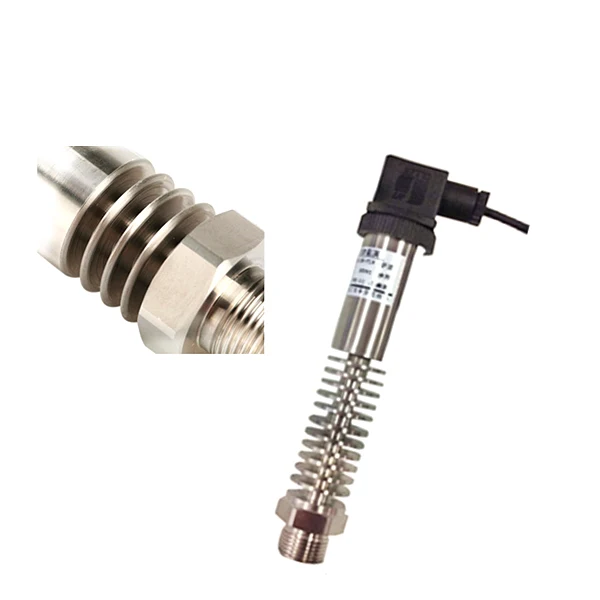 High-Temperature Pressure Transmitters
For hot fluids in pipes and reactors. Built per working temperature, media compatibility to 800 C.
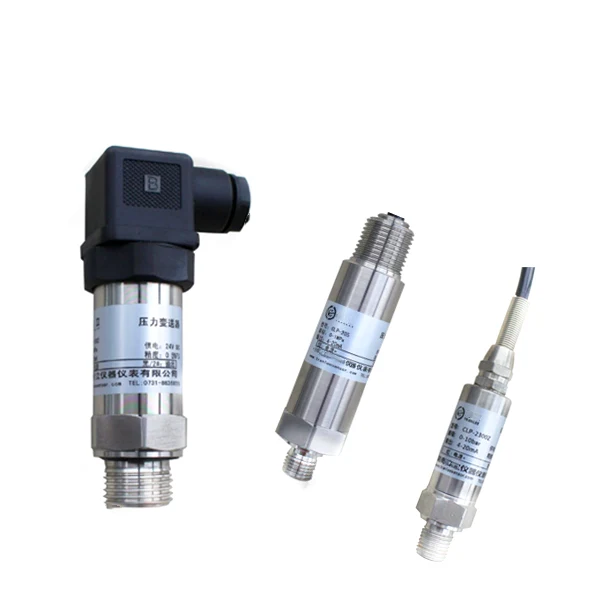 Pressure Transmitters
Gauge and absolute duties from -100 kPa to 100 MPa. The general-purpose line.
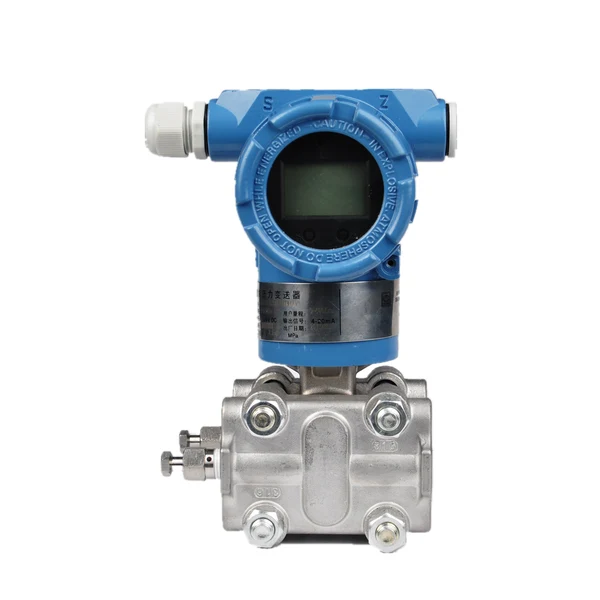 Differential Pressure Transmitters
Flow, level and filter monitoring across two pressure ports.
FAQ
What is a melt pressure transducer?
A pressure transducer built to measure molten-polymer (melt) pressure on an extrusion or injection line. It mounts flush at the barrel or die, withstands the high process temperature, and outputs 4–20 mA. The SI-PT series has several models for the position and range on the line.
What are the three types of pressure transducers?
By reference: gauge (versus atmosphere), absolute (versus vacuum), and differential (between two points). A melt pressure transducer is a gauge type, reading the melt pressure against atmosphere.
What is the purpose of a pressure transducer?
To convert pressure into a standard electrical signal the control system can read. On an extrusion line the melt transducer protects the process: it monitors die pressure for product quality and trips before an overpressure damages the screen pack or tooling.
How do you know if a melt pressure transducer is bad?
It drifts, sticks at a value, or loses output; on a melt line a coated or damaged diaphragm shows as a slow or noisy reading. Zero it at no load and compare against a known reference, and replace it if it will not zero or track.
Request a quote
Tell us the pressure range, the melt temperature at the port, the thread and the output signal. We respond with a configured model code, lead time and price, usually within one working day.