Home › Level Instruments › SI-302 Anti-corrosive Submersible Level Transmitter
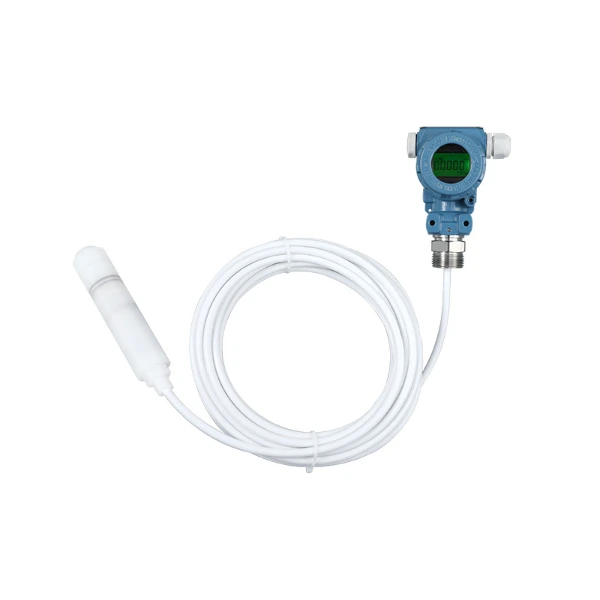
SI-302 Anti-corrosive Submersible Level Transmitter
A submersible level transmitter with a PTFE wetted path for acid, alkali, sludge, and slurry. The probe and cable are jacketed in fluoropolymer, so the unit drops straight into aggressive liquid that would eat a stainless probe, and reads level as 4–20 mA.
- Range: 0–200 m liquid level
- Accuracy: 0.5% FS
- Output: 4–20 mA (2-wire); 0–20 mA
- Wetted parts: PTFE, PP, stainless steel
- Mounting: direct submersion, flange or thread
- Hazardous area: Exia / Exd II CT6 option
Drop a standard stainless probe into a tank of acid, caustic, or abrasive sludge and it corrodes or cakes over in weeks. The SI-302 answers that with material, not isolation: the diaphragm, probe body, and cable jacket are PTFE and PP, so the aggressive liquid touches only fluoropolymer. It reads hydrostatic level the same way a normal submersible probe does, but survives the chemistry.
Overview
The SI-302 is a submersible hydrostatic level transmitter built for the harshest liquids: acid and alkali baths, sludge, and slurries. The wetted path is all-PTFE or PP, which resists corrosion, handles higher temperatures than a rubber-sealed probe, and sheds the buildup that clogs ordinary cells. It hangs in the tank on its own cable, applies temperature compensation, and outputs a 4–20 mA signal proportional to level. ATEX, 3-wire, and remote-mount versions are available.
It is the chemical-service member of our submersible level line. Where the liquid is clean, the SI-151 hydrostatic level transmitter is simpler; where the medium is hot or you would rather keep the sensor out of it entirely, the gas-conducted stainless transmitter isolates the cell behind a gas column instead.
Working principle
Level comes from hydrostatic pressure: the deeper the liquid, the higher the pressure at the probe. The liquid presses on a PTFE-faced diffused-silicon sensing element through the fluoropolymer diaphragm; the element turns that pressure into a small electrical signal, and the electronics apply temperature compensation and linearization to give a 4–20 mA output proportional to level. Because only PTFE and PP touch the medium, the corrosion that would attack a metal diaphragm never reaches the cell. Level is read from pressure, so the unit reads true height only when it is scaled for the liquid density.
Technical specifications
Representative specifications; confirm the exact build per datasheet.
| Parameter | Specification |
|---|---|
| Measuring range | 0–200 m liquid level (about 0–656 ft) |
| Accuracy | 0.5% FS |
| Output signal | 4–20 mA (2-wire); 0–20 mA |
| Supply voltage | 24 VDC |
| Load resistance | 0–600 ohm |
| Transmission distance | Over 1000 m |
| Medium temperature | -50 to +80 °C standard; up to +450 °C high-temperature build |
| Ambient temperature | -40 to +50 °C |
| Wetted material | Stainless steel, PP, PTFE |
| Mounting | Direct submersion; flange DN32 (HG/T20593 RF) or G2 inch thread |
| Electrical connection | M20 x 1.5 |
| Hazardous area | Exia II CT6 Ga; Exd II CT6 Gb (option) |
Output and wiring
The standard build is a 2-wire 4–20 mA loop, which carries cleanly over the long cable runs a deep or remote tank needs, as long as the loop load stays at or below 600 ohm; the unit is rated to drive over 1000 m of cable. A 4–20 mA live-zero also flags a cut or flooded cable as a fault rather than an empty tank. Where the area is classified, order the Exia or Exd version; where the tank runs hot or the head must sit away from the liquid, a 3-wire or remote-mount build is available.
Materials and mounting
The defining feature is the wetted material. The diaphragm, probe, and cable jacket are PTFE and PP, which stand up to strong acids and alkalis, resist the buildup that clogs a bare cell, and tolerate higher temperatures than a rubber seal. For mounting, the SI-302 either hangs directly in the tank on its cable or fixes to a DN32 flange or a G2 inch thread on the tank top. A standard build covers media to 80 °C; a high-temperature variant extends to 450 °C for hot process baths. Tell us the chemistry and temperature and we confirm the fluoropolymer and seal set.
Applications
The SI-302 is built for level in liquids that destroy ordinary probes:
- Acid and alkali storage and process tanks in chemical plants
- Electroplating and surface-treatment baths
- Sewage, sludge, and slurry sumps that cake a bare cell
- Pickling, scrubber, and wastewater-neutralization tanks
- Battery and electrolyte tanks with aggressive chemistry
Application example
Energy storage, corrosive electrolyte tank. A flow-battery maker needed a continuous level reading in a tank of aggressive electrolyte, where a standard stainless probe would be attacked by the chemistry. That is exactly what this transmitter is built for: an all-fluoropolymer wetted path that the electrolyte cannot corrode, hung straight in the tank with a 4–20 mA output. We supplied an anti-corrosive submersible level transmitter for that service.
FAQ
What is a submersible level transmitter?
A submersible level transmitter is a sealed probe you lower into a tank or well; it sits at the bottom and reads the pressure of the liquid column above it, which is proportional to level. The SI-302 is the anti-corrosive version: its wetted parts and diaphragm use chemically resistant materials such as PTFE or PVDF, so it can hang directly in acids, alkalis, and waste streams that would attack a plain stainless probe.
How does a water level transmitter work?
It measures hydrostatic head. The deeper the probe, the more liquid sits above it, and that weight produces a pressure the sensor reads. The transmitter converts that pressure to a 4-20 mA or digital signal, and a vented cable references it to atmosphere so changes in barometric pressure do not show up as false level. You turn the pressure into height with the liquid density (P = density x g x height), which is why a corrosion-proof, drift-free diaphragm matters on aggressive media.
What is the best sensor to measure water level?
It depends on the liquid and the vessel. For open tanks, sumps, and wells a submersible hydrostatic probe is simple, accurate, and easy to install. Non-contact radar or ultrasonic suits sealed or very corrosive vapor spaces, and differential pressure suits pressurised tanks. When the water carries acids, alkalis, or chemicals, an anti-corrosive submersible like the SI-302 is usually the most practical choice, because its PTFE or PVDF wetted parts resist attack while keeping the reading drift-free.
Request a quote
Tell us five things and we configure one unit, not a shelf part:
- Chemistry (acid, alkali, slurry), concentration, and temperature
- Maximum level / range and the medium density
- Mounting (direct submersion, flange, or thread)
- Hazardous area rating, if any (Exia or Exd)
- Output and cable length (4–20 mA, 2-wire or 3-wire)
Tell us the application and we configure one unit, not a shelf part. Have a chemistry we have not listed? Reach our application engineers.