Home › Level Instruments › Stainless Steel Submersible Level Transmitter
Stainless Steel Submersible Level Transmitter
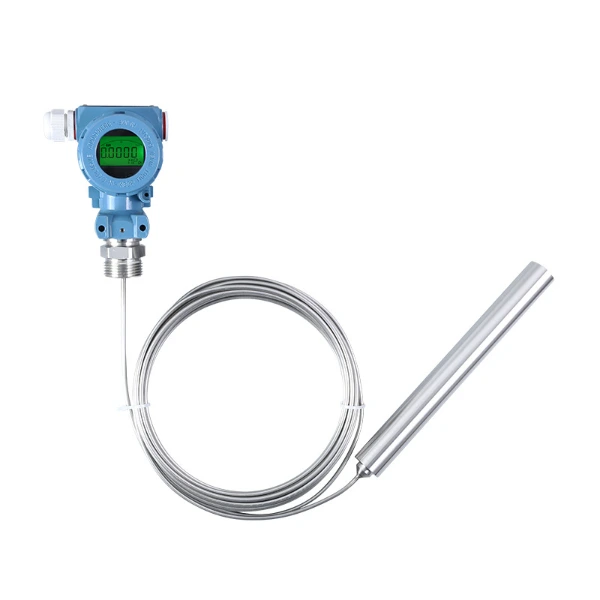
A pressure-guided (gas-conducted) submersible level transmitter for hot, corrosive, or dirty liquids. Only a stainless gas cylinder goes in the tank; a sealed gas column carries the pressure up to the sensor in a dry junction box, so the electronics never touch the medium.
- Range: 0–100 m liquid level (water column)
- Accuracy: 0.5% FS
- Output: 4–20 mA, 0–20 mA, 0–5 / 1–5 V, or RS485
- Medium temperature: up to 400 °C (gas-conducted build)
- Wetted parts: stainless steel (304 / 316 optional)
- Protection: IP68
Drop a normal submersible probe into a tank of hot caustic or raw sewage and you are on a clock: heat cooks the cell, and the chemistry eats the cable and the diaphragm. This transmitter solves that by keeping the sensor out of the liquid. A stainless gas cylinder sits in the tank, the medium presses on the gas trapped inside it, and that pressure travels up a thin stainless tube to a sensor mounted in a dry junction box above the tank.
Overview
The stainless steel submersible level transmitter is a pressure-guided, gas-conducted level instrument for liquids that a standard probe cannot survive: high-temperature media, strong acids and caustics, and sewage or sludge. Because the sensor and signal electronics live in the junction box and only the welded stainless gas cylinder and tube are wetted, the unit reads hydrostatic level the same way a hydrostatic probe does, but without putting the cell in the medium.
For clean water wells and ordinary tanks, a direct hydrostatic level transmitter is simpler and cheaper. Step up to this gas-conducted build when the liquid is hot, aggressive, or solids-laden enough to clog or attack a submerged probe.
Working principle
Level is read from hydrostatic pressure: the deeper the liquid, the higher the pressure at the bottom. Here, the bottom pressure is captured by a sealed gas cylinder. Liquid pushes on the gas inside the cylinder, the gas pressure rises to match the head above it, and a thin stainless air tube carries that pressure to a sensor in the junction box. The sensor converts it to 4–20 mA or RS485. Nothing electronic and nothing heat-sensitive ever enters the tank, so a 300 °C or strongly corrosive liquid is held off the cell by the gas column and the stainless wall.
Technical specifications
Representative specifications, at room temperature and rated supply unless stated. Values typical; confirm the exact build per datasheet.
| Parameter | Specification |
|---|---|
| Measuring range | 0–100 m liquid level (about 0–145 psi water column) |
| Accuracy class | 0.5% FS |
| Output signal | 4–20 mA or 0–20 mA (2-wire); 0–5 V, 1–5 V; RS485 digital |
| Supply voltage | 24 VDC (9–36 VDC) |
| Long-term stability | ≤ 0.2% FS per year |
| Medium temperature | 0 to 400 °C (gas-conducted build; confirm rating per datasheet) |
| Temperature compensation | 0–80 °C |
| Ambient temperature | 0 to 60 °C |
| Load resistance | Current output ≤ 800 ohm |
| Insulation resistance | ≥ 2000 Mohm at 100 VDC |
| Protection | IP68 |
| Wetted material | Gas cylinder and air tube 304 stainless (304 / 316 optional); pressure tube 1Cr18Ni9Ti |
| Junction box | Cast aluminum; flexible air tube can be routed to suit the tank |
Output and wiring
For most installs, run the 4–20 mA loop: it is a 2-wire current signal that ignores cable resistance and electrical noise as long as the loop load stays at or below 800 ohm, which suits the long cable runs between a tank and a control room. Where you want a digital reading or several units on one bus, order the RS485 version and poll it from the PLC or SCADA. The 0–5 and 1–5 V outputs suit short runs into a high-impedance analog input; a 1–5 V or 4–20 mA live-zero also flags a broken wire as a fault rather than an empty tank.
Selecting the range
Size the range to the maximum head the cylinder will see, in the liquid you actually run. Level comes from pressure by the hydrostatic relation, pressure = density x g x height, so the transmitter reads true height only when it is scaled for your liquid’s density. Water gives about 9.8 kPa per meter; a denser liquid reads a higher pressure for the same level, so a 0–100 m water scale would over-read a heavy brine and under-read a light oil unless it is corrected.
In practice: take the deepest the liquid can reach, add a margin, and tell us the medium density (or specific gravity). For comparison, 10 m of water is about 1 bar or 14.5 psi, so a 0–100 m range spans roughly 0–10 bar at the cylinder. For tall clean-water columns a plain hydrostatic level transmitter does the same math with a simpler probe.
Applications
This transmitter earns its keep where a submerged sensor would not last:
- Hot process liquids and heat-transfer fluids that exceed a normal probe rating
- Strong acid and caustic tanks in chemical and surface-treatment plants
- Sewage, sludge, and wastewater sumps with solids and grease
- Dye, pulp, and food liquids that foul or coat a direct cell
- Sealed or pressurized vessels where only a tube can be routed in
Application example
Energy storage, corrosive electrolyte tank. A flow-battery maker needed a continuous level reading in a corrosive electrolyte tank, around a 2.6 m span, without exposing the sensing cell to the chemistry. That is exactly the service this series is built for: keep the electronics out of the medium and let a corrosion-resistant wetted path take the pressure. We configured a sensor-isolated, stainless level transmitter with a 4–20 mA output, alongside the temperature and pressure sensors the same skid needed.
FAQ
What is a submersible level transmitter?
It is a level transmitter lowered into the liquid that measures level from the hydrostatic head pressure at its depth: pressure equals density times gravity times depth (P = ρgh). The stainless body and vented cable suit wells, tanks, and sumps, and it outputs a 4–20 mA signal proportional to level.
What is the best sensor to measure water level?
It depends on the tank. A submersible hydrostatic transmitter is the simplest and most economical choice for wells, tanks, and open water; where you cannot put a sensor in the water, non-contact ultrasonic or radar are better. For deep wells and clean water the submersible probe is usually the best value.
How does a water level transmitter work?
A submersible type senses the pressure of the water column above it. Because pressure equals density times gravity times depth, the reading is proportional to level. A vented cable references atmospheric pressure, so changes in barometric pressure do not shift the measurement.
What is the difference between a level transducer and a transmitter?
A transducer outputs a raw signal proportional to the measured pressure; a transmitter conditions and scales that into a standard 4–20 mA (or digital) output ready for a PLC or display. This unit is a transmitter, giving 4–20 mA directly.
Related products
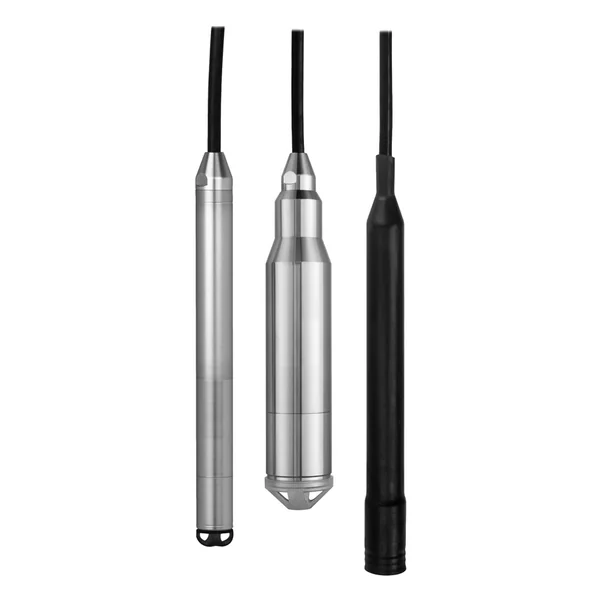 Hydrostatic Level Transmitter
The SI-151 direct submersible probe for clean water wells, tanks, and reservoirs.
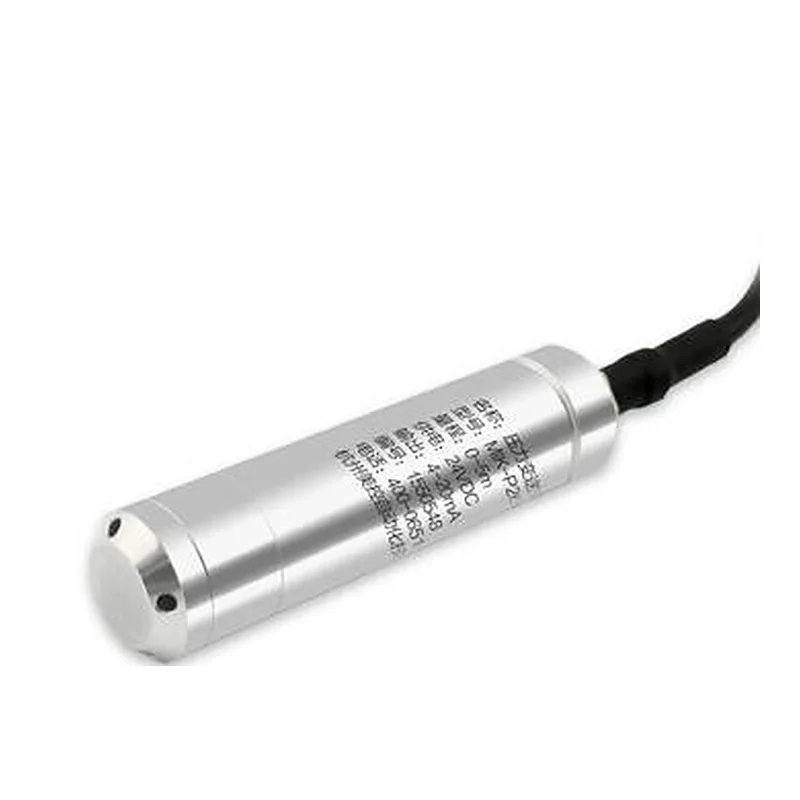 Submersible Pressure Transducers
The SI-PCM261 narrow probe for boreholes and pump wells, with a vented cable.
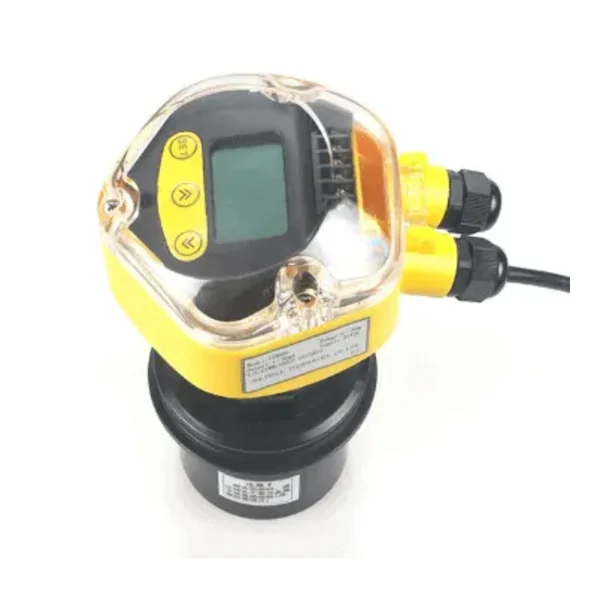 Ultrasonic Level Transmitter
Non-contact level for open channels and tanks where nothing should touch the liquid.
Browse all level instruments →
Request a quote
Tell us five things and we configure one unit, not a shelf part:
- Liquid and conditions (medium, temperature, corrosive or solids-laden)
- Maximum level (tank or sump depth) and the medium density / specific gravity
- Output (4–20 mA, RS485, or voltage) and supply
- Wetted material (304 or 316 stainless, or a coated path)
- Mounting (tank top, side, or how the tube is routed)
Ordering example: Stainless steel submersible level transmitter, range 0–5 m, 0.5% FS, 4–20 mA 2-wire, 316 stainless gas cylinder and tube, hot caustic service.
Tell us the application and we configure one unit, not a shelf part. Have a tank we have not listed? Reach our application engineers.