By Wu Peng, Senior Process Instrumentation Engineer · Last reviewed September 17, 2026
Type S, Type R and Type B are the platinum-rhodium thermocouples, the noble metal letter types used above the ceiling of Type K. A Type S thermocouple pairs Pt-10%Rh against pure platinum. A Type R thermocouple uses Pt-13%Rh.
A Type B thermocouple carries rhodium in both legs, Pt-30%Rh against Pt-6%Rh. That lets it reach 1700 °C but leaves it blind near room temperature. All three give roughly a quarter of the signal of a base metal type, and all three fail by contamination rather than by burning out.
Two decisions drive the cost of getting this wrong. Pick the type on temperature alone and the sheath or the atmosphere will poison the element inside a season. Pick the tolerance class from the wrong standard and the accuracy you paid for never reaches the order. This guide sets ranges, classes, output, contamination and cable codes side by side, with the arithmetic shown.
Contents
- Kiln shops and furnaces
- Three platinum pairs
- Ranges by standard
- Tolerance and classes
- Output and readout
- Type B near ambient
- Contamination and drift
- Compensating cable codes
- Choosing between them
- FAQ
Kiln shops and furnaces
Search for a Type S thermocouple and half the results are pottery studios. A studio kiln takes a specific replacement element with a specific protection tube. The right place to buy that is the kiln maker or their parts dealer, and listings in 2026 run from roughly 285 to 730 US dollars.
This page is about the other half. In industrial furnaces, glass tanks, heat treatment lines and calibration ovens, the element, the protection tube, the cable and the tolerance class are separate line items. The physics is the same. The buying process is not.
Three platinum pairs
The difference between the three is how much rhodium is alloyed into the wire and where it sits. Rhodium raises the thermoelectric output and the melting point, and it is the expensive half of the bill.
| Type | Positive leg | Negative leg | Rhodium in the assembly |
|---|---|---|---|
| S | Pt-10%Rh | Pure platinum | One leg, 10% |
| R | Pt-13%Rh | Pure platinum | One leg, 13% |
| B | Pt-30%Rh | Pt-6%Rh | Both legs, 30% and 6% |
Neither R nor B has a pure platinum positive leg, a detail several supplier pages currently state the other way round.
That last column is the price. A Type R costs more than an otherwise identical Type S because of the extra three percent of rhodium, and a Type B carries rhodium in both conductors. Used elements therefore have a scrap value worth recovering. Some builders also weld a short noble metal section to a base metal extension rather than run platinum the whole length.
Ranges by standard
Published maximum temperatures for these three run from 1480 to 1820 °C across published tables and supplier pages. The spread is not disagreement about physics. Each number is the end of a different document.
| Type | ASTM E230 tolerance table | IEC 60584-1 classes | Also quoted |
|---|---|---|---|
| S and R | 0 to 1480 °C | 0 to 1600 °C | 1600 continuous, 1700 short term, 538 as a lower bound for protected assemblies |
| B | 870 to 1700 °C | 600 to 1700 °C | 1820, the end of the reference table; 1800 in vendor copy |
The 538 °C figure some catalogs print as the S and R minimum is a protected-assembly recommendation, not a limit of the wire.
The Type B row is the one that catches buyers. ASTM will not state a tolerance below 870 °C and IEC will not state one below 600 °C. Put a Type B on a furnace that spends its mornings at 400 °C and the measurement is unspecified for part of every shift.
Tolerance and classes
Both standards again write tolerance as a fixed value or a percentage, whichever is greater. For S and R that crossover lands at 600 °C, so on any real furnace the percentage term is the one doing the work.
| Grade | Formula | At 1000 °C | At 1400 °C |
|---|---|---|---|
| S, R ASTM standard | ±1.5 °C or 0.25% | ±2.5 °C | ±3.5 °C |
| S, R ASTM special | ±0.6 °C or 0.1% | ±1.0 °C | ±1.4 °C |
| S, R IEC Class 1 | ±1.0 °C to 1100, then 1+0.003(t−1100) | ±1.0 °C | ±1.9 °C |
| S, R IEC Class 2 | ±1.5 °C or 0.0025t | ±2.5 °C | ±3.5 °C |
| B ASTM standard | ±0.5% from 870 °C | ±5.0 °C | ±7.0 °C |
| B IEC Class 2 | ±0.0025t from 600 °C | ±2.5 °C | ±3.5 °C |
Values computed from the formulas at the two temperatures shown.
Three results are worth carrying into a specification. Above 600 °C the ASTM standard limit and the IEC Class 2 limit for S and R give the same number, because both work out to a quarter of one percent. The IEC Class 1 grade holds a flat ±1.0 °C up to 1100 °C, but that is not the tightest thing on the table. The ASTM special grade reads ±0.6 °C below 600 °C, meets Class 1 at 1000 °C, and stays the narrower of the two above it.
The third result concerns Type B. There is no IEC Class 1 for Type B, and ASTM E230 publishes no special limits of error for it either. The tightest grade available is IEC Class 2.
At 1700 °C that works out to ±4.25 °C against ±8.5 °C for the ASTM standard limit. The IEC class is exactly twice as tight wherever both apply, because 0.25 percent is half of 0.5 percent. A purchase order asking for special limits on a Type B is asking for something that does not exist.
Output and readout
Platinum thermocouples are low-output devices. The ITS-90 reference functions put a Type S at 9.587 mV at 1000 °C, where a Type K is already at 41.276 mV at the same temperature.
| Type | mV at 600 | mV at 1000 | mV at top of range | Average µV per °C, 600 to 1000 |
|---|---|---|---|---|
| S | 5.239 | 9.587 | 16.777 at 1600 | 10.9 |
| R | 5.583 | 10.506 | 18.849 at 1600 | 12.3 |
| B | 1.792 | 4.834 | 13.820 at 1820 | 7.6 |
ITS-90 reference values against a 0 °C reference junction. Type R gives about 10 percent more signal than Type S at 1000 °C, rising to about 12 percent at 1600 °C.
Ten or twelve microvolts per degree sets a floor under the readout. Work it through on a card with a 0 to 20 mV input range, which covers a Type S to the top of its span.
Resolution = 20,000 µV / 2bits, divided by 10.9 µV per °C
12-bit: 4.88 µV per count = 0.45 °C per count. 16-bit: 0.31 µV per count = 0.03 °C per count.
A twelve-bit input gives up about half a degree of resolution before any tolerance is counted, which wastes an element bought to Class 1. Input impedance matters for the same reason. A megohm or better keeps the loading error small against a signal this size. Specify the card at the same time as the sensor.
Type B near ambient
The Type B curve does something none of the other letter types do. It turns back on itself near room temperature, reaching a minimum around 21 °C and returning to its zero-degree value at about 42 °C.
Across the whole 0 to 50 °C band the output stays inside roughly −3 to +2 microvolts. At 7.6 µV per °C up in the working range, that band is worth well under a degree of equivalent error. A Type B therefore tolerates an uncompensated cold junction, and plain copper leads are accepted practice for its extension wiring.
The same curve is the reason a Type B cannot measure near ambient. Two temperatures share one output, so the reading is not unique. Both standards decline to state a tolerance below 600 °C. Treat that as the working floor and add a second sensor if the low end of the cycle has to be trended.
Contamination and drift
Platinum thermocouples rarely fail by melting. They fail because something gets into the wire. Three mechanisms are the classic causes, and all three drift the reading low rather than high, so nothing on the panel announces the problem.
Rhodium migrates out of the alloy leg and into the pure platinum leg, which flattens the difference between the two conductors. Rhodium also volatilizes from the surface at high temperature.
Above about 1100 °C the pure platinum leg undergoes grain growth. That does not shift the calibration by itself, but it leaves the wire brittle enough to break on the next thermal cycle. Type B suffers less grain growth than R or S, one reason it lasts longer at the top of the range.
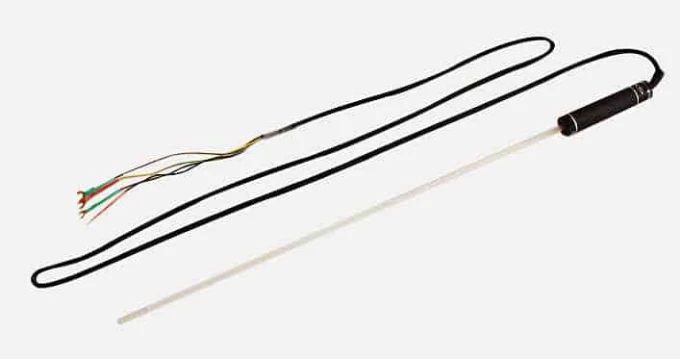
The fourth mechanism is chemical, and it is the fastest. In a reducing atmosphere, silicon is reduced out of silica-bearing ceramics and absorbed into the platinum. Mullite is therefore the wrong protection tube for anything except clean oxidizing service. High purity recrystallized alumina, around 99.7 percent, is the usual specification, and metal sheaths in direct contact are worse again because metal vapor reaches the wire.
Three rules follow: keep the element in a non-metallic tube, keep the atmosphere oxidizing or inert, and do not run platinum in vacuum or reducing conditions for extended periods. A thermowell or ceramic outer tube lets the expensive part come out without opening the furnace.
Compensating cable codes
There is no such thing as SX or RX cable. Under IEC 60584-3 the X suffix marks extension cable made from the same alloys as the element. That is affordable for base metal types and out of the question for platinum.
R and S instead use compensating cable, built from substitute alloys that follow the platinum curve over a narrow band near ambient. The codes are RCA, RCB, SCA and SCB. RCB has largely replaced the older split, with one alloy pair now serving both R and S.
Type B has no letter code at all in that scheme. It does not need one. The section above shows why: over the band an extension cable sees, a Type B produces microvolts, so ordinary copper leads introduce an error too small to matter.
| Type | Cable grade | IEC sheath color | Note |
|---|---|---|---|
| S | SCA or SCB compensating | Orange | Negative conductor white |
| R | RCA or RCB compensating | Orange | RCB commonly serves both R and S |
| B | No letter code | Gray | Copper leads accepted |
Compensating grades hold their match only over a limited ambient band, typically stated on the cable data sheet. The equivalent distinction for Type K is set out in the Type K wire guide.
Choosing between them
Start with the working temperature, then check the atmosphere and the readout. Below 1200 °C in a clean oxidizing furnace, a Type S is the usual choice among the three and the cheapest. Choose Type R where the extra 10 percent of output buys resolution you can use. Above 1500 °C, Type B is the one built for the job.
| Situation | Choice |
|---|---|
| Process cycles down near ambient | S or R, never B alone |
| Sustained work above 1500 C | B, in recrystallized alumina |
| Tightest available grade needed | S or R to IEC Class 1 |
| Reducing or vacuum atmosphere | None of the three for extended service |
| Ceiling below about 1250 C | Reconsider Type K or N first |
Application note
No platinum case in our records. We searched all 330 entries in our project archive and found no platinum-rhodium request: the temperature records are resistance sensors and transmitter work, with a handful of Type K and Type T thermocouples. Noble metal elements tend to reach the plant inside a furnace package rather than as a separate instrument order, so we have written this page from standards and reference data rather than dress up a case that is not ours.
The last decision is the readout. Signals this small are usually converted at the sensor, and a head-mounted temperature transmitter takes both the cable grade and the card resolution out of the accuracy budget. For the full letter-type picture see the thermocouple types chart, and for base metal alternatives below 900 °C the Type J, T and E guide. Assemblies are listed on the thermocouple sensor page.
Why R and S are supplied with compensating cable rather than true extension cable, and what that costs in accuracy, is set out in the thermocouple extension wire guide.
FAQ
What is type S thermocouple?
A Type S thermocouple pairs a Pt-10%Rh positive leg against a pure platinum negative leg. ASTM E230 tabulates it from 0 to 1480 °C and IEC 60584-1 states classes to 1600 °C. It gives 9.587 mV at 1000 °C, needs a non-metallic protection tube, and suits clean oxidizing or inert service.
What are the differences between Type R and Type S thermocouples?
Composition and output. Type R uses Pt-13%Rh against platinum where Type S uses Pt-10%Rh. Type R therefore produces about 10 percent more signal at 1000 °C, 10.506 mV against 9.587 mV, widening to about 12 percent by 1600 °C. Ranges, tolerance classes and contamination behavior are the same, and the extra rhodium makes Type R the more expensive of the two.
What is the difference between a Type S thermocouple and a Type K thermocouple?
Type S is platinum-rhodium and reaches 1600 °C; Type K is chromel-alumel and stops around 1260 °C. The price of that extra range is signal. Type S gives roughly 10.9 µV per °C in its working band against about 41 µV per °C for Type K, so the readout has to be chosen to match.
What is the temperature range of a Type B thermocouple?
ASTM E230 states tolerances from 870 to 1700 °C and IEC 60584-1 states classes from 600 to 1700 °C. The ITS-90 reference table continues to 1820 °C, which is where the 1800 °C figures in vendor copy come from. Below 600 °C no tolerance class applies, and near room temperature the output is not unique.
What is the typical accuracy of a Type B thermocouple?
IEC Class 2 gives ±0.25 percent of reading above 600 °C, which is ±2.5 °C at 1000 °C and ±4.25 °C at 1700 °C. The ASTM standard limit is ±0.5 percent, twice as wide. There is no IEC Class 1 and no ASTM special limits grade for Type B, so Class 2 is the tightest grade available.
Request a quote
Tell us the application and we configure one unit, not a shelf part. Send the working temperature, the atmosphere, the protection tube material and the tolerance class you need, and we will write the standard and the class into the specification rather than leave them to the data sheet. Reach our application engineers or use the form below.
Written and technically reviewed by Wu Peng and the Instranova engineering team.