By Wu Peng, Senior Process Instrumentation Engineer · Last reviewed August 24, 2026
Molten salt level measurement means reading liquid level in tanks and loops running between roughly 250 and 600 °C. The service appears in concentrated solar power (CSP) storage, molten salt reactor test loops, and heat treatment salt baths. Four technologies survive it: high-temperature guided wave radar, air-cooled non-contact radar, differential pressure with remote seals, and the bubbler.
The instrument choice is only half the problem. The common nitrate blends freeze between about 140 and 240 °C, and next-generation chlorides freeze higher still. Salt density drops roughly 10 percent from cold tank to hot tank, and every nozzle is a cold bridge waiting to grow a salt plug. This guide covers the salt chemistries, the technology comparison, the arithmetic that turns level into tonnes and megawatt hours, and the freeze protection rules.
Contents
- Salt families and properties
- What breaks first
- Six technologies compared
- Radar and GWR
- DP seals and bubblers
- Temperature profile backup
- Level to inventory
- Freeze protection rules
- FAQ
Salt families and properties
An engineer specifying a level instrument meets three salt families in practice, and the chemistry decides the wetted metallurgy before any sensor principle enters the conversation.
| Family | Typical blend | Melts near | Service range | Wetted alloy practice |
|---|---|---|---|---|
| Nitrate (solar salt) | 60% NaNO3 / 40% KNO3 | 220−240 °C | 290−565 °C | 347H or 321H stainless, Alloy 800H, Inconel 600 at the top end |
| Nitrate-nitrite (Hitec type) | NaNO3-KNO3-NaNO2 ternary | ~142 °C | 150−500 °C | 300-series H grades |
| Chloride and fluoride | MgCl2-KCl-NaCl; LiF-BeF2 | 380−460 °C | 450−800 °C | Nickel alloys: Hastelloy C-276 or N, Alloy 617, Inconel 625 |
Compositions in weight percent for nitrates; chloride and fluoride blends are program specific. Confirm alloy selection against the actual salt certificate, not the family name.
Two physical properties drive the measurement design. First, molten salts are ionic conductors with conductivities on the order of 1 S/cm. A radar signal therefore reflects off the surface almost as strongly as off a metal plate, so echo strength is rarely the limiting factor.
Second, density falls steeply with temperature; solar salt follows close to 2090 − 0.636 × T in kg/m³ with T in °C. The inventory section below turns that slope into tonnage.
What breaks first
Failures at salt temperature happen in a predictable order, and none of them start with the electronics. The transmitter head sits on the cold end of the assembly and holds an ordinary 80 °C ambient rating.
Polymer parts go first. Elastomer O-rings, even perfluoroelastomer grades, top out near 325 °C, which rules out every soft-sealed process connection. Salt service uses metal-to-metal or graphite gasket joints. The same ceiling applies to PTFE radar windows and polymer probe spacers; specify metallic-only antennas and ceramic spacers instead.
The next weak point is the temperature gradient itself. A radar antenna rated 450 °C cannot bolt straight onto a 565 °C hot tank, a mismatch that shows up on more than one manufacturer application sheet.
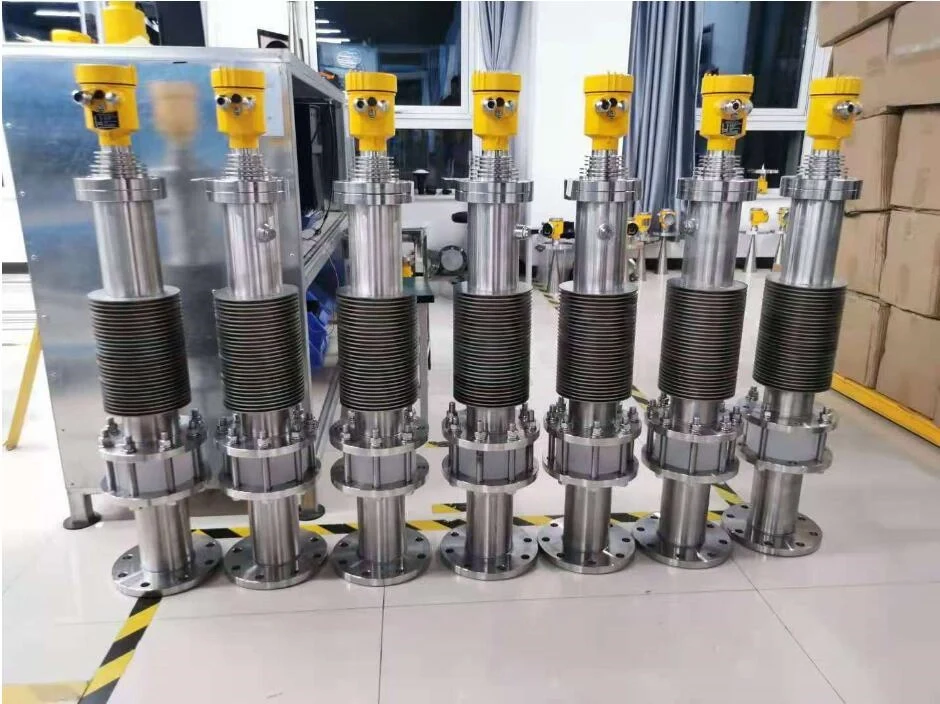
The gap closes with a cooled standoff. A nozzle extension of roughly 250 to 400 mm, sometimes with an air purge, drops the temperature profile step by step. The antenna face, the seal, and finally the electronics each end up inside their ratings.
Wetted alloy selection follows the salt family table above. The general logic of matching wetted material to the medium is covered in our wetted parts selection guide. Molten salt just moves the exercise a few hundred degrees up the scale.
Six technologies compared
Six level technologies have a defensible record on molten salt. The right molten salt level sensor depends on whether the tank tolerates a penetration, how much accuracy the inventory accounting needs, and what the maintenance plan can support.
| Technology | Type | Realistic accuracy | Main risk in salt |
|---|---|---|---|
| Guided wave radar, HT probe | Continuous | ±5−10 mm | Salt crystallizing on the probe during cool-down |
| Non-contact radar, cooled | Continuous | ±10 mm class | Vapor and salt mist fouling the antenna |
| DP with remote seals | Continuous | ±15 mm class | Fill fluid temperature ceiling, capillary thermal error |
| Bubbler (dip tube) | Continuous | ~1% of depth | Salt freezing in the tube tip; needs a purge gas skid |
| Conductive point probes | Point only | Switch action | Insulator life; ceramic is brittle at long lengths |
| Multipoint temperature profile | Stepwise | One element spacing | Coarse resolution; backup role only |
Floats and magnetic gauges are absent from the table deliberately. Their seals, floats, and indicator assemblies have no credible construction at nitrate temperatures. The occasional online claim that a standard gauge handles the service does not survive contact with a 565 °C flange.
Radar and GWR
Guided wave radar is the default for nitrate storage tanks. A single-rod probe in Inconel 600 or 800H, ceramic spacers, and a 300 mm class cooling neck delivers continuous level across a 10 to 15 m tank. Repeatability stays in the millimeter class through the daily charge and discharge cycle. Single rod beats coaxial here because the annular gap of a coaxial probe traps crystallizing salt on every cool-down.
Two configuration rules come from commissioning experience. Capture the empty-tank echo fingerprint before the first fill, because the probe-end reflection is the only reference an empty tank offers. And preheat the probe before salt ever touches it; the thermal shock of hot salt meeting a cold probe is a known cause of cracked assemblies at first fill.
Non-contact radar takes over where the surface splashes or the probe cannot enter: dump tanks, receiver vessels, and tanks with agitation during transfer. The furnace-style build applies: metallic horn, no polymer window, purge on the antenna. The cooled standoff logic is the same one described in our blast furnace level measurement guide, which shares the flange-cooling architecture at even higher gas temperatures.
On the product side, the guided wave radar level transmitter covers the probe-based configuration. The high-temperature radar level sensor covers the non-contact build, and the wider selection logic sits in the level transmitter types guide.
DP seals and bubblers
Differential pressure holds the niche where no top penetration is allowed, or where vapor turbulence defeats an echo. The transmitter reads head pressure through remote diaphragm seals. A 12 m column of solar salt at 565 °C works out to about 204 kPa, comfortably inside a standard DP range.
The engineering constraint is the fill fluid, not the transmitter. Standard silicone fills fade above roughly 315 °C, and high-temperature oils reach about 400 °C. A 565 °C tank therefore needs either a long thermal standoff ahead of the diaphragm or a liquid-metal fill.
Recalibrate at operating temperature, because fill density shifts with the thermal profile along the capillary. Our diaphragm seal pressure transmitters page covers seal and capillary construction, and the base instrument is a standard differential pressure transmitter.
The bubbler is the most overlooked of the four continuous options. A dip tube purged with nitrogen or argon reads level from back-pressure with no electronics anywhere near the salt. A two-tube arrangement at different depths adds live density, which converts level to mass directly. The two-tube density formula is worked through in our bubbler level measurement guide.
Research loops report roughly one percent of depth for accuracy. The costs are a permanent purge gas consumer and a tube tip that freezes solid the moment the purge stops.
Temperature profile backup
A multipoint temperature assembly, one protection tube carrying sensing elements every 1 to 1.5 m, is standard equipment in large salt tanks for thermal stratification monitoring. It doubles as an independent level check at no extra cost.
The logic is simple. Elements below the surface read salt temperature, elements above it read gas space, and the step change between them brackets the level to within one element spacing. During a radar outage that stepwise reading keeps inventory accounting alive, and during normal operation it verifies the primary instrument for free. Sensing elements at these temperatures are standard thermocouple types in high-temperature protection tubes.
Level to inventory
Level by itself is not what a storage tank operator needs; the plant runs on tonnes of salt and megawatt hours of stored heat. The conversion from molten salt tank level to inventory runs through density, and density depends on temperature, which is where fixed-density configurations go wrong.
Mass = area × level × density(T) density(T) = 2090 − 0.636 × T
A 38 m diameter tank holds 1134 m² per meter of level. At 12 m and 565 °C: 1134 × 12 × 1731 kg/m³ = about 23,550 tonnes.
Run the same numbers with the cold-tank density of 1906 kg/m³ and the mass comes out 10.1 percent high. That is an error of some 2,400 tonnes on one reading. Any inventory calculation must take temperature from the tank, not from a constant in the historian.
The energy view makes the stakes concrete. Cooling those 23,550 tonnes from 565 to 290 °C releases roughly 2,700 MWh of heat, a full evening of generation for a mid-size tower plant. On the same tank, 10 mm of level uncertainty corresponds to about 20 tonnes of salt, or a bit over 2 MWh.
That is why CSP storage projects specify millimeter-class repeatability. Many also cross-check the two tanks against each other during a transfer: salt leaving one tank must appear in the other.
Freeze protection rules
Solar salt freezes around 220 to 240 °C, and the cold tank runs only 50 to 70 K above that. Every instrument connection is a heat leak pointed at that margin, so freeze protection is part of the level design rather than an afterthought.
- Trace heat every nozzle, standpipe, and bubbler line, with the heater under the insulation and its setpoint held above the salt liquidus with margin.
- Preheat probes and dip tubes before first fill, and write the preheat into the start-up procedure rather than relying on memory.
- Watch the cooled standoff: the same neck that protects the electronics also cools the salt in the nozzle throat, and an overcooled nozzle grows a plug.
- Alarm on trace heating circuit failure with the same priority as a level alarm, because a frozen nozzle takes the measurement down for days.
Application note
Scoping a molten salt level package. A workable inquiry states five things. They are the salt chemistry from the supplier certificate, the operating and freeze temperatures, tank geometry and allowed penetrations, the accuracy the inventory accounting needs, and the trace heating available at the nozzle. From those inputs the probe alloy, the standoff length, and the choice between GWR, cooled radar, DP, and bubbler follow as engineering rather than guesswork.
FAQ
How to measure salt level?
For molten salt, guided wave radar carrying a high-temperature probe is the first choice. Air-cooled non-contact radar suits splashing surfaces, and differential pressure with remote seals or a purged bubbler suits tanks that allow no top penetration. Every option needs trace heating on the process connection.
At what temperature does salt turn molten?
Pure sodium chloride melts at 801 °C, but engineered salt blends melt far lower. Solar salt melts at roughly 220 to 240 °C and nitrate-nitrite ternaries near 142 °C. Storage systems hold the salt well above those points, typically 290 °C in a cold tank and up to 565 °C in a hot tank.
What is the density of molten salt?
Solar salt runs from about 1906 kg/m³ at 290 °C down to about 1731 kg/m³ at 565 °C. The correlation is roughly 2090 minus 0.636 times temperature in Celsius. That 10 percent swing is why level alone does not give inventory; mass calculations need the tank temperature as well.
What are the downsides of molten salt reactors?
From an instrumentation standpoint, fluoride and chloride salts are aggressive toward most alloys, and operating temperatures near 700 °C sit beyond standard sensor ratings. Salt freezes in any unheated line, and level and flow instruments have far less operating history than in water-cooled plants. Materials qualification remains the long pole.
Request a quote
Tell us the salt chemistry, temperature range, tank geometry, and accuracy target. We will return a probe alloy, standoff, and technology recommendation with the trace heating interface defined. Reach our application engineers or use the form below.
Written and technically reviewed by Wu Peng and the Instranova engineering team.