Home › Products › Gas Analysis Instruments › Zirconia Oxygen Analyzer
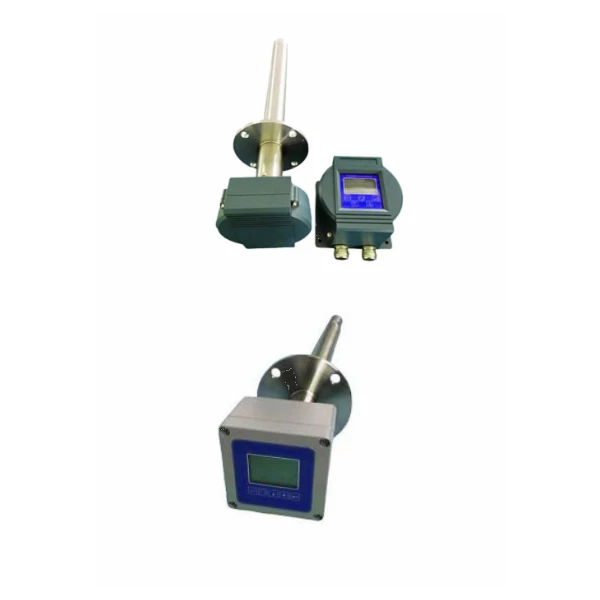
Zirconia Oxygen Analyzer (In Situ)
An insertion-type analyzer that reads oxygen directly in hot flue gas with a heated zirconia cell, so combustion can be trimmed for fuel savings and lower emissions. No sampling pump or gas dryer, with a 4–20 mA output and a long service life.
- Measures: oxygen in flue gas, in situ
- Range: 0–25% O2, programmable (5 / 10 / 20.6 / 25%)
- Flue gas: 0–700°C; −20 to +20 kPa
- Probe: 316L, 500–1200 mm; output 4–20 mA
- Build: cast-aluminum head, IP65, ~15-year cell life
Overview
A zirconia oxygen analyzer measures the oxygen left in flue gas after combustion, which is the single most useful number for tuning a burner. Too little excess air leaves unburned fuel and risks carbon monoxide; too much carries heat straight up the stack. Hold the flue oxygen at the right few percent and a boiler or furnace burns cleaner and cheaper, with lower CO2, NOx, and SOx.
This analyzer is an in situ type: the zirconia cell sits on the tip of an insertion probe that goes straight into the duct, so it reads the hot gas where it is, with no sampling pump, sample line, or gas dryer to lag or contaminate the reading. The cell is held at its operating temperature by a built-in heater, and the transmitter outputs 4–20 mA to a controller or DCS. The 316L probe is built for flue gas to 700°C and a service life measured in years.
Features
The cell reads hot flue gas directly; no pump, sample line, or dryer.
A Nernst-type cell gives a true partial-pressure measurement of oxygen.
Full-scale 5, 10, 20.6, or 25% O2 to 4–20 mA.
316L probe in 500 to 1200 mm lengths; low, medium, and high-temp builds.
Menu-driven LCD transmitter; disc or wall-mounted converter.
Cast-aluminum, IP65 head; cell life up to 15 years by conditions.
How a zirconia oxygen analyzer works
Zirconium dioxide becomes a conductor of oxygen ions once it is hot, above roughly 650°C, so the cell is held at temperature by a heater. One side of the cell sees reference air at a known 20.6% oxygen, the other sees the flue gas. The difference in oxygen partial pressure drives oxygen ions through the zirconia, which builds a voltage across two platinum electrodes. That voltage follows the Nernst equation, E = (RT / 4F) ln(P1 / P2), where P1 and P2 are the oxygen partial pressures on the reference and process sides. Because the relationship is logarithmic, the cell stays sensitive even at the low oxygen levels that matter for combustion, and it reads partial pressure directly rather than inferring it.
Technical specifications
| Parameter | Specification |
|---|---|
| Measurement | Oxygen in flue gas, in situ zirconia cell |
| Range | 0–25% O2, programmable; full-scale 0–5 / 0–10 / 0–20.6 / 0–25% |
| Accuracy | 1%; temperature-control accuracy ±1°C |
| Output / display | 4–20 mA; menu-driven LCD |
| Flue gas temperature | 0–700°C (low, medium, and high-temp builds) |
| Flue gas pressure | −20 to +20 kPa |
| Probe | 316L stainless steel, Φ45 mm; length 500 / 800 / 1000 / 1200 mm (custom) |
| Heater resistance | 60 ohms standard (80, 120, 160 optional) |
| Flange | OD 155 mm, hole pitch 130 mm (other specifications optional) |
| Transmitter | Cast aluminum, IP65; disc or wall-mounted |
| Power | 220 V ±10%, < 150 W |
| Service life | Up to 15 years by working conditions |
Representative specifications; the temperature build, probe length, and range depend on the flue, so confirm per datasheet for your order.
Selecting the type and probe
Two choices set the build: the flue gas temperature and whether the gas is clean enough to read in situ.
| Flue gas condition | Build to choose |
|---|---|
| Below 400°C | Low-temperature in situ probe |
| Up to 700°C | Medium-temperature in situ probe |
| Above 700°C | High-temperature build |
| Dusty or corrosive flue gas | Aspirating (sampling) type with gas pretreatment |
Probe length follows the duct: it spans the mounting flange, the wall thickness, and the insertion depth into the flue, so a thicker wall or a larger duct needs a longer probe. The cell is calibrated against a known span gas, typically around 5% oxygen in nitrogen, fed to the calibration port.
Applications
Zirconia oxygen analyzers are the standard tool for combustion oxygen on energy-intensive plant: power-station and industrial boilers, furnaces and kilns, steel and petrochemical plant, ceramics, paper, and food processing, and incinerators. They tie into the burner control so the air-to-fuel ratio is trimmed from a live oxygen reading rather than a fixed damper setting.
Application example
Industrial boiler, excess-air trim. A gas-fired boiler was running with the combustion air set high for safety, which sent usable heat up the stack. An in situ zirconia analyzer was inserted in the flue and its 4–20 mA oxygen signal wired to the burner control, which trims the air damper to hold the flue oxygen near a target of a few percent. Typical excess oxygen is around 2 to 3% for gas burners and 3 to 6% for oil and larger boilers, so closing the gap between an over-aired setting and the target cuts fuel and lowers emissions. The target is set per the burner and fuel.
Related products
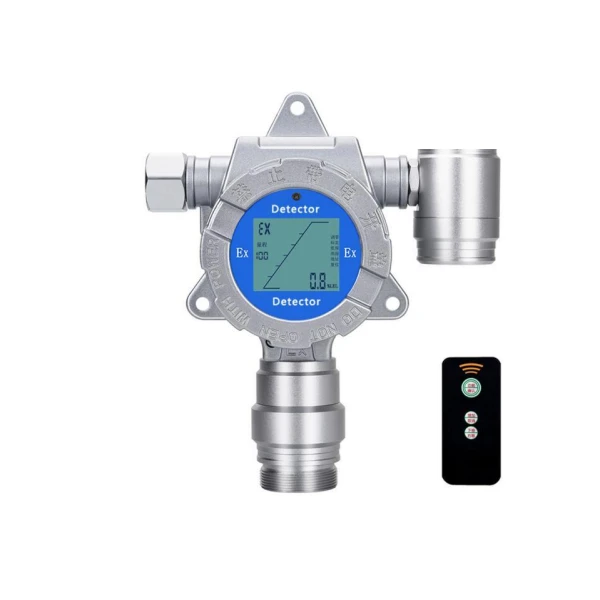 Fixed Gas Detector
Explosion-proof single and multi-gas detector for combustible, toxic and oxygen.
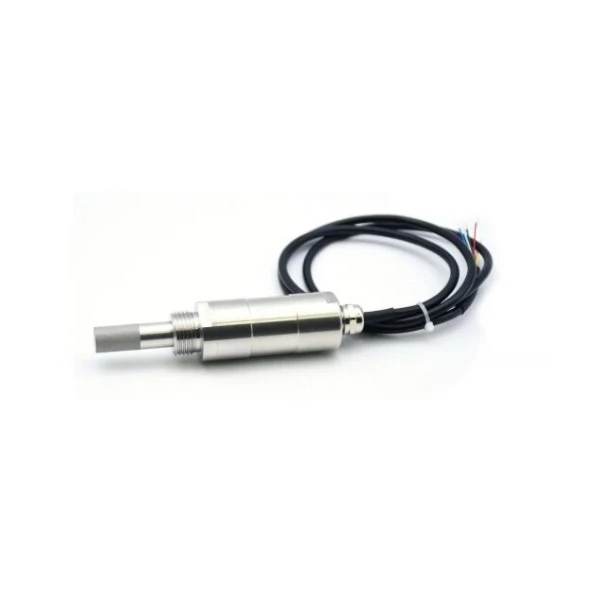 Online Dew Point Meter
In-line transmitter for moisture and pressure dew point in compressed air and gas.
See all gas analysis instruments, or tell us the flue and fuel and we will size the right analyzer.
FAQ
What is zirconia oxygen analysis?
It is the measurement of oxygen using a heated zirconia cell that produces a voltage from the difference in oxygen partial pressure between reference air and the process gas. It is the standard method for measuring oxygen in hot flue gas for combustion control.
How does a zirconia oxygen analyzer work?
The zirconia cell is heated above about 650°C so it conducts oxygen ions. Reference air on one side and flue gas on the other set up a partial-pressure difference that drives ions through the cell and builds a voltage across platinum electrodes, which the transmitter converts to an oxygen reading.
What is the equation for a zirconia oxygen analyzer?
It follows the Nernst equation, E = (RT / 4F) ln(P1 / P2), where E is the cell voltage, R the gas constant, T the absolute temperature, F the Faraday constant, and P1 and P2 the oxygen partial pressures on the reference and process sides. The 4 reflects the four electrons per oxygen molecule.
What temperature does a zirconia oxygen analyzer run at?
The cell itself is held hot, above roughly 650°C, by a built-in heater so the zirconia conducts oxygen ions. The flue gas it measures can be from 0 to 700°C with the standard probe, and a high-temperature build is used above that.
About this product page
Specifications drawn from the integrated zirconia oxygen analyzer datasheet and reviewed by the Instranova engineering team — last reviewed 2026-06-30. The Nernst principle and excess-air figures follow established combustion practice. Questions? Reach our application engineers.
Request a quote
Tell us the flue gas temperature, the duct size, and the fuel, and we will configure the right zirconia oxygen analyzer for the combustion, not a shelf part.