Home › Products › Gas Analysis Instruments › Dew Point Meter
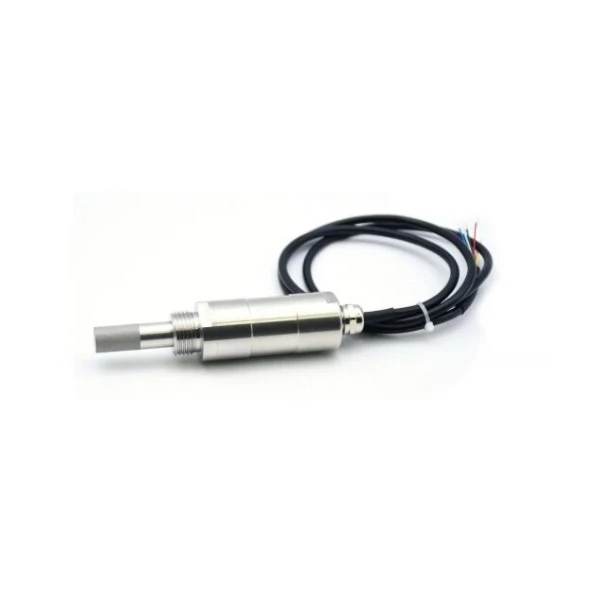
Online Dew Point Meter (602 / 608 Series)
A compact, stainless-steel dew point transmitter that reports dew point, temperature, and relative humidity from one probe, with 4–20 mA and RS485 Modbus-RTU output. Built for compressed air, drying lines, and process gas where moisture has to stay inside an ISO 8573-1 class.
- Dew point range: −100 to +80°C Td (settable)
- Dew point accuracy: ±2°C in air or N2
- Output: 4–20 mA, 0–5 V or 0–10 V, plus RS485 Modbus-RTU
- Supply / pressure: 10–30 VDC, <0.1 W; rated to 16 bar
- Also measures: temperature ±0.1°C, humidity ±2 %RH
Overview
A dew point meter reports the temperature at which water vapor in a gas starts to condense. In a compressed air system that number is the pressure dew point (PDP), and it is the single value that tells you whether your dryer is still delivering the ISO 8573-1 humidity class the plant signed up for. The 602 / 608 series is a one-probe transmitter that outputs dew point, temperature, and relative humidity together, so a PLC or DCS sees moisture trend and ambient conditions from the same point.
The probe is a stainless steel, anti-condensation design with strong resistance to contamination, which is what lets it sit in a real plant header rather than a clean lab. It speaks RS485 Modbus-RTU and carries an analog channel at the same time, so it drops into both legacy 4–20 mA loops and digital networks without a separate converter.
Features
Dew point, temperature, and humidity from a single stainless steel sensor.
4–20 mA or voltage output and RS485 Modbus-RTU at the same time.
Settable dew point range covers refrigerated to desiccant-dryer air.
Holds calibration in high-humidity headers where cheaper sensors saturate.
10–30 VDC input with reverse-polarity protection, under 0.1 W.
Mounts directly in pressurized lines for true pressure dew point.
Working principle
The 602 / 608 series uses a capacitive polymer sensor. A thin hygroscopic film sits between two electrodes; as water vapor diffuses into the film its dielectric constant changes, which changes the capacitance the electronics read. That capacitance maps to relative humidity, and the meter combines it with the measured temperature and line pressure to compute the dew point. Capacitive sensors are the standard for in-line compressed air monitoring because they tolerate continuous pressure and recover from short wet excursions, unlike a chilled-mirror instrument that has to actively cool a surface until condensation forms.
Technical specifications
| Parameter | Specification |
|---|---|
| Measured values | Dew point, temperature, relative humidity |
| Measuring range | −40 to +80°C, 0 to 100 %RH |
| Dew point range | −100 to +80°C Td (settable, within the temperature and humidity range) |
| Accuracy (20°C, 50 %RH, 1 atm) | Dew point ±2°C (air or N2); temperature ±0.1°C; humidity ±2 %RH |
| Analog output | 4–20 mA (RL ≤ 500 Ω) / 0–5 V / 0–10 V (RL > 10 kΩ) |
| Digital output | 1 channel RS485, Modbus-RTU; baud 1200–19200 (default 9600) |
| Resolution | 0.01 / 0.1°C; 0.01 / 0.1 %RH (selectable) |
| Response | Fastest 1 s; acquisition frequency settable |
| Pressure rating | 16 bar |
| Supply | 10–30 VDC, <0.1 W, reverse-polarity protected |
| Housing | Stainless steel, anti-condensation, compact integrated body |
Representative specifications for the 602 / 608 series; confirm the exact range, output, and process connection per datasheet for your order.
Pressure dew point and ISO 8573-1 classes
Set the meter range to the dryness class your process has to hold, not to the widest range available. ISO 8573-1 fixes the humidity classes by pressure dew point, so the class decides both the sensor selection and the alarm point.
| ISO 8573-1 class | Pressure dew point | Typical use |
|---|---|---|
| Class 1 | ≤ −70°C | Desiccant dryers, critical and electronics processes |
| Class 2 | ≤ −40°C | Food-grade air, pharmaceuticals, instrument air |
| Class 3 | ≤ −20°C | General process air, paint spraying |
| Class 4 | ≤ +3°C | Refrigerated dryers, general plant air |
| Class 5 / 6 | ≤ +7°C / ≤ +10°C | Shop air for tools, non-critical service |
For air in direct contact with food or beverage, ISO 8573-1 calls for Class 2 or better, a pressure dew point at or below −40°C. Match the meter so the class limit sits comfortably inside its measuring range.
Output and wiring
The transmitter carries one analog channel and one RS485 channel at once. For the analog loop, choose 4–20 mA into a load of 500 Ω or less, or a 0–5 V / 0–10 V voltage output into 10 kΩ or more. The analog value maps linearly across the set range: on a −40 to +80°C span at 4–20 mA, the 120°C span is carried by 16 mA, so each milliamp is 7.5°C and a 12 mA reading is +20°C. For digital integration, the RS485 channel uses standard Modbus-RTU, 8 data bits, 1 stop bit, no parity, so it lands directly on a PLC or DCS register map.
Applications
Dew point monitoring shows up wherever moisture has to stay under a limit: compressed air after refrigerated or desiccant dryers, instrument air, plastics and pharmaceutical drying hoppers, electronics manufacturing, SF6 and other process gases, and dry-storage rooms. The same transmitter covers HVAC humidity control and oil and gas lines where a high dew point means corrosion risk.
Application example
Compressed air, desiccant dryer verification. A plant running an instrument-air header to ISO 8573-1 Class 2 needed proof its desiccant dryer was holding a −40°C pressure dew point. A single in-line transmitter was set with its alarm at −40°C Td and wired to the DCS on both 4–20 mA and Modbus, so the control room sees the trend and an alarm fires before the bed breaks through. Mounting the probe directly in the pressurized line, rated to 16 bar, gave a true pressure dew point rather than an atmospheric reading that would have misread the class.
Related products
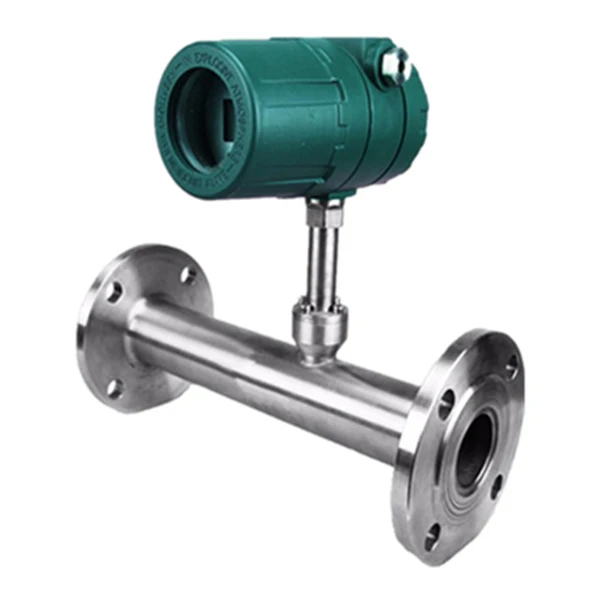 Compressed Air Flow Meter
Thermal mass meter for compressed air consumption and leak baselines.
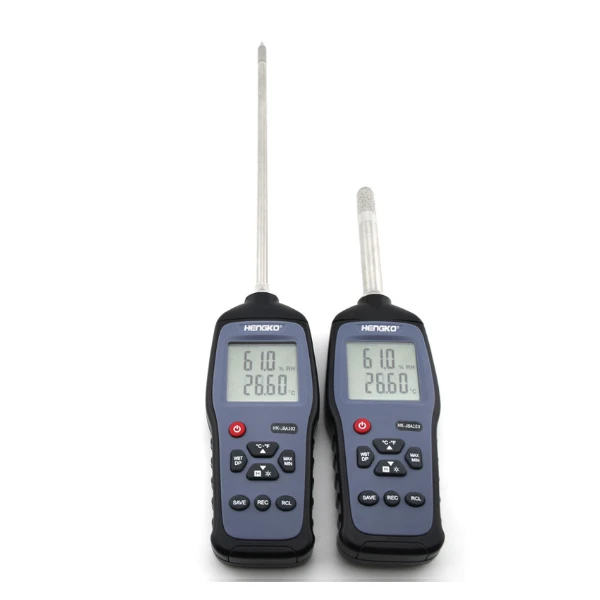 Portable Dew Point Meter
Handheld spot-check meter for temperature, humidity, dew point and wet bulb.
For a digital RS485 Modbus version, see the dew point transmitter, and the zirconia oxygen analyzer for flue gas oxygen. Ask our application engineers for the one that fits your gas and class.
FAQ
What is a dew point meter?
A dew point meter measures the temperature at which water vapor in a gas condenses into liquid. In a pressurized line that value is the pressure dew point, and it tells you how dry the gas is. The 602 / 608 series reports dew point, temperature, and humidity from one probe.
What is a good dew point for compressed air?
It depends on the process, not a single number. ISO 8573-1 Class 4 (refrigerated dryer) allows up to +3°C, Class 2 needs −40°C or lower for food and pharmaceutical air, and Class 1 needs −70°C for critical or electronics work. Set the meter to the class your line must hold.
How do you measure dew point in a compressed air system?
Mount the transmitter in the pressurized line downstream of the dryer so it reads the true pressure dew point, set its range and alarm to your ISO 8573-1 class, and wire it to the PLC or DCS on 4–20 mA or RS485 Modbus. Mounting it after the dryer, not at atmosphere, is what makes the reading meaningful.
About this product page
Specifications drawn from the 602 / 608 series datasheet and reviewed by the Instranova engineering team — last reviewed 2026-06-30. ISO 8573-1 class limits per the published standard. Questions? Reach our application engineers.
Request a quote
Tell us the gas, the ISO 8573-1 class you have to hold, the line pressure, and the output you need, and we will configure the right dew point meter for the application, not a shelf part.