Flow Meters › Target Flow Meters › Target Flow Meter
Target Flow Meter
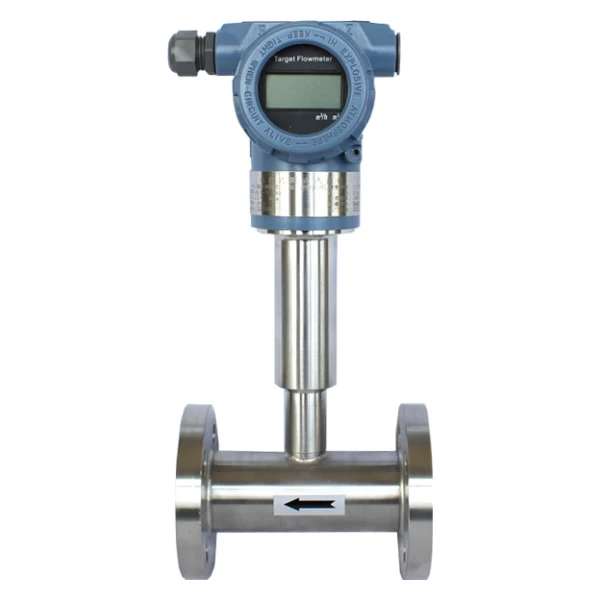
A target flow meter, also called a drag-force flow meter, puts a target disc in the flow and measures the force the fluid pushes on it. A force sensor turns that drag into a flow reading. With no pressure taps to plug and a fully welded body, it reads low flow and handles viscous, dirty, corrosive, and extreme-temperature service that defeats an orifice.
- Principle: Drag force on a target, force sensor
- Best for: Low flow, viscous, dirty, and extreme temperature
- Temperature: -196 C to +500 C
- Pressure: Up to 42 MPa
- Accuracy: 0.5% to 1.5% by connection
- Output: 4-20 mA, pulse, RS485 or HART
Overview
A target flow meter measures flow from the force of the fluid, not from a pressure tap. A target, usually a flat disc on a rod, sits in the pipe facing the flow. Moving fluid pushes on the disc with a drag force that rises with the square of the velocity, and a force sensor on the rod reads that push and converts it to flow rate. Because the meter senses force directly, it works where the pressure drop across an orifice would be too small to read, which is its strength at low flow.
The modern version uses a chip-level force sensor with an anti-overload structure, so it is sensitive and rugged at once. The body has no pressure taps to plug and can be made fully welded with no dead corners, so it holds up on viscous, dirty, and corrosive fluids and across a wide temperature and pressure range. That makes the target meter a good answer for liquid, gas, and steam in petroleum, chemical, power, and similar plants, especially on the awkward fluids and the low flows other meters struggle with.
Features
Everything here follows from one idea: read flow from the drag force on a target, instead of a pressure tap or a moving rotor.
Reads low flow
It senses the drag force directly, so it stays accurate where the pressure drop across an orifice is too small to read.
Chip-level force sensor
A chip-level force sensor with an anti-overload structure gives high sensitivity and accuracy to 0.5%.
Extreme temperature and pressure
Rated from -196 C to 500 C and up to 42 MPa, for cryogenic, high-temperature, and high-pressure lines.
Handles difficult fluids
No pressure taps to plug, so it reads viscous, dirty, and corrosive liquid, gas, and steam that foul an orifice.
Welded, no moving parts
A solid target and sensor, with no rotor to wear, and a fully welded body with no leak paths.
Standard outputs
4-20 mA, a voltage or pulse signal, and optional RS485, for a display, a PLC, or a DCS.
Working principle
The target is the sensor. A disc of a chosen size sits in the flow on a rod, facing upstream. Moving fluid exerts a drag force on the disc that rises with the fluid density and the square of the velocity, so the force is a direct measure of flow. The rod carries that force to a force sensor outside the flow, which reads the tiny deflection and converts it to a flow rate. Changing the disc size changes the range, which is how one body covers different flows.
Because the reading comes from force rather than a pressure tap, there are no small impulse lines to plug, and the meter resolves low flows that an orifice cannot. The target and rod are the only parts in the stream, so on dirty or corrosive service the whole wetted assembly can be made of one resistant alloy and fully welded.
Technical specifications
| Parameter | Specification |
|---|---|
| Measurement principle | Drag force on a target; force rises with density and the square of velocity, read as flow |
| Sensor | Chip-level force sensor with an anti-overload structure |
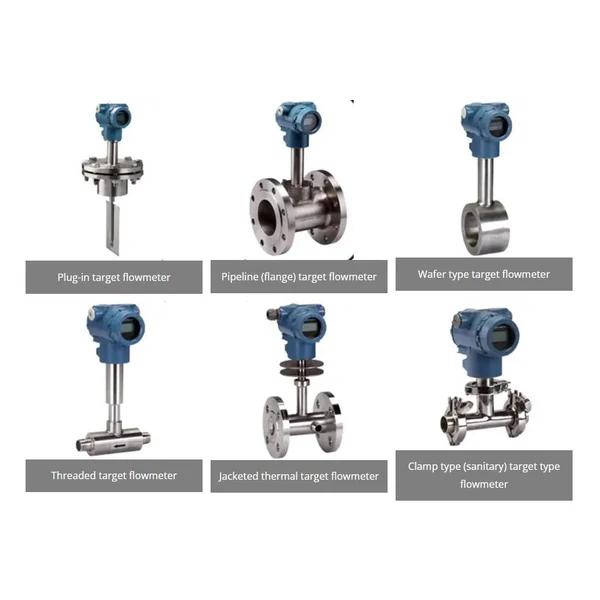
| Accuracy | 0.5% flanged, 1.0% clamp-on, 1.5% insertion |
| Repeatability | 0.05% to 0.08% |
| Turndown | 1:5 for liquid; up to 1:10 for gas and steam |
| Nominal diameter | Flange DN15 to DN500; clamp-on DN15 to DN300; insertion DN80 to DN5000 |
| Process temperature | -196 C to +500 C across low, normal, and high-temperature builds |
| Working pressure | 0.6 to 42 MPa |
| Media | Liquid (including high viscosity), gas, and steam; corrosive and dirty service |
| Materials | Carbon steel or stainless tube; 316 stainless, Hastelloy, or titanium wetted parts; other materials on request |
| Output | Local display; 4-20 mA (two- or four-wire); pulse; 0-5 V; RS485 or RS232; HART |
| Lowest velocity | 0.08 m/s |
| Pressure loss | About half that of a standard orifice plate |
| Compensation | Optional integrated temperature and pressure compensation for direct mass or standard-volume output |
| Power | Built-in 3.6 V lithium battery or external 24 VDC |
| Explosion-proof | Intrinsically safe (Exia IIC T4) or flameproof (Exd IIC T6 Gb) |
| Protection | IP65 or IP67 |
| Moving parts | None; only the target and the force sensor |
Target size, materials, and rating are set per line and service. Send the fluid, the line size, the flow range, and the pressure and temperature and we size the target.
Target vs orifice
The target meter and the orifice plate both rise with the square of velocity, but they read it differently. An orifice creates a pressure drop and reads it through two taps, which works well on clean, moderate flow but loses signal at low flow and plugs on dirty or viscous fluid. A target meter reads the drag force on a disc, with no taps, so it resolves lower flows and shrugs off fouling, at a higher cost than a simple plate.
| Point | Target vs orifice |
|---|---|
| Low flow | Target reads the force directly and resolves low flow; an orifice signal fades there. |
| Dirty or viscous | Target has no taps to plug; an orifice tap fouls and its edge wears. |
| Extreme service | Target runs -196 to 500 C and to 42 MPa, fully welded; an orifice needs tap and seal care. |
| Cost and standard | Orifice is cheaper and a published standard; the target costs more for its sensor. |
Applications
The target meter fits the flows that are low, awkward, or harsh:
- Low-flow liquid, gas, and steam where an orifice signal is too small
- Viscous fluids such as heavy oil, tar, and bitumen
- Dirty and corrosive process liquid and gas
- Cryogenic and high-temperature lines, from liquefied gas to hot oil
- Petroleum, chemical, metallurgy, power, pharmaceutical, and food plants
Challenge: A customer in the UK needed flow of hot tar and bitumen at about 100 C on a 2 in line, a thick fluid that fouls the taps of a thin DP element.
Solution: A target flow meter, which reads the drag force on a disc with no pressure taps to plug and a body rated for the hot, viscous service.
Result: The target meter kept reading on the hot tar where a tapped element would clog, and the range was set with the target size to match the line.
Related products
 Orifice Plate Flow Meter
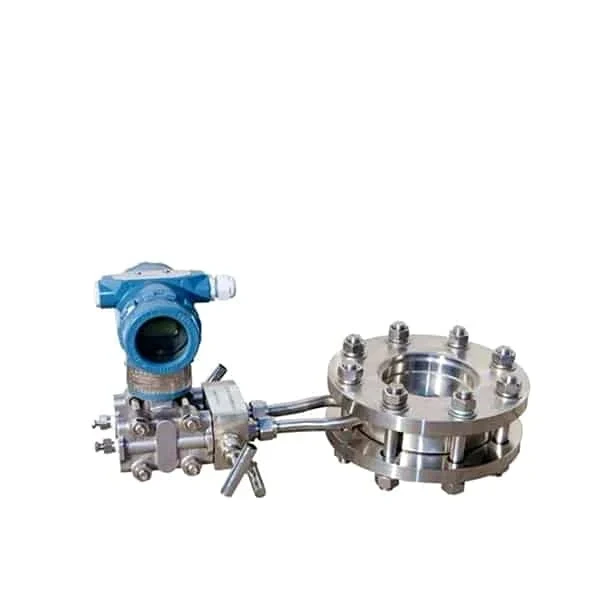
The standard, low-cost DP element for clean, moderate liquid, gas, and steam.
 Wedge Flow Meter
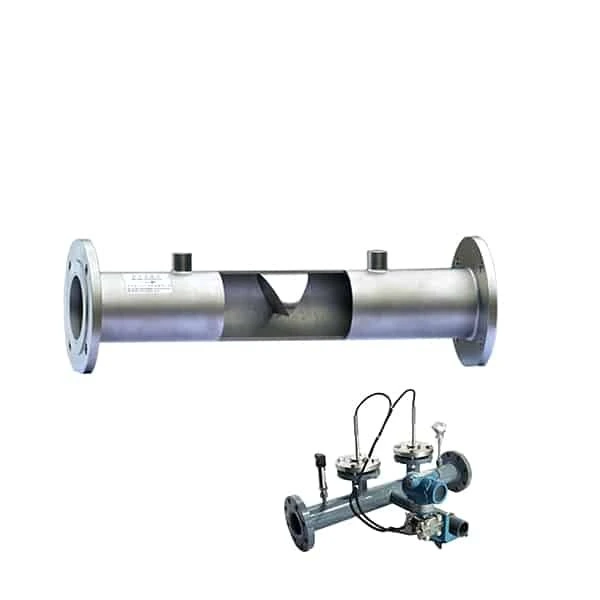
A non-clogging DP meter for viscous, dirty, and slurry fluids and low Reynolds numbers.
Related applications: High viscosity, Slurry.
FAQ
What is a target flow meter?
A target flow meter, or drag-force flow meter, measures flow from the force a fluid exerts on a target disc set in the pipe. A force sensor on the target rod reads that drag and converts it to flow rate. It suits low flow and viscous, dirty, or extreme-temperature service.
What is the difference between a target flow meter and an orifice plate?
Both follow the square law, but an orifice reads a pressure drop through two taps, while a target reads the drag force directly with no taps. The target resolves lower flows and does not plug on dirty or viscous fluid; the orifice is cheaper and a published standard for clean service.
What can a target flow meter measure?
Liquid, including high-viscosity oil and tar, plus gas and steam, in clean, dirty, and corrosive service. It is rated from -196 C to 500 C and up to 42 MPa, so it covers cryogenic, high-temperature, and high-pressure lines.
How accurate is a target flow meter?
A target flow meter reaches about 0.5% accuracy in its best (flanged) build, with grades down to 2.5%, and repeatability of 0.05% to 0.08%. The force sensor and anti-overload design give it accuracy comparable to volumetric meters over a 1:5 to 1:10 range.
Request a quote
Send us the fluid, the line size, the flow range, and the pressure and temperature, and we size the target flow meter and set the target.