Flow Meters › Vortex Flow Meters › Vortex Flow Meter
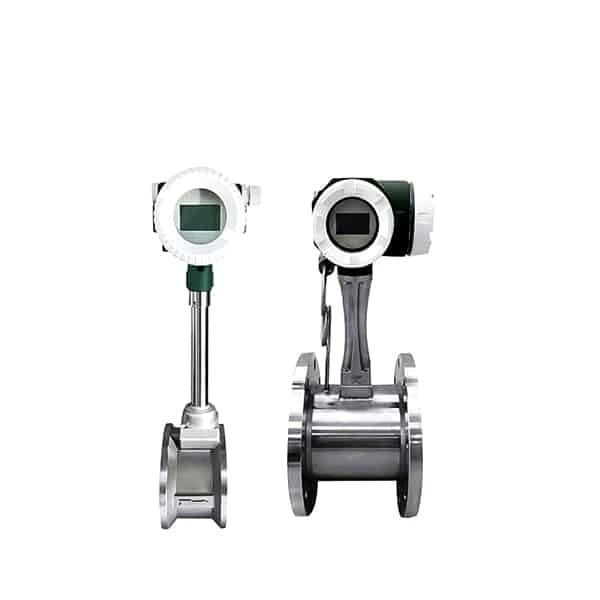
Vortex Flow Meter
A flow meter for steam, gas, and liquid that counts the vortices a bluff body sheds into the flow. The shedding frequency is proportional to velocity, so there are no moving parts to wear, and with temperature and pressure compensation it reports the mass flow of steam. Sizes DN15 to DN1000.
- Principle: Karman vortex shedding; volumetric, with T/P compensation
- Size: DN15 to DN1000, wafer or flange
- Accuracy: ±1.0% or ±1.5% of rate; turndown 20:1
- Output: 4-20 mA, pulse, RS-485
- Rating: IP65; Ex ia IIC T6 Ga
Overview
A vortex flow meter measures flow from the Karman vortex street. A bluff body, the shedder bar, sits across the pipe, and as fluid passes it sheds vortices alternately from each side. The frequency at which they shed is proportional to the flow velocity, and a piezoelectric sensor counts it. There are no moving parts and almost no pressure loss, and within its Reynolds-number range the meter coefficient depends only on the geometry, not on the fluid density, viscosity, or composition.
That makes it the usual choice for steam. The meter reads volume directly, and with the integrated temperature and pressure compensation it converts to the mass flow of saturated or superheated steam without a separate flow computer. It handles steam, gas, and liquid in sizes from DN15 to DN1000, at ±1.0% to ±1.5% of rate over a 20:1 range. For very low flow or dirty liquid, where vortex shedding is weak or unstable, a different technology is the better choice.
Features
Everything here follows from one fact: the meter counts vortices, with nothing moving in the line.
Steam, gas, and liquid
One meter measures saturated and superheated steam, gas, and liquid, with mass flow from T/P compensation.
No moving parts
The only working element is a fixed shedder bar, so there is nothing to wear and little to maintain.
Low pressure loss
It drops about a quarter to a half of what an orifice plate costs, with no impulse lines to leak or freeze.
Stable meter coefficient
The reading depends on geometry, not on density or viscosity, so calibration holds across conditions.
To 400 C
Temperature builds cover -40 to 400 C, for hot steam and gas service.
4-20 mA, pulse, RS-485
An LCD head shows rate, total, frequency, temperature, and pressure, and drives analog, pulse, and Modbus.
Working principle
A bluff body placed across the flow sheds vortices alternately from its two sides, the Karman vortex street. The rate at which the vortices form rises in direct proportion to the flow velocity, so counting the shedding frequency gives the velocity, and the velocity times the bore area gives the volume flow. A piezoelectric sensor in the shedder bar picks up the pressure pulse of each vortex. Because the frequency depends on the bar and pipe geometry and not on the fluid properties, the meter coefficient is stable, and the volume reading does not change with density, viscosity, or composition. For steam and gas, where density changes with conditions, the integrated temperature and pressure sensors convert the volume reading to mass flow. The meter needs a developed flow profile, so it requires 40D of straight pipe upstream and 20D downstream.
Technical specifications
| Parameter | Specification |
|---|---|
| Measurement principle | Karman vortex shedding; volumetric, with optional T/P compensation |
| Medium | Saturated and superheated steam, gas, and liquid |
| Size | DN15 to DN1000 (wafer DN15 to DN300; flange to DN1000) |
| Accuracy | ±1.0% or ±1.5% of rate |
| Turndown | 20:1 |
| Velocity range | Liquid 0.15 to 7 m/s; gas 1.5 to 60 m/s; steam 2 to 70 m/s |
| Medium temperature | -40 to 80, 150, 300, or 400 C (by build) |
| Ambient temperature | -20 to 70 C |
| Nominal pressure | Liquid 1.6 to 25 MPa; gas and steam 1.6 to 5.0 MPa |
| Outputs | 4-20 mA; three-wire voltage pulse (high ≥5 V, low ≤1 V); RS-485 |
| Display | LCD: rate, total, vortex frequency, temperature, and pressure |
| Straight run | 40D upstream, 20D downstream |
| Connection | Wafer or flange; 304 or 316 stainless body |
| Mounting | Integral or split (10-core shielded cable) |
| Cable entry | M20 x 1.5 or 1/2 NPT |
| Protection | IP65 |
| Explosion protection | Intrinsically safe Ex ia IIC T6 Ga |
Representative specifications; confirm per datasheet for the size, medium, and temperature you need.
Ordering example. DN100 flange vortex flow meter for saturated steam, with integrated temperature and pressure compensation, 4-20 mA and RS-485, Ex ia.
Measuring range
A vortex meter is sized by velocity, not by a fixed flow figure: the flow range is the velocity range times the bore area, and the usable turndown is 20:1. Keep the working velocity inside the band for the medium so vortex shedding stays strong and stable.
| Medium | Velocity range | Note |
|---|---|---|
| Liquid | 0.15 to 7 m/s | Clean, low-viscosity liquid |
| Gas | 1.5 to 60 m/s | With T/P compensation for mass |
| Steam | 2 to 70 m/s | Saturated or superheated |
Versions
The body and head are configured to the medium and the service:
- Wafer. A compact body clamped between two pipe flanges, DN15 to DN300, the economical choice on smaller lines.
- Flange. A flanged body to DN1000 for larger lines and higher pressure.
- Temperature builds. -40 to 80, 150, 300, or 400 C, the high-temperature build for hot steam.
- Integrated temperature and pressure. Built-in sensors give the mass flow of steam and gas without a separate flow computer.
- Split. The head is mounted away from a hot line on a 10-core shielded cable.
- Insertion. A probe inserted into a large duct, for big pipes where a full-bore body is not practical.
Applications
Vortex meters are used wherever steam and gas need metering with no moving parts:
- Saturated and superheated steam, with mass flow from T/P compensation
- Compressed air and plant gas distribution
- Natural gas and other industrial gases
- Boiler and energy metering
- Clean, low-viscosity process liquids
- Insertion metering of large air and gas ducts
Application example
Plant steam metering. A site needed to meter saturated steam on a DN100 header running up to about 8 t/h at around 7 bar, for energy accounting between departments. A flanged vortex meter with integrated temperature and pressure compensation read the steam mass flow from one connection, with no impulse lines and almost no added pressure loss on the header. Measuring mass directly from the meter avoided a separate steam flow computer.
Related products
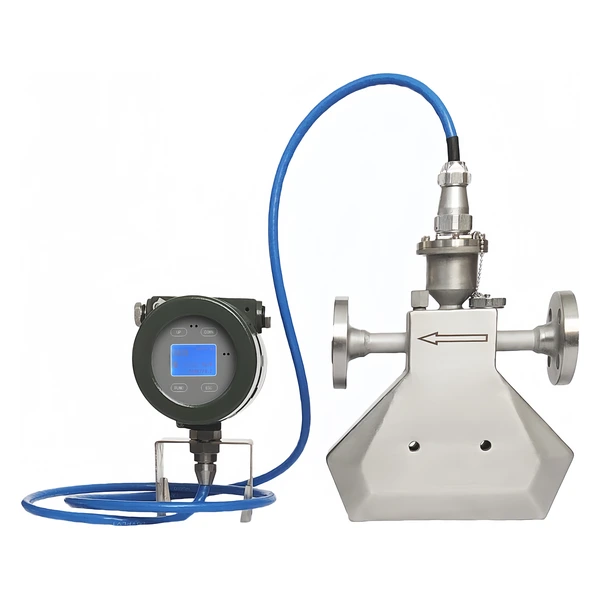 Coriolis Mass Flow Meter
Direct mass measurement for custody and hard fluids.
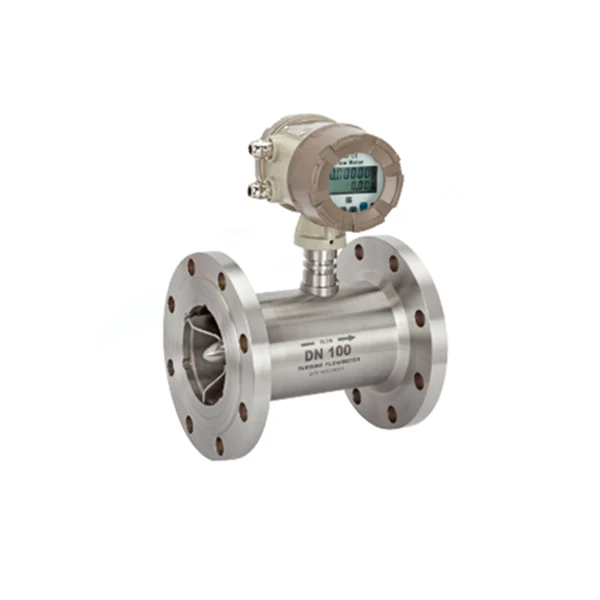 Turbine Flow Meter
Volumetric measurement for clean, low-viscosity liquids.
Browse all vortex flow meters →
To check where your flow sits against the 0.15 to 7 m/s liquid band, convert it with the pipe velocity calculator using the real pipe bore.
For steam service on small bores, capacity tables for the two common sizes are on the 2 inch and 3 inch steam flow meters page.
The vortex street behind the shedder bar is the same physics that once ran automotive Karman air flow sensors; our Karman vortex air flow sensor guide covers the frequency math and the history.
FAQ
How does a vortex flow meter work?
A bluff body across the pipe sheds vortices alternately from its sides, the Karman vortex street. The shedding frequency is proportional to the flow velocity, and a piezoelectric sensor counts it; velocity times the bore area gives the volume flow. Because the frequency depends on geometry, the reading does not change with density or viscosity.
Can a vortex meter measure steam?
Yes, steam is its main application. The meter reads the steam volume, and with integrated temperature and pressure compensation it converts that to the mass flow of saturated or superheated steam, without a separate flow computer.
What are the advantages and limits of a vortex meter?
Advantages: no moving parts, low pressure loss, a stable coefficient independent of fluid properties, and one meter for steam, gas, and liquid. Limits: it needs long straight runs (40D and 20D), it is sensitive to pipe vibration, it does not suit dirty or very low-velocity flow, and the medium is limited to about 400 C.
What size and connection should I choose?
A wafer body suits DN15 to DN300 and clamps between flanges; a flanged body covers larger lines to DN1000. Size by velocity: keep the working velocity inside the band for the medium so vortex shedding stays strong.
Request a quote
Send us the medium, the line size, the flow range, and the temperature and pressure, and we size the vortex meter and set the outputs, with temperature and pressure compensation for steam or gas.