Flow Meters › Ultrasonic Flow Meters › Inline Ultrasonic Flow Meter
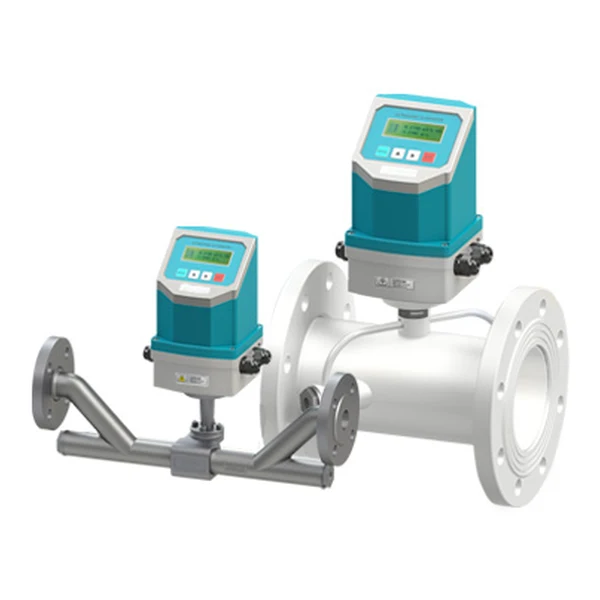
Inline Ultrasonic Flow Meter
A transit-time meter with the transducers built into a pipe section, wired to a TUF-2000B convertor. The acoustic path is set in the factory, not in the field, so the rated 1% reading is easy to hold and repeat over the long term. Full bore, no pressure loss, transducer rated IP68.
- Principle: transit-time, inline pipe-section sensor
- Pipe size: DN15 to DN6000, by transducer type
- Accuracy: ±1%; repeatability 0.2%
- Protection: convertor IP67, transducer IP68; medium to 160 C
- Output: 4-20 mA, OCT pulse, relay; RS-485 Modbus
Overview
A clamp-on ultrasonic meter is quick to fit, but its reading depends on what the installer does in the field: the pipe wall thickness keyed in, the couplant, the spacing, the condition of the outside of the pipe. An inline ultrasonic meter takes those variables out. The transducers are mounted into a machined pipe section and aligned at the factory, so the path length and angle are fixed, known values rather than something set on site. The meter is rated 1%, the same as the clamp-on and insertion versions of the same TUF-2000B convertor, but the fixed path makes that figure easy to hold and repeat, which is what matters on a long-term sub-metering or balance point.
It is a transit-time meter for clean, sound-conducting liquids, supplied from DN15 up to DN6000 with a choice of pipe-section transducers, the convertor rated IP67 and the transducer IP68 so the wetted part can sit in a pit or a flooded chamber. The trade is that you have to cut the line in to fit it. If the pipe cannot be opened, the same convertor runs a clamp-on or an insertion transducer instead; for a quick check, the portable ultrasonic flow meter clamps on with no plumbing.
Features
Building the transducers into a pipe section rather than strapping them on the outside is what makes the rated accuracy easy to hold and lets the wetted part be submerged.
Fixed factory path
A machined pipe section sets the acoustic path, so the rated 1% holds without any field setup.
Full bore, no pressure loss
The pipe section is a clear bore, so there is no obstruction and no permanent pressure drop.
IP68 transducer
The transducer is sealed to IP68 and the convertor to IP67, so the wetted part works in a pit or chamber.
Wide size span
DN15 to DN6000 across pi-type and standard pipe transducers, from a dosing line to a water main.
Data logging
An optional SD card stores totals and flow history for reports and balance work.
Energy-ready
Add a paired Pt100 temperature set and the same meter computes heat or cooling energy.
Working principle
Two transducers built into the pipe section sit at an angle across the bore. Each sends an ultrasonic pulse to the other: the pulse travelling downstream is carried by the liquid and arrives sooner, while the pulse travelling upstream arrives later. The convertor measures the difference between the two travel times, which is proportional to the average velocity along the path, then multiplies by the known bore area to give flow. Because the pipe section is machined and the transducers are aligned on a rig, the path length and angle are fixed values rather than figures an installer enters, which is why an inline build holds its rating more easily than a field-fitted clamp-on. Multi-pulse signal processing and a differential receiver keep the reading steady against electrical interference.
Technical specifications
| Parameter | Specification |
|---|---|
| Measurement principle | Transit-time ultrasonic, inline pipe-section transducer |
| Pipe size | DN15 to DN6000, by transducer type |
| Accuracy | ±1% of reading; repeatability 0.2% |
| Velocity range | 0 to ±7 m/s, bidirectional |
| Liquid | Single sound-transmitting liquid; turbidity under 10000 ppm, low bubble |
| Transducer styles | Pi-type (DN15 to DN32) and standard (DN40 to DN1000) pipe sections |
| Medium temperature | -30 to 160 C |
| Outputs | 4-20 mA (0.1%), OCT pulse, relay |
| Inputs | 3 way 4-20 mA; Pt100 for heat/energy |
| Interface | RS-485 Modbus (M-Bus option); over 1000 m |
| Power | DC 8 to 36 V or AC 85 to 264 V; about 1.5 W |
| Pipe material | Steel, stainless, cast iron, copper, cement, PVC, aluminum, glass-steel; liner allowed |
| Straight run | 10 diameters upstream, 5 downstream, 30 from a pump |
| Protection | Convertor IP67; transducer IP68 |
| Data logging | Optional SD card; totals and flow history |
Specifications from the TUF-2000B convertor datasheet. Values typical; confirm per datasheet for your size, transducer style, and certification.
Ordering example. TUF-2000B convertor with a standard pipe-section transducer, DN100, carbon steel, 4-20 mA plus RS-485, with SD card.
Inline or clamp-on
The inline, clamp-on, and insertion meters are the same TUF-2000B convertor with a different transducer. Pick the transducer by whether you can cut the pipe, how stable the reading must be, and whether it is permanent.
| Need | Use this |
|---|---|
| Permanent point, the line can be cut, best long-term stability | Inline pipe-section transducer (this page) |
| Permanent point, the pipe cannot be opened | Clamp-on ultrasonic flow meter |
| Large or thick-walled line, hot-tap a probe | Insertion ultrasonic flow meter |
| Temporary survey or meter check | Portable ultrasonic flow meter |
Transducers
The pipe-section transducer comes in two styles, picked by line size. The convertor mounts on the wall as standard, with panel-mount and explosion-proof housings available for the site.
- Pi-type, DN15 to DN32. A small-bore pipe section with a threaded connection for dosing and sub-lines.
- Standard, DN40 to DN1000. A flanged or threaded pipe section for the main run; clamp-on and insertion transducers carry the same convertor up to DN6000.
- Energy build. A paired Pt100 temperature set turns the meter into a heat or cooling energy meter.
The pipe material and the medium temperature decide the transducer, so tell us the liquid, the temperature, and the line size and we set the build.
Applications
The inline build suits the lines where a permanent, repeatable reading is worth cutting in for:
- Ultra-pure, potable, and treated water
- Sub-metering and balance points where the reading is checked over time
- Buried or pit-mounted meters that need an IP68 transducer
- Chemicals, reclaimed water, cooling water, and plant effluent that are clean enough to carry sound
- Energy and BTU metering, with the paired temperature sensors
Application example
Process plant, demineralized water metering. A plant metered demineralized water on several identical lines and needed the readings to track each other, not drift apart because each meter had been clamped on a little differently. Inline pipe sections solved that: every meter is the same machined, factory-aligned part, so the lines read consistently and the totals can be compared with confidence. Where a stream ran hot, the high-temperature transducer was specified for that line. The result was a set of meters that agreed with each other, which on a balance calculation matters as much as any single absolute reading.
Related products
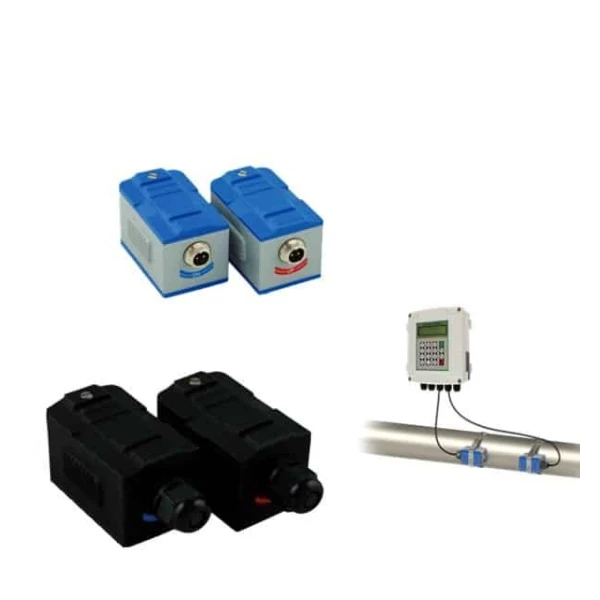 Clamp-On Ultrasonic Flow Meter
Same convertor, non-invasive transducer when the pipe cannot be cut.
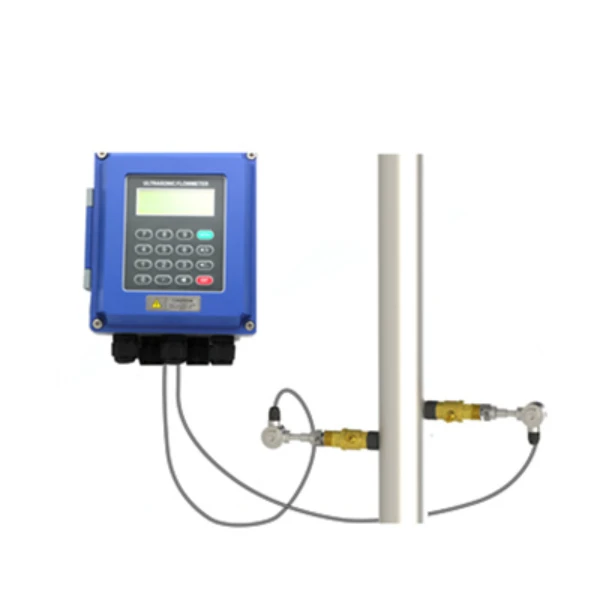 Insertion Ultrasonic Flow Meter
Same convertor, probe transducer for large or thick-walled lines.
Browse all ultrasonic flow meters →
With the optional paired Pt100 input, this meter becomes a complete thermal energy metering point; the selection logic is covered in our guide to BTU meters for chilled water.
FAQ
How does an inline ultrasonic flow meter work?
Transducers built into a machined pipe section send ultrasonic pulses diagonally across the bore, one with the flow and one against it. The pulse going with the flow arrives sooner; the convertor measures that time difference, converts it to average velocity, and multiplies by the bore area to give flow. The path length and angle are fixed in the pipe section, so the result does not depend on field setup.
Is an inline ultrasonic flow meter more accurate than a clamp-on?
Both are rated 1% on the same TUF-2000B convertor, so the headline accuracy is the same. The difference is in practice: a clamp-on depends on the pipe data and couplant set in the field, while an inline pipe section is machined and aligned at the factory, so the rated figure is easier to hold and repeat. The trade is that the line has to be cut to fit an inline meter.
What pipe sizes and liquids does it suit?
DN15 to DN6000 across pi-type and standard pipe transducers, on single sound-transmitting liquids such as ultra-pure water, potable and treated water, and clean process fluids. Heavy suspended solids or entrained air scatter the signal; for dirty conductive water a magnetic meter is steadier.
Can it be buried or measure hot liquid?
The transducer is rated IP68 and the convertor IP67, so the wetted part can sit in a pit or a chamber that floods. The meter handles liquid up to 160 C with the high-temperature transducer. Tell us the temperature and we confirm the build.
Can an inline ultrasonic meter measure energy?
Yes. Add a paired Pt100 temperature set and the meter computes heat or cooling energy from the flow and the temperature difference, which suits chilled-water and heating BTU metering.
Request a quote
Send us the liquid, the line size, the temperature and pressure, and whether you want a wall, panel, or explosion-proof convertor. We set the transducer style and the connection, and configure one inline meter for your line.