Home › Products › Flow Meters › Turbine Flow Meters › Gas Turbine Flow Meter
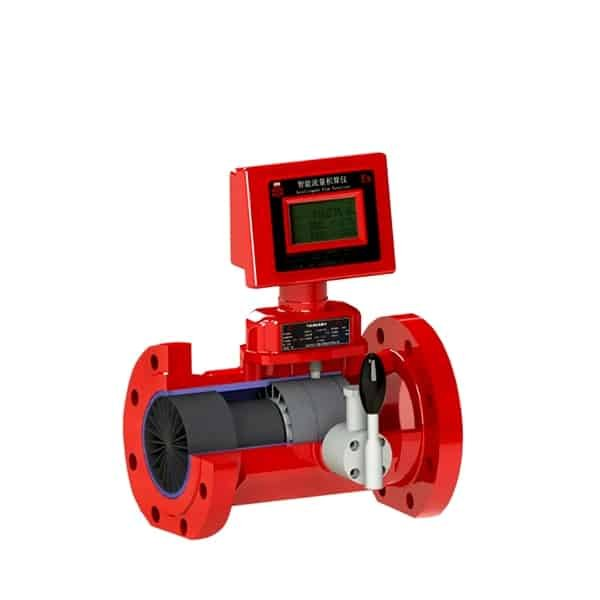
Gas Turbine Flow Meter
A turbine flow meter built for gas, with a built-in flow computer that corrects the reading for temperature and pressure to a standard volume. It meters natural gas and clean industrial gases on DN50 to DN300 to plus or minus 0.5%, which is what billing and balance need.
- For: natural gas and clean, non-corrosive gas
- Size: DN50 to DN300
- Accuracy: plus or minus 0.5% to 1.5%
- Range: 6.5 to 6500 m3/h
- Output: standard volume; 4-20 mA, pulse, RS485, GPRS
Overview
A gas turbine flow meter measures the flow of a gas by the speed of a rotor the gas spins as it passes. It is built differently from a liquid turbine: the rotor and bearings are sized for the lower density and the higher velocity of gas, and a built-in flow computer reads the line temperature and pressure and corrects the volume to standard conditions. That correction is the point, because a cubic meter of gas at line pressure is not the same amount of gas as a cubic meter at standard conditions.
It meters natural gas and clean, non-corrosive industrial gases on DN50 to DN300, over 6.5 to 6500 m3/h, to plus or minus 0.5% in the high-accuracy build. It shows the actual and the standard volume, the temperature, the pressure and the battery, and outputs 4-20 mA, pulse, RS485 and GPRS, so it suits custody and sub-metering on a gas line.
Features
Why a gas turbine meter suits a gas line:
Standard-volume output
A built-in flow computer corrects for temperature and pressure to a standard volume.
0.5% accuracy
Reads to plus or minus 0.5% in the high-accuracy build, with 0.1% repeatability.
Wide range
6.5 to 6500 m3/h across DN50 to DN300, for a small feed to a large distribution line.
Battery option
Runs on a battery or external power, so it meters a remote gas point with no supply.
On-board readout
Shows actual and standard volume, temperature, pressure and battery at the meter.
4-20 mA to GPRS
4-20 mA and pulse with RS485 and GPRS for remote custody and sub-metering.
Working principle
Gas flowing through the meter spins a bladed rotor, and the rotor turns at a speed proportional to the gas velocity. A pickup counts the rotor and the meter scales the count to the volume passing at line conditions. Because gas is compressible, that actual volume changes with temperature and pressure, so the flow computer reads both and corrects the actual volume to a standard volume at reference conditions, which is the figure that is billed or balanced.
The gas has to be clean, dry and non-corrosive, because dust, liquid or a sticky deposit slows the rotor and wears the bearings. A turbine reads poorly at very low flow where the rotor barely turns, so it suits a steady flow above its minimum rather than an intermittent trickle.
Technical specifications
| Parameter | Specification |
|---|---|
| Medium | Clean, dry, non-corrosive gas, natural gas and similar |
| Caliber | DN50 to DN300, flange connection |
| Accuracy / repeatability | Plus or minus 1.5%, 1.0% or 0.5%; repeatability better than 0.1% |
| Flow range | 6.5 to 6500 m3/h |
| Display | Actual and standard volume, temperature, pressure, battery |
| Power supply | Battery or external power |
| Output / communication | Standard-volume; pulse, 4-20 mA, RS485, GPRS |
Standard volume and T/P correction
Gas is compressible, so a volume measured at the line tells you little unless you know the temperature and pressure. The meter reads both at the rotor and applies the gas law to convert the actual volume to a standard volume at reference conditions, the figure used for custody, billing and balance. For a wider gas-composition correction a full flow computer can take a density or a chromatograph input. Set the reference conditions and the gas to match your contract, and fit the temperature and pressure tappings where the meter expects them.
Installation
Fit the meter on a clean, dry gas line on a straight run of at least ten diameters upstream and five downstream, with a filter ahead of it to keep dust and liquid off the rotor. Mount it horizontally with the flow arrow correct, support the line so it does not load the meter, and place the temperature and pressure points where the computer reads them. Set the reference conditions, the gas and the units, and prove the meter if it is for custody.
Applications
- Natural-gas distribution and custody transfer
- Industrial gas sub-metering and energy balance
- Compressed-air and clean-gas process lines
- Boiler and burner fuel-gas metering
- Remote gas points read over GPRS
A site needed to meter natural gas for billing, where the volume had to be corrected to standard conditions to be fair. A gas turbine flow meter with the built-in flow computer read the actual volume, the temperature and the pressure, and reported the standard volume, with the actual and corrected figures both on the display for the audit.
Related products
 Turbine Flow Meter
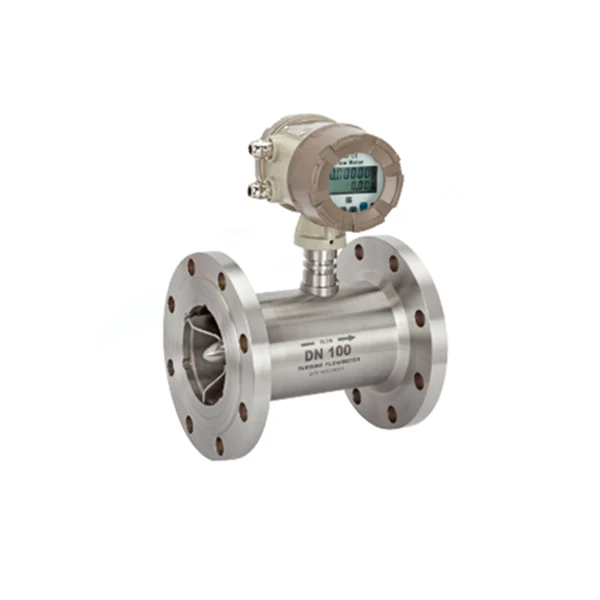
The liquid version (LWGY) for clean, low-viscosity liquids, with a pulse and 4-20 mA output.
 Cryogenic Turbine Flow Meter
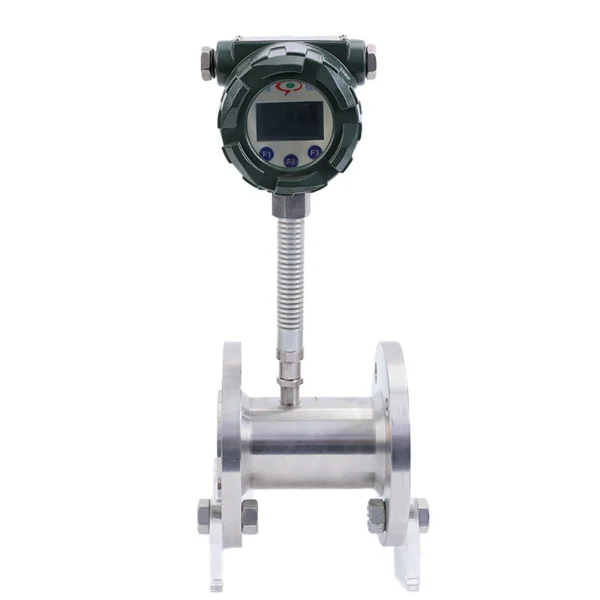
The cold version for LN2, LOX and LNG down to minus 196 C.
Browse all turbine flow meters →
Related applications: Natural gas.
For the wider fuel-gas picture, including where a vapor meter sits relative to the vaporizer and regulator, see our LPG and propane flow meter guide.
FAQ
How does a gas turbine flow meter work?
Gas spins a bladed rotor at a speed proportional to its velocity; a pickup counts the rotor and the meter scales the count to the volume at line conditions. A flow computer then corrects that for temperature and pressure to a standard volume.
What is the difference from a liquid turbine meter?
The rotor and bearings are sized for the lower density of gas, and a gas meter adds the temperature and pressure correction to a standard volume, which a liquid meter does not need because liquid is nearly incompressible.
Why does gas flow need temperature and pressure correction?
Because gas is compressible, the same amount of gas takes a different volume at a different temperature or pressure. Correcting the actual volume to standard conditions gives the figure that is billed or balanced fairly.
What gases can it measure?
Clean, dry, non-corrosive gases such as natural gas, air and many industrial gases. Dust, liquid or a corrosive gas fouls or wears the rotor, so the gas should be filtered and dried ahead of the meter.
Request a quote
Tell us the gas, the line size, the pressure and the reference conditions, and we configure one meter and flow computer for the application, not a shelf part.