By Wu Peng, Senior Process Instrumentation Engineer · Last reviewed September 21, 2026
A thermocouple is a single junction of two dissimilar metal wires; in a pilot flame it produces about 30 millivolts. A thermopile is a stack of thermocouples wired in series, so the same flame yields a rated 750 millivolts from one armored cartridge. In a gas appliance the thermocouple only holds the pilot safety valve open, while the thermopile generates enough power to run the entire millivolt control circuit, wall thermostat included.
Ask what is a thermopile in a hearth shop and you get that answer. Ask in a sensor lab and you get a different one: a chip of microscopic junctions that measures infrared radiation without touching anything. Most pages on the thermopile vs thermocouple question cover one world and ignore the other. This guide covers both, with the manufacturer numbers the comparisons skip: rated outputs, open-circuit and loaded test values, and how to identify which part is in front of you.
Contents
- One junction or many
- Telling them apart
- Why thermostats need thermopiles
- The voltage numbers
- The sensing thermopile
- The process instrument side
- FAQ
One junction or many
Both devices run on the same physics: two dissimilar metal wires joined at one end generate a small voltage that grows with the temperature difference between the hot junction and the cold end. Our guide on what a thermocouple is walks through that effect. A thermocouple uses the effect once. A thermopile repeats it: junctions are connected in series so their voltages add, the way cells add in a battery.
The arithmetic shows up in real catalog parts. One manufacturer rates its single-junction pilot thermocouple at 30 mV and its thermopile generator, sold for the same pilot flames, at 750 mV. Dividing one by the other says the cartridge stacks roughly 25 junctions in series. Both parts carry the same 1400 °F hot-end rating, about 760 °C, which fits: same flame, same rating, just more junctions.
750 mV ÷ 30 mV per junction ≈ 25 junctions in series
Inside a sheathed cartridge the stack is packed and insulated much like the measuring junction of a process probe; the construction options for those are covered in our junction style guide. From the outside, nothing hints at the count. The nameplate voltage is the tell.
Telling them apart
In an appliance the build and the landing point identify the part before a meter comes out.
| What to look at | Thermocouple | Thermopile |
|---|---|---|
| Cable | One thin copper tube; the tube itself is the return conductor | Thicker armored cable carrying two separate leads |
| Connection | Threaded nut screwed into the gas valve body | Spade or screw terminals landing on the valve terminal block |
| Valve markings | Plain socket, no terminal labels | Terminals labeled TH, TP and TH/TP for the thermostat circuit |
| Nameplate voltage | 30 mV class | 250 mV or 750 mV class |
The appliance type does not decide it either. Standing-pilot water heaters and gas fireplaces both exist in thermocouple and thermopile versions, so read the valve and the cable rather than assuming from the equipment.
The trade names help too. Suppliers list thermopiles as pilot generators, and one maker sells them under the PowerPile brand, so any of those words on a parts list means a multi-junction unit, not a plain thermocouple.
Why thermostats need thermopiles
A pilot thermocouple has exactly one job: it feeds a small electromagnet inside the gas valve, and as long as the pilot flame heats the junction, the magnet holds the safety valve open. Thirty millivolts will hold a magnet that is already latched, and nothing more. It cannot power a switch loop across the room.
A millivolt heating system asks for more. The wall thermostat or fireplace switch has to open and close the main burner valve through its own little circuit, and in a self-powered system that circuit has no battery and no line power. The thermopile is the power source: 750 mV at useful current runs the main valve coil and the thermostat wiring by itself, which is why these systems keep heating through a power outage.
That is also the answer to swapping one for the other. A thermocouple cannot replace a thermopile, because the main valve circuit would have no source; a thermopile cannot screw into a thermocouple socket, because the valve interfaces differ. The valve type decides the part, and the part is not a preference.
The voltage numbers
Voltage checks separate a tired generator from a wiring problem, and the published thresholds are worth pinning down because trade sources quote them differently.
| Reading | 30 mV thermocouple | 750 mV thermopile |
|---|---|---|
| Open circuit, healthy | 26 to 32 mV per the maker | 600 to 750 mV per the maker; trade pages quote 650 to 850 |
| Under load, healthy | High teens of mV at the valve coil | Roughly 400 to 500 mV with the burner circuit closed |
| Replace threshold, as published | Below the high-teens loaded value | Sources split: 300 mV under load, or 325 to 400 mV with the pilot alone |
Catalog and trade-published figures for standing-pilot appliance parts. Open-circuit and loaded values are different tests, not disagreement: the maker lists 2.89 ohms of internal resistance for a 750 mV generator, so terminal voltage drops as soon as the circuit draws current.
The spread in replace thresholds is real, not a typo, and no single page reconciles it. Measurement point explains the spread: a reading taken at the valve terminals with only the pilot lit sits higher than one taken with the main burner circuit closed. Record which condition you measured, then compare against the matching threshold. The single-junction procedure, with its own open and loaded values, is worked through in our thermocouple testing guide.
The sensing thermopile
The other thermopile never sits in a flame. Etch dozens of junction pairs onto a silicon membrane, blacken the center so it absorbs infrared radiation, and the hot junctions warm a fraction of a degree above the cold ones at the chip edge. The summed output, microvolts to millivolts, tracks the temperature of whatever surface the chip is aimed at.
That is the detector inside ear thermometers, forehead scanners and low-cost non-contact pyrometers. A widely used module of this kind reads surfaces from −70 to 380 °C, holding half-degree accuracy near room and body temperatures, from a part the size of a transistor can. Gas analyzers use the same principle to measure infrared absorption instead of temperature.
This is where a popular oversimplification needs correcting: thermopiles are not non-contact devices by definition. The pilot generator in a gas fireplace is a thermopile sitting directly in a flame. Contact or non-contact is a property of the packaging, not of the principle; both worlds stack junctions to multiply the same small voltage.
The process instrument side
Industrial temperature loops are built on the single-junction form. A process thermocouple assembly feeds a temperature transmitter that amplifies one junction cleanly to 4-20 mA, so there is no need to stack junctions for signal. Where a plant does meet thermopiles is in portable non-contact thermometers and IR gas analyzers, bought as finished instruments rather than as elements.
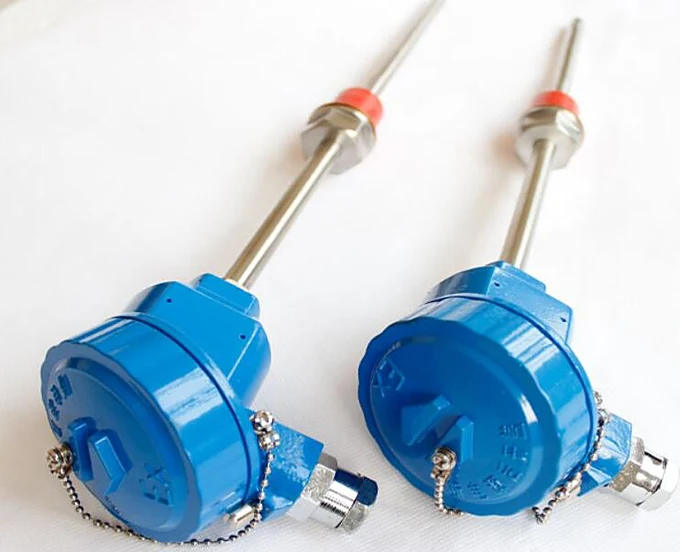
In day-to-day process work the thermocouple vs thermopile choice rarely comes up at all. We supply that side: sheathed thermocouple assemblies, RTDs and transmitters. Appliance pilot parts move through hearth and HVAC parts channels, and a process probe is not a drop-in for a gas valve, any more than the reverse.
Application note
What our inquiry log says. None of the 330 inquiries in our log asks for a thermopile. Appliance generators are stocked by HVAC and hearth distributors, and sensing thermopiles arrive inside finished analyzers, so neither reaches a process-instrument RFQ. What plants do ask us for is the single-junction side: sheathed assemblies, junction construction and transmitters to pair with them.
FAQ
What is the difference between a thermocouple and thermopile?
A thermocouple is one junction of two dissimilar metals and produces about 30 millivolts in a pilot flame. A thermopile connects many junctions in series, so the same heat produces 250 to 750 millivolts. The thermocouple holds a pilot safety valve; the thermopile powers a whole millivolt control circuit.
How do I know if I have a thermopile or thermocouple?
Look at the cable and the connection. A thermocouple is a single thin copper tube ending in a threaded nut screwed into the gas valve. A thermopile is a thicker armored cable with two leads on spade or screw terminals, landing where the valve is marked TH and TP. Nameplate voltage confirms it: a 30 mV class versus a 250 or 750 mV class.
Can you replace a thermopile with a thermocouple?
No. The two parts serve different valve types. A thermocouple only holds the pilot safety magnet and cannot power the thermostat circuit a millivolt valve needs, while a thermopile does not fit a thermocouple socket. Replace like with like, matched to the valve, and match the rated millivolt class.
What is another name for a thermopile?
In the heating trade a thermopile is called a pilot generator or a powerpile, the second name coming from a manufacturer brand. In electronics it is called a thermopile detector or thermopile sensor, the infrared-sensing chip used in non-contact thermometers. All of the names describe thermocouple junctions stacked in series.
Request a quote
Instranova supplies sheathed thermocouple assemblies, RTDs and temperature transmitters for process service, with junction construction, sheath and connection built to your line. Tell us the application and we configure one unit, not a shelf part. Reach our application engineers or use the form below.
Written and technically reviewed by Wu Peng and the Instranova engineering team.