Products › Torque Sensors › Reaction Torque Sensor
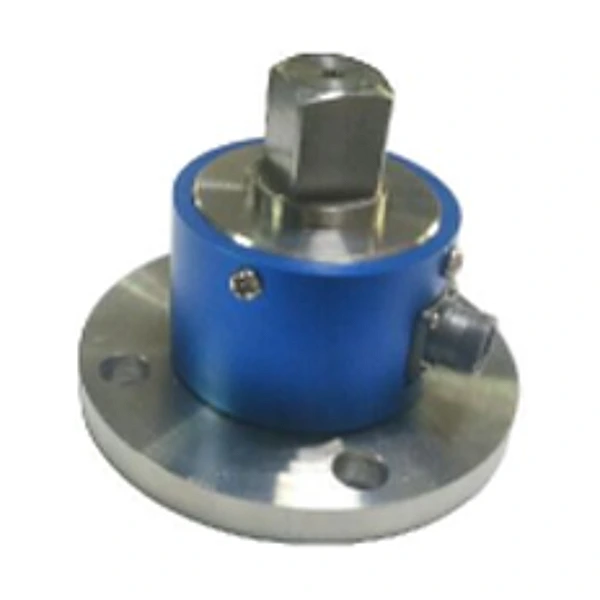
WTQ-32 Static Torque Sensor (Square + Flange, 5-500 Nm)
A reaction torque sensor measures torque on a stationary flange. It is bolted between a fixed frame and the device under test and reads the torque the casing reacts against, with no rotation and no slip rings. It suits torque-wrench calibration, motor and fastener bench tests, and any static torque check.
- Model: WTQ-32
- Range: 5 N·m to 500 N·m
- Type: static (reaction)
- Mounting: square drive one end, flange the other
- Accuracy: ±0.1 to ±0.3% FS
- Output: 1.0-1.5 mV/V bridge
Overview
The WTQ-32 is a static (reaction) torque sensor for 5 to 500 N·m. One end carries an external square drive and the other a flange, so it couples a square-drive tool or shaft to a fixed flange and holds against the torque without turning.
It is the square-and-flange member of the static line. For a turning shaft, use a rotary torque sensor; for the general static range, see the reaction torque sensor.
Features
What sets this reaction torque sensor apart on the bench:
Static reaction
Holds against the torque and reads it; nothing rotates.
Square drive + flange
An external square on one end, a flange on the other.
5 to 500 N·m
Mid-range static torque for tools, fixtures and stands.
High accuracy
Non-linearity of ±0.1 to ±0.3% of full scale.
mV/V output
A 1.0-1.5 mV/V bridge signal, with amplified options available.
Overload protected
Safe to 150% and ultimate to 200% of full scale.
Working principle
The WTQ-32 is held at the flange end, so the shaft does not turn. Torque applied through the square drive is carried as a reaction load and strains a metal-foil bridge inside the body. The bridge gives a 1.0-1.5 mV/V signal in proportion to torque, and an amplifier can convert it to a current or voltage output. The square drive accepts a socket or tool, while the flange bolts to the fixed side.
Technical specifications
| Parameter | Specification |
|---|---|
| Measuring principle | Static reaction strain-gauge |
| Measuring range | 5 to 500 N·m (5 / 10 / 20 / 50 / 100 / 200 / 300 / 500 N·m) |
| Mounting | Square drive one end, flange the other |
| Sensitivity | 1.0-1.5 mV/V |
| Non-linearity | ±0.1 / ±0.3% FS |
| Zero output | ±1% FS |
| Hysteresis | ≤±0.05% FS |
| Repeatability | ≤±0.05% FS |
| Input resistance | 350 / 750 Ω |
| Insulation resistance | ≥5000 MΩ / 100 VDC |
| Compensated temperature | -10 to 60 °C |
| Operating temperature | -20 to 65 °C |
| Excitation | 10-15 VDC |
| Safe overload | 150% FS |
| Ultimate overload | 200% FS |
| Material | Stainless steel or alloy steel |
Models and ranges
Standard rated torques, square drive and flange:
| Rated torque | Mounting |
|---|---|
| 5 N·m | Square + flange |
| 20 N·m | Square + flange |
| 50 N·m | Square + flange |
| 100 N·m | Square + flange |
| 200 N·m | Square + flange |
| 500 N·m | Square + flange |
Mounting and range
Pick by mounting and range:
| Model | Range | Mounting |
|---|---|---|
| WTQ-32 | 5-500 N·m | Square drive + flange |
| WTQ-120 | 5-200 N·m | Keyed shaft |
| WTQ-9500 flange | 50-1,000 N·m | Disc flange |
| WTQ98 series | 0.2 N·m-50 kN·m | Flange both ends |
See the keyed static torque sensor, flange torque sensor or reaction torque sensor.
Applications
- Torque-tool and socket calibration on a fixed stand
- Reaction torque on a square-drive tool fixture
- Static holding and breakaway torque, 5 to 500 N·m
- Assembly and quality torque verification
- Laboratory torque references
Challenge: A tool lab needed to calibrate square-drive torque tools against a fixed reference up to 500 N·m, without a rotating sensor.
Solution: A WTQ-32 with the tool on its square drive and the flange bolted to the bench, reading reaction torque straight to the readout.
Result: The square drive took the tool directly and the flange fixed the other end, so the lab calibrated tools across the range on one mount.
Related products
FAQ
What is the WTQ-32 torque range?
From 5 to 500 N·m: 5, 10, 20, 50, 100, 200, 300 and 500 N·m.
What is another name for it?
A static or reaction torque sensor. The WTQ-32 is the square-drive and flange version.
Request a quote
Tell us the torque range, the mounting style and the test, and we configure one reaction torque sensor for your bench, not a shelf part. Send the details and our engineers reply with a specification and quote.