Home › Level Instruments › Radar Level Sensor for Solids
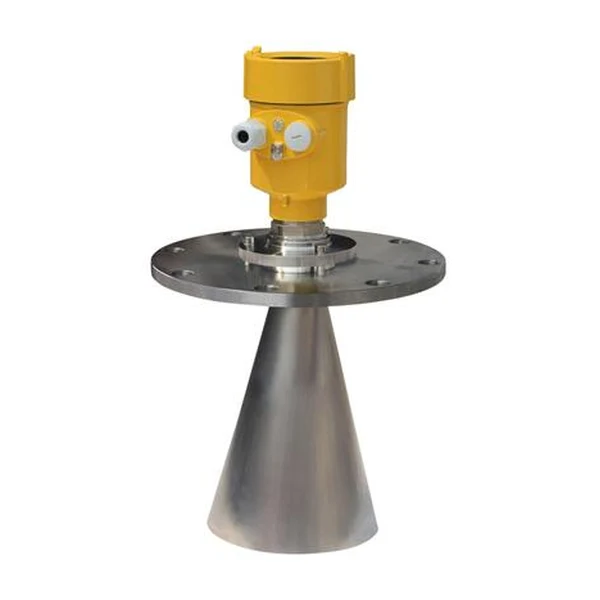
SIRD-804 Radar Level Sensor for Solids
A 6 GHz pulse radar built for solid particles and blocks, not liquid. Non-contact, dust-tolerant continuous level in silos, bins and bunkers up to 35 m, with a 4-20 mA / HART output and an explosion-proof option.
- Frequency: 6 GHz pulse radar, horn antenna
- Range: up to 35 m, blind zone small
- Accuracy: ±20 mm, repeatability ±1 mm
- Media: solid particles or blocks (coal, lime, aggregate); not powder
- Process temp: -40 to 130 C standard, -40 to 250 C high-temp
- Hazardous area: Exia IIC T6 Ga / Exd IIC T6 Gb optional
Overview
Solids do not behave like liquids. The surface tilts at the angle of repose, the top face is rough, dust hangs in the headspace, and grains or powders reflect far less energy than a flat liquid level. The SIRD-804 radar level sensor for solids is designed around those problems. It fires a 6 GHz pulse from a horn antenna, times the echo from the material surface, and reports a continuous level out to 35 m. Because the signal is microwave, it ignores dust density, headspace temperature and steam in the way an ultrasonic sensor cannot.
It is a non-contact instrument, so nothing wears, bridges or gets buried in the silo. The trade-off is honest: the 6 GHz pulse suits particles and blocks such as raw coal, lime, clinker and aggregate. Fine, dry powders with a low dielectric constant are better served by a higher-frequency 26 GHz unit, and we say so below rather than oversell one antenna for every solid.
Features
Nothing hangs in the material, so there is no bridging, abrasion or build-up on a probe.
Short wavelength penetrates airborne dust that blinds ultrasonic sensors during filling.
Useful measurement close to the antenna, so short silos and bins still read well.
Concentrated energy and a high signal-to-noise ratio dodge internal structure and false echoes.
Exia IIC T6 Ga / Exd IIC T6 Gb for coal, grain dust and other classified bins.
Four-digit programmable LCD shows level on the vessel; 4-20 mA / HART runs to the control room.
Working principle
The SIRD-804 is a pulse time-of-flight radar. The antenna sends short 6 GHz microwave bursts straight down. When a burst hits the solid surface, part of it reflects back. The electronics measure the round-trip time, halve it, and multiply by the speed of light to get the distance to the material. Subtract that distance from the known silo height and you have the level. Microwave travel time does not change with dust, pressure or temperature in the headspace, which is why radar holds its reading while a bin is being filled.
Technical specifications
Representative specifications; confirm the exact build per datasheet.
| Parameter | Specification |
|---|---|
| Applicable medium | Solid particles or blocks; not suitable for solid powder |
| Typical application | Lime block, raw coal, clinker, aggregate |
| Frequency | 6 GHz, pulse radar |
| Antenna | Horn antenna |
| Measuring range | Up to 35 m |
| Accuracy | ±20 mm |
| Repeatability | ±1 mm |
| Process temperature | -40 to 130 C (standard); -40 to 250 C (high-temperature) |
| Process pressure | -0.1 to 0.3 MPa |
| Signal output | 4-20 mA / HART |
| On-site display | Four-digit programmable LCD |
| Power supply | Two-wire (DC24V); four-wire (DC24V / AC220V) |
| Explosion-proof | Exia IIC T6 Ga / Exd IIC T6 Gb (optional) |
| Housing | Single-cavity / aluminum double-cavity / plastic / stainless single-cavity |
| Process connection | Universal joint flange (optional) |
Particles vs powder: matching the radar to your solid
Frequency decides whether the SIRD-804 is the right call. The 6 GHz pulse has plenty of energy for solids that reflect well: lumps, granules and blocks. Fine, dry powder with a low dielectric constant reflects weakly and is easy to under-read, so it belongs on a higher-frequency unit with a tighter beam. Pick the technology by the material first, then size the range to the silo.
| Your solid | Recommended | Why |
|---|---|---|
| Coal, lime, clinker, aggregate, granules | SIRD-804 (6 GHz) | Strong echo from lumps and particles; rugged, cost-effective |
| Fine dry powder, flour, cement, low-dielectric dust | 26 GHz or 80 GHz radar | Tighter beam and higher sensitivity catch a weak return |
| Sticky, coating or condensing media | RF / capacitance | Contact methods tolerate build-up a beam cannot |
For a wider view of non-contact options, compare the SIRD-804 with our general radar level transmitter for liquids and the 80 GHz FMCW radar for fine powders and long ranges.
Installation in silos and bins
Solids reward careful mounting more than liquids do. Three rules cover most installs. Aim the beam at the lowest draw point, usually the outlet, because the heap surface slopes and the radar reads the nearest strong echo. Mount the antenna off-center, clear of the fill stream, so falling material does not scatter the pulse. Keep ladders, beams and weld seams out of the narrow beam path, or use the false-echo mapping to ignore them. In tall, narrow silos the small beam angle is an advantage: the energy stays in a column and skips the wall.
Output and wiring
The standard build is a two-wire 4-20 mA loop with HART on DC24V, which most PLC and DCS inputs accept directly. Where you need mains power or extra drive for a remote display, the four-wire version runs on DC24V or AC220V. HART carries the level, the echo profile and diagnostics over the same pair, so a handheld or asset-management tool can map false echoes and set the empty and full points without opening the silo.
Applications
The SIRD-804 fits continuous solids level wherever dust, abrasion or a sloped surface rules out contact methods:
- Coal bunkers and raw-coal storage in power and steel plants
- Lime, clinker and cement raw-material silos
- Aggregate, sand and gravel bins in construction materials
- Ore and mineral storage in mining and processing
- Grain, feed and granule silos that hold particles rather than fine flour
Application example
Bulk-solids OEM. An equipment builder needed continuous, non-contact level on silos holding grain and concrete aggregate, with a working pressure inside the -0.1 to 0.3 MPa window and temperatures swinging across the seasons. Ultrasonic units kept dropping out during pneumatic filling when dust filled the headspace. We supplied a 6 GHz solids radar with a horn antenna and a sample unit first so the builder could qualify it on one bin. The radar held its reading through filling, and the program moved from sample to a multi-silo rollout.
Related products
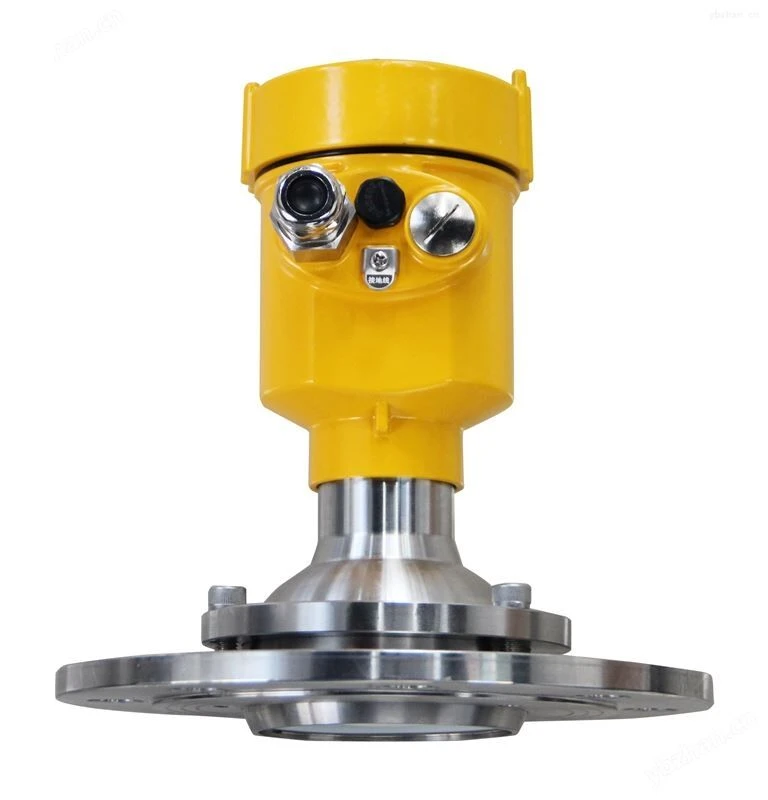 Radar Level Transmitter
26 GHz non-contact radar for liquids and slurries.
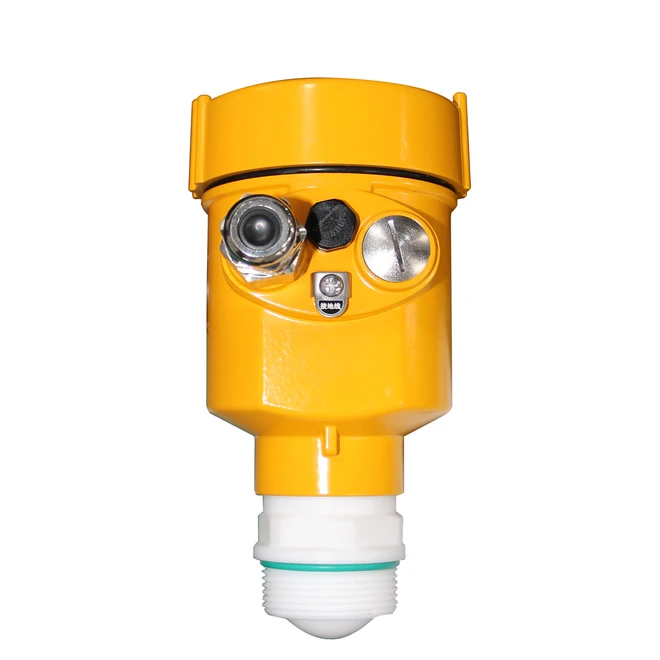 80 GHz Radar Level Transmitter
FMCW radar with a tight beam for fine powders and long ranges.
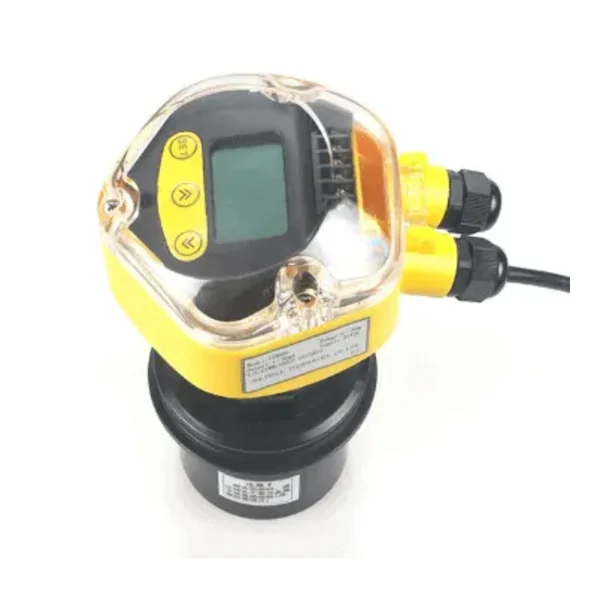 Ultrasonic Level Transmitter
Lower-cost non-contact level for clean, low-dust vessels.
Browse all level instruments →
Point-level alternative: for a simple on/off silo switch instead of continuous level, see the rotary paddle level switch.
FAQ
What are the disadvantages of a radar level transmitter on solids?
Fine, dry, low-dielectric powders reflect weakly, so a 6 GHz unit can under-read them; those belong on a 26 GHz or 80 GHz radar. A sloped surface and internal structure can create false echoes that need mapping out during setup. Radar also costs more than ultrasonic, so for clean, low-dust vessels a simpler sensor may be enough.
How do you calibrate a radar level sensor?
Set the empty reference at the silo bottom and the full reference at the highest measured level, then enter the blocking distance for the near zone close to the antenna. Because the SIRD-804 is non-contact, you can do this over HART without emptying or entering the vessel, and use the echo profile to suppress fixed false echoes from beams or the fill pipe.
Request a quote
Quote checklist, send these five points: silo height and diameter; the solid and its rough particle size (lumps, granules or powder); the maximum measured range; process temperature and pressure; and whether you need a hazardous-area rating. Tell us the application and we configure one unit, not a shelf part.
Ordering example: SIRD-804, 6 GHz horn antenna, 0-20 m range, two-wire 4-20 mA / HART, -40 to 130 C standard housing, Exia IIC T6 Ga.
Written and technically reviewed by the Instranova engineering team, last reviewed 2026-06-21. Based on the SIRD-804 datasheet plus field experience with solids level in silos and bins. Questions? Reach our application engineers.