Home › Products › Level Instruments › Ultrasonic Level Sensors › Portable Ultrasonic Water Depth Gauge
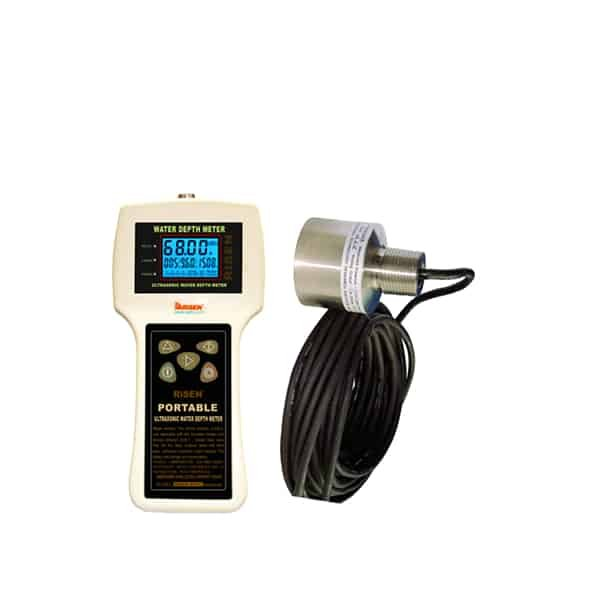
Portable Ultrasonic Water Depth Gauge (HS-SFCC)
A handheld echo sounder that reads water depth from a boat or a bridge. The transducer hangs just below the surface and times a pulse to the bottom, so one person measures the depth of a river, reservoir or harbour on the spot, to 500 m.
- Type: portable ultrasonic echo sounder (depth)
- Range: 50 / 100 / 200 / 300 / 500 m (customisable)
- Accuracy: 0.5% (in 20 C water)
- Output: 4-20 mA and RS485 (both standard)
- Power: rechargeable battery
Overview
A portable ultrasonic water depth gauge is a handheld echo sounder for measuring how deep the water is. The transducer is lowered just under the surface and sends an ultrasonic pulse straight down; the time the echo takes to return from the bottom gives the depth. One operator can carry it onto a small boat, a jetty or a bridge and read the depth at each point without a fixed installation.
The HS-SFCC reads to 50, 100, 200, 300 or 500 m depending on the build, to 0.5% in 20 degree water, and shows the depth on a handheld display while also giving 4-20 mA and RS485 at the same time for a logger or a survey system. It runs on a rechargeable battery, so it suits field hydrography, reservoir and river surveys and dredging checks.
Features
Why a portable echo sounder suits field depth survey:
Handheld and portable
Carried onto a boat, jetty or bridge and used by one person, with no fixed install.
Depth to 500 m
Range options of 50, 100, 200, 300 and 500 m cover shallow channels to deep reservoirs.
0.5% accuracy
Reads to 0.5% in 20 degree water, enough for survey, dredging and reservoir checks.
4-20 mA and RS485
Both outputs as standard, so the depth logs to a survey system as well as the display.
Rechargeable battery
Runs a field day on a charge, with a 110 to 240 V charger for the office or the truck.
Non-contact with the bed
Sound reaches the bottom, so nothing drags on the bed and silt or weed does not foul it.
Working principle
The gauge is an echo sounder. Its transducer, held about half a meter below the surface, sends a short ultrasonic pulse straight down and times the echo that returns from the bottom. Sound travels through water at a known speed, so the round-trip time gives the distance to the bed; adding the draft, the depth of the transducer below the surface, gives the full water depth.
Because the path is straight down through the water, the reading is unaffected by color or surface chop, and there is nothing on the bed to drag or wear. A blind area just below the transducer sets the shallowest depth it can resolve, and very soft silt, dense weed or heavy aeration can soften the bottom echo.
Technical specifications
| Parameter | Specification |
|---|---|
| Model / type | HS-SFCC portable ultrasonic water depth gauge (echo sounder) |
| Maximum range | 50, 100, 200, 300, 500 m (customisable) |
| Detection accuracy | 0.5% (in 20 °C water) |
| Blind area | 500 mm, 800 mm or 1200 mm (by range) |
| Draft depth | 500 mm (transducer below surface) |
| Output | 4-20 mA and RS485 (both as standard) |
| Power | Rechargeable battery; charger 110 to 240 V AC, output 12.6 V DC 350 mA |
How to use it
Lower the transducer over the side until it sits about half a meter below the surface, clear of the hull and any wake, and let it settle so it points straight down. Read the depth on the handheld unit, and log it over 4-20 mA or RS485 if you are running a survey. Set the range to suit the water so the gauge ignores the blind area near the transducer, and keep the face clean of weed and silt between readings.
Applications
- River, lake and reservoir depth surveys
- Hydrographic and bathymetric field work
- Dredging depth and progress checks
- Harbour, jetty and channel soundings
- Flood and water-resource field measurement
Challenge: A water authority needed depth readings across a reservoir and its feeder channels for a survey, where a fixed gauge was impractical and a lead line was slow and rough.
Solution: A handheld HS-SFCC echo sounder taken out on a small boat, lowering the transducer at each point and reading the depth on the spot, logging over RS485.
Result: Fast, repeatable depth readings across the survey with one operator and no installation.
Related products
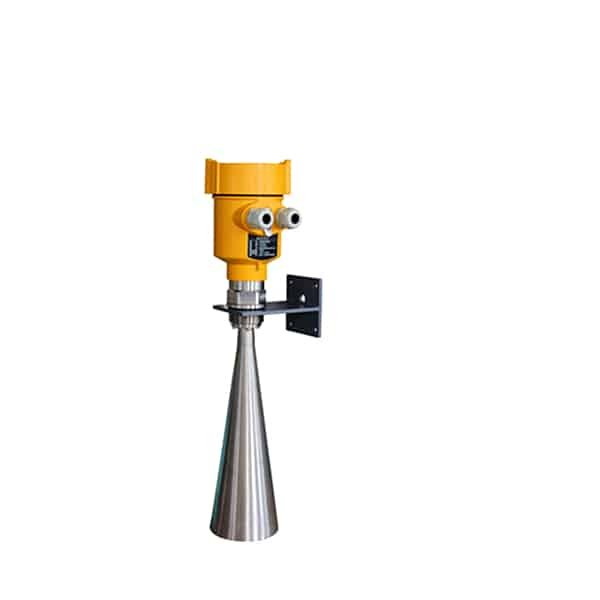 Radar Water Level Sensor
Fixed 26 GHz non-contact radar for river, reservoir and canal level from a bracket.
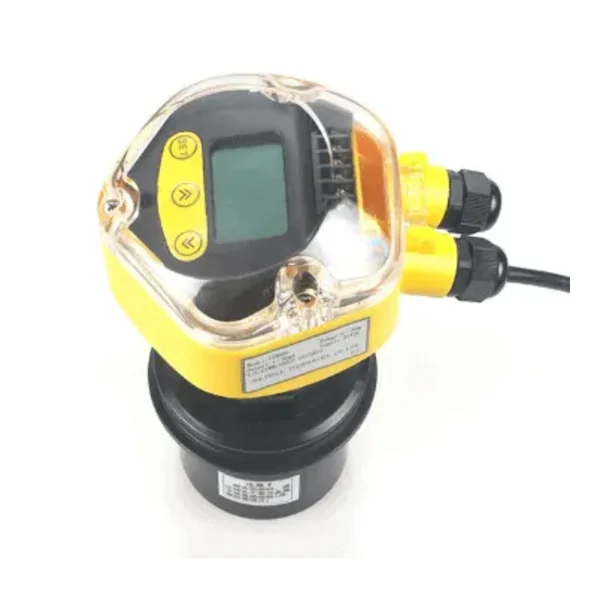 Ultrasonic Level Transmitter
Fixed ultrasonic transmitter for a continuous 4-20 mA level signal on tanks and channels.
Browse all ultrasonic level sensors →
FAQ
How does an ultrasonic water depth gauge work?
It is an echo sounder. The transducer, held just below the surface, sends an ultrasonic pulse straight down and times the echo from the bottom; the round-trip time gives the distance to the bed, and adding the draft gives the full water depth.
How deep can the depth gauge measure?
The HS-SFCC is built for 50, 100, 200, 300 or 500 m depending on the version, to 0.5% in 20 degree water. A blind area of 500 to 1200 mm near the transducer sets the shallowest depth it resolves.
How do you measure water depth in the field?
Lower the transducer about half a meter below the surface from a boat or a bridge, let it point straight down, and read the depth on the handheld unit. The 4-20 mA and RS485 outputs log each reading to a survey system.
What can affect a depth reading?
Very soft silt, dense weed or heavy aeration can soften the bottom echo, and a reading shallower than the blind area cannot be resolved. Keeping the transducer clear of the wake and the face clean of weed handles most field conditions.
Request a quote
Tell us the water depth you need to cover and whether you log over RS485, and we set the range and configure one gauge for the survey, not a shelf part.