Home › Products › Pressure Instruments › High Pressure Transducers
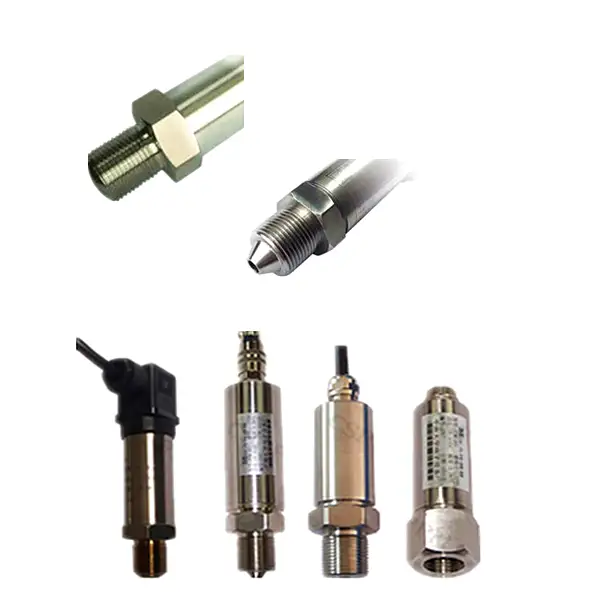
SI-702 Series High Pressure Transducers
A water jet cutter runs at 4,000 bar and a hydraulic test bench slams its circuit with pressure spikes all day. At these levels an ordinary threaded port with a gasket extrudes its seal, so the SI-702 series machines the sensing body from a rare-metal alloy as one piece, welds the stainless steel package shut, and seals to the process metal-to-metal on a ball head or cone. Laser-trimmed resistors handle temperature compensation, and every unit goes through high and low temperature aging plus long-term fatigue testing before it ships.
- Ranges: 0–40 to 0–600 MPa standard; SI-702S to 0–1500 MPa
- Accuracy: 0.1 / 0.2 / 0.5% FS
- Outputs: 4–20 mA two-wire; 0–5, 1–5, 0–10 VDC three-wire
- Stability: 0.1% FS per year
- Sealing: ball head, 58° outer cone or 60° inner cone, IP65 housing
High pressure work splits into two bands. Up to about 100 MPa, a general-purpose unit like our SI-300 pressure transmitter does the job with a standard thread and a soft seal. Above that, in water jet cutting, high-pressure cleaning, pasteurization vessels, hydraulic test platforms and oilfield equipment, both the sensing element and the process connection have to change. The SI-702 series covers that second band.
Seal options
At a few hundred bar, any thread with a bonded washer seals fine. At a few thousand bar, soft seals extrude through the clearance gap, so ultra-high pressure fittings seat metal on metal: a polished sphere or cone pressed into a matching seat makes a narrow line of contact at enormous local stress, and that line is the seal. Which geometry you need is set by the port you already have.
| Model | Type | Range | Connection | Notes |
|---|---|---|---|---|
| SI-702 | Standard high pressure | 0–40 to 0–600 MPa | Thread per order | The base model for hydraulic and test-bench work |
| SI-702S | Ultra-high pressure | 0–1500 MPa standard | Per order | Higher custom ranges quoted case by case |
| SI-702Q | Spherical seal | Per order within series | Ball head | Adds 0–20 mV output option |
| SI-702Z | 58° outer cone seal | Per order within series | Cone head | Extended version of the 702S |
| SI-702W | 60° inner cone seal | Per order within series | M20 × 1.5 external thread | Multiple electrical interfaces |
| SI-702N | 60° inner cone seal | Per order within series | M20 × 1.5 internal thread | Multiple body shapes available |
Technical specifications
| Parameter | Specification |
|---|---|
| Pressure ranges | 0–40 MPa to 0–600 MPa; SI-702S 0–1500 MPa standard, higher ranges on request |
| Accuracy | 0.1% FS, 0.2% FS or 0.5% FS |
| Output signal | 4–20 mA (two-wire); 0–5 / 1–5 / 0–10 VDC (three-wire); 0–20 mV on SI-702Q |
| Power supply | 24 VDC (10–30 VDC) |
| Medium temperature | −20 to 75 °C |
| Ambient temperature | −20 to 75 °C |
| Long-term stability | 0.1% FS per year |
| Vibration effect | Less than 0.1% FS over 20–1000 Hz |
| Load resistance | Current output: 800 Ω max; voltage output: greater than 50 kΩ |
| Insulation resistance | Greater than 2000 MΩ at 100 VDC |
| Sensing body | Rare-metal alloy, one-piece integrated design, all stainless steel welded package, laser-trimmed temperature compensation |
| Factory screening | High and low temperature aging, long-term fatigue testing |
| Process connection | Ball head M20 × 1.5, cone head M20 × 1.5, M22 × 1.5; other threads to order |
| Electrical connection | Four-core aviation connector; Hirschmann connector optional |
| Protection | IP65 |
Specifications apply at room temperature and rated supply unless stated. Confirm the exact figure for your model and range on the order sheet.
Working principle
The principle is the same strain gage bridge used across our pressure line: process pressure deflects the sensing element, the bridge resistance shifts in proportion, and the electronics convert that shift to a 4–20 mA or voltage signal. What changes at ultra-high pressure is everything around the bridge. The one-piece alloy body removes welds and joints from the loaded path, and the heavy wall sets the burst margin.
Size the range so working pressure sits at 60 to 80% of full scale. From the case file: a calibration house in the Middle East needed a sensor for a 700 bar hydraulic pressure comparison pump, replacing a discontinued imported model. 700 bar is 70 MPa, so a 0–100 MPa unit carries the working point at 70% of span: headroom for pump overshoot, resolution where the measurement lives.
Quick connectors
We also supply matching high pressure quick connectors in 1/4 NPT and 3/8 NPT: high-strength carbon steel with galvanized finish, check valves at both ends and a steel ball lock, rated 10,000 psi (700 bar) working pressure with a 2× safety factor, −30 to 100 °C. They interchange with ENERPAC and Parker 3000 series fittings, which keeps an existing test bench plumbed without adapter stacks.
Ordering information
An SI-702 unit is built per application, not pulled off a shelf. The range and the seal geometry drive everything else, so settle those two first and the rest of the order is connector codes.
Quote checklist: five things to put in your inquiry
- Maximum working pressure and the range you want (we size for 60–80% FS at working pressure)
- Seal geometry your port needs: ball head, 58° outer cone or 60° inner cone, with thread size
- Output signal (4–20 mA, 0–5 / 1–5 / 0–10 VDC, or mV) and supply voltage available
- Medium and its temperature at the port (−20 to 75 °C is the standard window)
- Electrical connector preference (four-core aviation or Hirschmann) and any quick connectors you want on the same order
Ordering example: SI-702W, range 0–100 MPa, M20 × 1.5 external thread with 60° inner cone seal, 4–20 mA output, 24 VDC supply, four-core aviation connector, for a 700 bar hydraulic comparison pump. The working point sits at 70% of full scale.
Applications
Water and cleaning service
- Water jet cutting machinery
- High pressure cleaning systems
- High-pressure pasteurization vessels
- Water cutting equipment monitoring
Hydraulic and test service
- Hydraulic components and high-pressure systems
- Test platform construction and pressure comparison pumps
- Oil extraction platforms and flow equipment
- Industrial automation control loops needing long-distance signal transmission
Related products
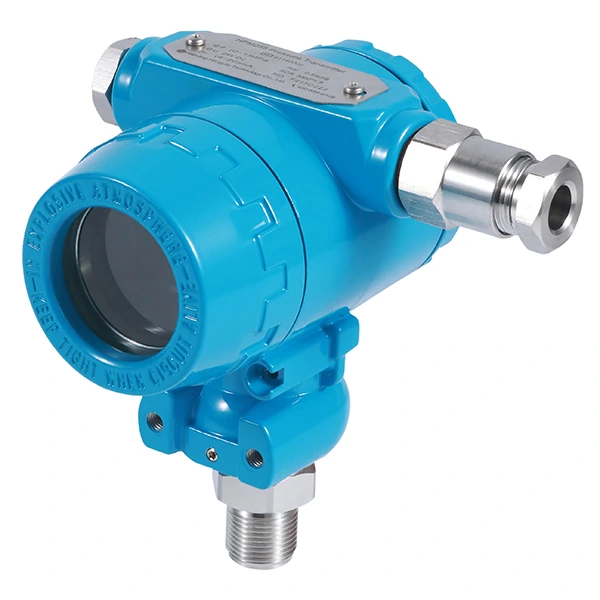 Explosion Proof Pressure Transmitter
Intrinsically safe Ex ia for hazardous areas.
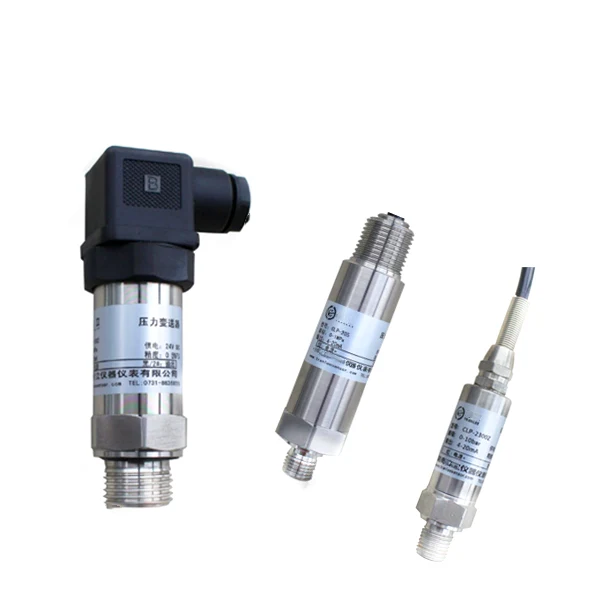 Pressure Transmitters
Gauge and absolute duties from -100 kPa to 100 MPa. Start here below the ultra-high band.
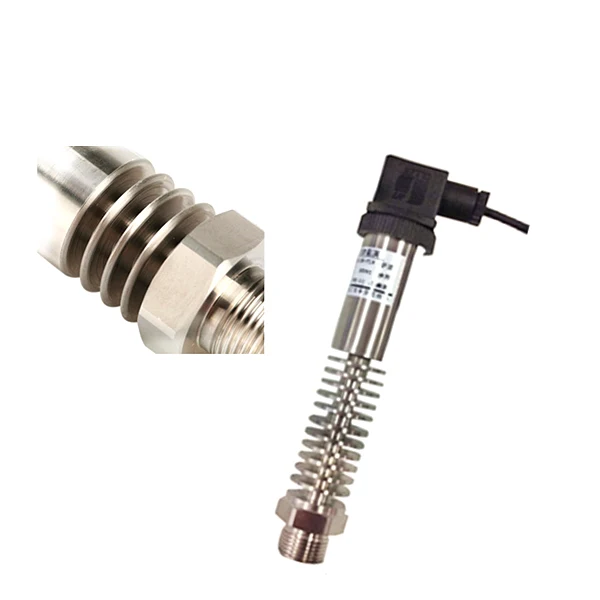 High-Temperature Pressure Transmitters
For hot fluids in pipes and reactors, built per working temperature.
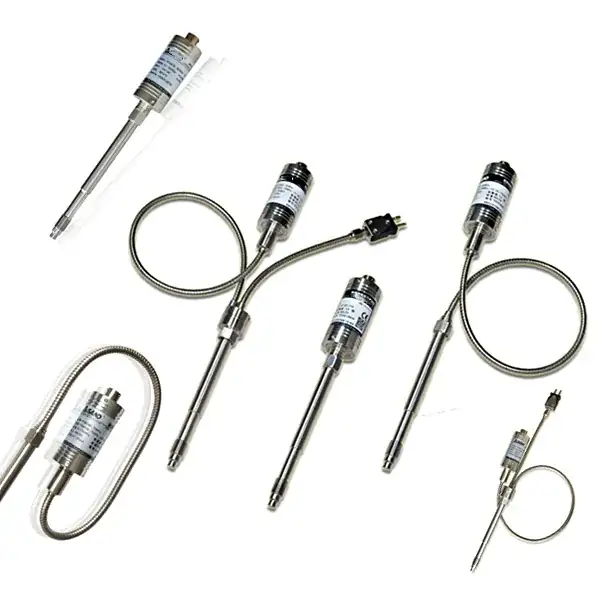 Melt Pressure Transducers
For molten polymer on extruders, diaphragm in the melt stream.
FAQ
What does a high pressure transducer do?
It measures very high pressures and converts them to an electrical signal. The SI-702 handles ranges into the high-megapascal region (standard to 1500 MPa) with a rugged sealed sensing element, outputting 4–20 mA proportional to pressure.
What are the three types of pressure transducers?
By reference: gauge (versus atmosphere), absolute (versus vacuum), and differential (between two points). The SI-702 is a gauge high-pressure transducer, with sealing variants chosen to suit the medium.
What are the four types of transducers?
In process instrumentation the four common measurands are pressure, temperature, level, and flow; a transducer converts each into a signal. This product is the pressure transducer, built for the high-pressure end.
How do you test a high pressure transducer?
Apply a known reference pressure from a deadweight tester or calibrated pump and compare the output against the expected 4–20 mA at several points across the range, checking zero and span. At high pressure use rated test equipment and follow safe practice; we can supply a calibration certificate.
Request a quote
Tell us the working pressure, the seal geometry and thread, the output signal and the medium temperature. We respond with a configured model, lead time and price, usually within one working day.