Flow Meters › Positive Displacement Flow Meters › Spiral Rotor Flow Meter
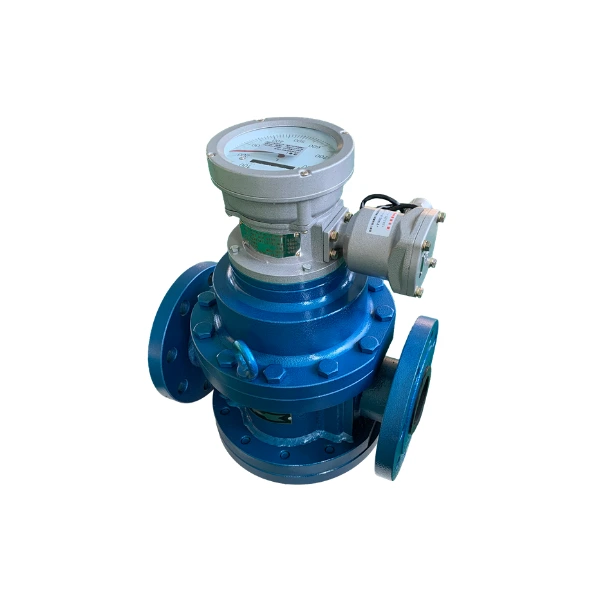
Spiral Rotor Flow Meter
A positive displacement flow meter that meters with a pair of helical rotors. The rotors turn smoothly and sweep a fixed volume each turn, so the flow reads steady with very low pulsation and low noise. It suits high-viscosity and high-temperature oil at higher flow.
- Principle: Positive displacement, twin helical rotors
- Size: DN15 to DN200
- Accuracy: 0.5 grade (0.2 grade optional)
- Medium: viscous oil, high temperature to 250 C
- Register: pointer or LCD; pulse output
Overview
A spiral rotor flow meter is a positive displacement meter that uses a pair of meshing helical, or spiral, rotors. As the liquid passes, the pressure across the rotors turns them, and each turn carries a fixed volume from inlet to outlet. Because the rotors are helical, they hand the flow off smoothly rather than in pulses, so the meter runs with very low noise and very low pulsation, and reads steady at higher flow than a gear meter of the same size.
It is built for viscous oil, and holds accuracy on heavy, high-viscosity, and high-temperature liquid where lighter meters struggle. Like all displacement meters it needs no straight pipe run, and a strainer upstream protects the rotors. For a smaller line or a simpler build, the oval gear flow meter is the base positive displacement meter; for mass and density, see the Coriolis mass flow meter.
Features
Everything here follows from one idea: meter with smooth-running helical rotors.
Twin helical rotors
A pair of spiral rotors sweeps a fixed volume each turn, so the meter counts volume directly.
Low pulsation, low noise
The helical hand-off runs smoothly, so the flow is steady and the meter is quiet.
High viscosity, high temperature
It holds accuracy on heavy oil, and a high-temperature build reads to 250 C.
No straight pipe run
Displacement metering does not depend on flow profile, so it needs no upstream or downstream straight pipe.
Pointer or LCD, pulse
A mechanical pointer reads with no power, or an LCD register adds a pulse for totalizing and control.
Cast steel or stainless
A cast steel or stainless body, to 4.0 MPa, with a double-body build to 6.3 MPa.
Working principle
Two helical rotors mesh inside the measuring chamber. The pressure difference between inlet and outlet turns them, and the spiral form means that as one rotor disengages, the next is already sealing, so the hand-off is continuous. Each turn carries a known, fixed volume of liquid through the chamber, so counting the turns counts the volume. A magnetic coupling drives a pointer or an electronic register and a pulse output outside the wetted chamber. Because the rotors run at a steady speed for a steady flow, the meter has very low pulsation and noise, and because it meters by displacement, viscosity and flow profile do not bias the reading.
Technical specifications
| Parameter | Specification |
|---|---|
| Measurement principle | Positive displacement; twin helical rotors, fixed volume per turn |
| Medium | Viscous oil: gasoline, kerosene, diesel, heavy oil, high-viscosity liquid |
| Size | DN15 to DN200 |
| Accuracy | 0.5 grade (0.2 grade on request) |
| Medium temperature | -20 to +80 C (0.5 grade); -20 to +60 C (0.2 grade); high-temp build to 250 C |
| Ambient temperature | -41 to +60 C |
| Nominal pressure | To 4.0 MPa (DN100); double-body build to 6.3 MPa |
| Body material | Cast steel, cast iron, or stainless; stainless rotors and shaft; graphite or ball bearing |
| Register and output | Mechanical pointer or LCD; pulse output for totalizing and control |
| Straight pipe | Not required; fit a strainer upstream |
Representative specifications; confirm per datasheet for the fluid, viscosity, size, and pressure you need.
Ordering example. Spiral rotor flow meter, DN80, heavy fuel oil at 120 C, 10 to 60 m3/h, cast steel body, LCD with pulse, flange connection.
Spiral rotor or oval gear
Both are positive displacement meters for oil, and the choice comes down to flow and smoothness:
- Spiral rotor. The helical rotors hand the flow off continuously, so pulsation and noise are very low and the meter runs well at higher flow, on heavy and high-temperature oil. It is the choice for larger viscous lines and custody-grade smoothness.
- Oval gear. The oval gear flow meter is simpler and well suited to small and medium lines, with the same displacement accuracy on viscous fluid.
- Both need a strainer. Each meters by close-fitting rotors, so a filter upstream is essential to keep grit out, whichever you choose.
Applications
Spiral rotor flow meters suit viscous and heavy oil at flow:
- Crude, heavy fuel, and residual oil transfer
- Lubricating and hydraulic oil at higher flow
- Asphalt, bitumen, and hot, heavy media
- Diesel and fuel oil custody transfer
- Resin and polymer at temperature
Application example
Heavy oil transfer. A terminal transferring hot heavy fuel oil needed a steady, custody-grade reading at high flow, where a gear meter pulsed. A spiral rotor flow meter ran the oil through its helical rotors with low pulsation and held accuracy as the oil thickened, on a high-temperature build. A strainer upstream kept the rotors clean, which was the one install detail to confirm.
Related products
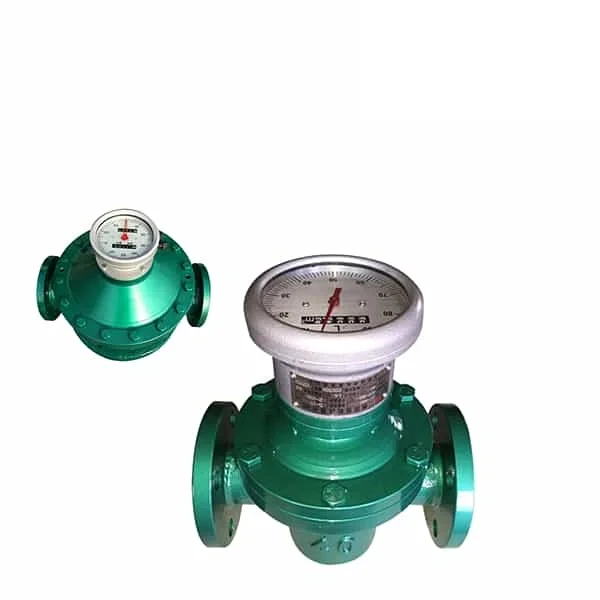 Oval Gear Flow Meter
The base positive displacement meter for small and medium viscous lines.
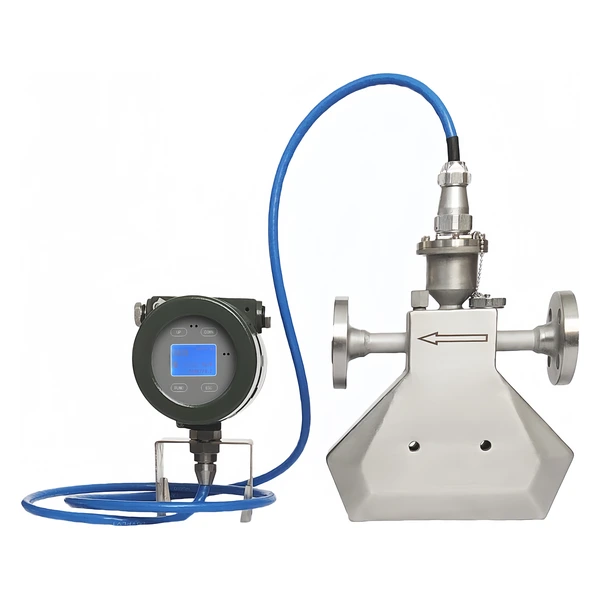 Coriolis Mass Flow Meter
For direct mass and density on the same heavy fluid.
Browse all positive displacement flow meters →
FAQ
What is a spiral rotor flow meter?
It is a positive displacement flow meter that meters with a pair of meshing helical, or spiral, rotors. Each turn carries a fixed volume of liquid, so the meter counts volume directly. The helical form makes the flow steady, with very low pulsation and noise.
What viscosity and temperature can it handle?
It holds accuracy on high-viscosity oil, and a high-temperature build reads to about 250 C with a heat radiator. Tell us the fluid, the viscosity, and the temperature and we set the build and the bearings.
Does it need a straight pipe run?
No. Because it measures by displacement rather than velocity, it needs no upstream or downstream straight pipe. A strainer upstream is the one fitting to add, to keep grit out of the rotors.
Request a quote
Send us the fluid, the viscosity, the size, the flow range, the temperature, and the pressure, and we set the body, the rotors, and the register.