Home › Products › Density Meters › DP Density Meter
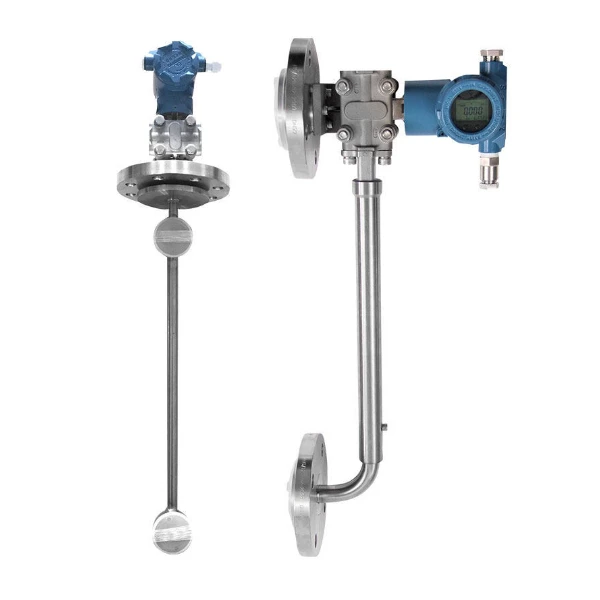
DP Density Meter (Slurry, Acid & Viscous Fluids)
An online density meter that reads liquid density from the hydrostatic pressure difference between two fixed heights in the process: ρ = ΔP / (g × H). Because the wetted interface is a flush diaphragm seal that senses only pressure, it keeps measuring on slurries, acids, and viscous liquors where Coriolis tubes stall and tuning-fork probes foul. It is a non-nuclear alternative to a radioactive density gauge.
- Range: 0.5–2.5 g/cc (500–2500 kg/m³); 0–100% concentration
- Accuracy: ±0.5% of reading (±1 kg/m³ typical)
- Output: 4–20 mA + HART 7; RS–485 Modbus RTU option
- Wetted parts: 316L standard; Hastelloy C–276, tantalum, PTFE–lined
- Principle: hydrostatic ΔP: no moving parts, no flow or viscosity limit
Overview
The DP density meter measures the density of a flowing or static liquid without a radioactive source and without any moving part in the wetted path. Two flush-mounted diaphragm seals, fixed a known vertical distance apart, are connected by oil-filled capillaries to a high-accuracy differential pressure transmitter. The pressure difference between the two seals depends only on the density of the liquid column between them, so the transmitter outputs density directly, in g/cc, kg/m³, °Brix, °Be, or concentration percent.
Because the diaphragms sense pressure rather than flow, the measurement is independent of flow rate, viscosity, and entrained gas. The meter keeps reading through two-phase flow, high solids loadings, and viscous liquors that stall a Coriolis tube, and solids that would coat a tuning-fork probe slide off a flush diaphragm. That makes it the practical choice for slurries and dirty fluids where cleaner technologies struggle. For clean single-phase liquids that need the tightest accuracy, a Coriolis density meter or a tuning fork density meter is the better fit.
Features
Hydrostatic sensing needs no gamma source, no licensing, and no radiation safety officer, a non-nuclear path to slurry density.
Flush diaphragm seals stay clean in tailings, cement slurry, black liquor, and heavy residuum where Coriolis and tuning fork foul.
The reading comes from pressure, not motion, so there is no upper viscosity limit and no minimum flow to maintain.
The transmitter outputs density, percent solids, °Be, °Brix, or concentration directly, so the PLC just reads a process variable.
316L stainless standard; Hastelloy C–276, Monel 400, tantalum, and PTFE–lined options for acids, caustics, and chlorides.
Loop-powered 4–20 mA with HART 7, or RS–485 Modbus RTU; local LCD shows density, temperature, and concentration together.
Working principle
A column of liquid exerts a hydrostatic pressure proportional to its density times the height of the column: P = ρ × g × H. If pressure is measured at two points separated by a known vertical distance H in the same fluid, the difference between them depends only on the fluid density:
ρ = ΔP / (g × H)
The two pressures are taken through flush-mounted diaphragm seals connected to a differential pressure transmitter by oil-filled capillaries. Because the separation H is fixed by the installation, ΔP is a direct read-out of density. The transmitter applies a temperature correction with its own Pt100, then outputs density, percent concentration, or °Be on 4–20 mA / HART. The measurement is independent of flow, viscosity, and bubble content, which is why it survives slurries and two-phase liquors.
Technical specifications
| Parameter | Specification |
|---|---|
| Measuring range | 0.5–2.5 g/cc (500–2500 kg/m³); concentration 0–100% |
| Accuracy | ±0.5% of reading (±1 kg/m³ typical) |
| Repeatability | ±0.1% of reading |
| Operating temperature | -40 °C to +120 °C standard; up to 200 °C with extended capillary |
| Process pressure | Up to 2.5 MPa (higher on request) |
| Viscosity limit | No upper limit: measurement is pressure-based, not flow-based |
| Wetted material | 316L stainless (std); Hastelloy C–276, Monel 400, tantalum, PTFE–lined (opt) |
| Diaphragm seal | Flush-mount; 2″, 3″, 4″ or DN50/80/100 flange; sanitary tri-clamp available |
| Fill fluid | Silicone oil (std); inert halocarbon or high-temp fluorolube (opt) |
| Capillary length | 1 m to 10 m, vacuum-sealed, armor-clad |
| Output | 4–20 mA with HART 7; RS–485 Modbus RTU option |
| Power supply | 24 VDC, loop-powered |
| Enclosure | IP66/67 aluminum alloy; Ex d IIC T6 available |
| Derived readings | Density, %solids, °Be, °Brix, concentration %, specific gravity |
Representative specifications; confirm the exact build against the datasheet for your fluid and installation.
Selecting the build
The DP cell and transmitter stay the same across builds. What changes is the wetted material, diaphragm style, and mounting fit. Pick the build by your fluid, tank height, and wetted material, then confirm on the spec table above.
| Build | Wetted material | Best for |
|---|---|---|
| Tank-side flanged | 316L stainless | Open tanks, atmospheric storage, general slurry service |
| Remote capillary seal | 316L or Hastelloy C | Long-reach installations, high-temperature service |
| Bypass loop | 316L + isolation valves | Pipeline mounting where tank access is limited |
| Anti-corrosion | Hastelloy C–276, tantalum, PTFE-capped | Strong acid, caustic, and chlorinated fluids |
| Sanitary tri-clamp | 316L electropolished | Food, dairy, brewery, and pharma concentration |
Honest limits. A DP density meter needs a vertical measuring column of a known height; it does not work on a horizontal pipeline where solids stratify. It is less precise than a nuclear or ultrasonic density gauge, and the diaphragm fill sets the temperature ceiling. Like any density device, it needs periodic recalibration against a sample. Send the medium, tank height, and wetted-material requirement and we will recommend the diaphragm alloy and fill fluid.
DP density vs nuclear and ultrasonic
Three technologies dominate slurry and process density. The DP method is the non-nuclear, lower-cost option; nuclear is the most stable but carries a radioactive source; ultrasonic is non-intrusive but narrower in range.
| Technology | Strengths | Trade-offs |
|---|---|---|
| DP / hydrostatic (this meter) | No radioactive source or licensing; lower cost; handles slurry, viscous, and two-phase fluids | Needs a vertical column of known height; less precise than nuclear; periodic recalibration |
| Nuclear (gamma) | Non-contact through the pipe wall; very stable; any pipe orientation | Radioactive source; licensing and a radiation safety program; higher cost |
| Ultrasonic | Non-intrusive clamp-on; no radioactive source | Sensitive to entrained gas and temperature; narrower fluid range |
Applications
The DP density meter is the default where density or concentration is a controlled variable and the fluid is too dirty, too viscous, or too two-phase for Coriolis or tuning-fork technology.
- Mining & mineral processing: thickener underflow, tailings pipeline, cyclone-feed density, dredger discharge
- Pulp & paper: black liquor density in chemical recovery, bleach liquor concentration
- Chemical: sulfuric acid, caustic soda, aqueous ammonia, ferric chloride concentration control
- Oil & gas: crude oil storage and transfer, heavy residuum, drilling mud density
- Food & beverage: sugar syrup °Brix, dairy concentrate, wort gravity, tomato paste
- Power: flue gas desulfurization limestone slurry density
- Water & wastewater: thickened sludge, lime milk dosing, MLSS monitoring
Challenge. A copper concentrator in Central Asia needed continuous slurry density on flotation and cyclone-feed lines. The slurry was abrasive and carried fine solids that wore Coriolis tubes and coated tuning-fork probes, and the site wanted to avoid a licensed radioactive gauge.
Solution. A DP density meter with flush 316L diaphragm seals on a vertical column fed density to the plant control system on 4–20 mA, alongside the slurry flow meter, with no radioactive source to license.
Result. The flotation and cyclone control received a stable, continuous slurry density signal from a non-nuclear instrument that the maintenance crew could service in place.
Related products
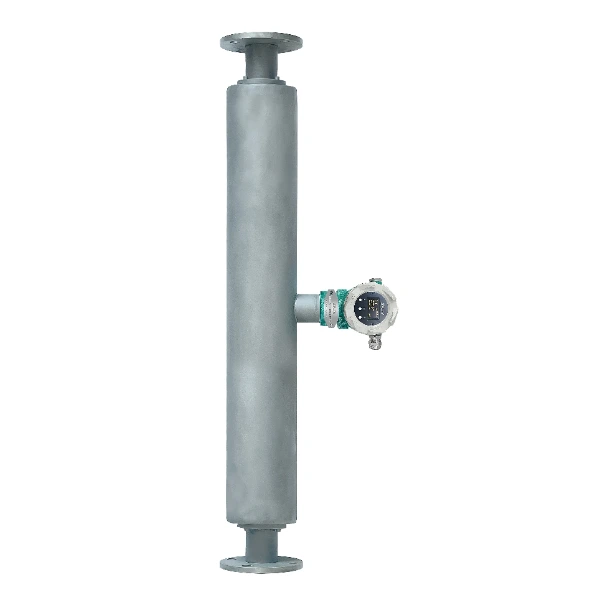 Coriolis Density Meter
Inline Coriolis density and concentration to ±0.001 g/cc for clean, single-phase fluids.
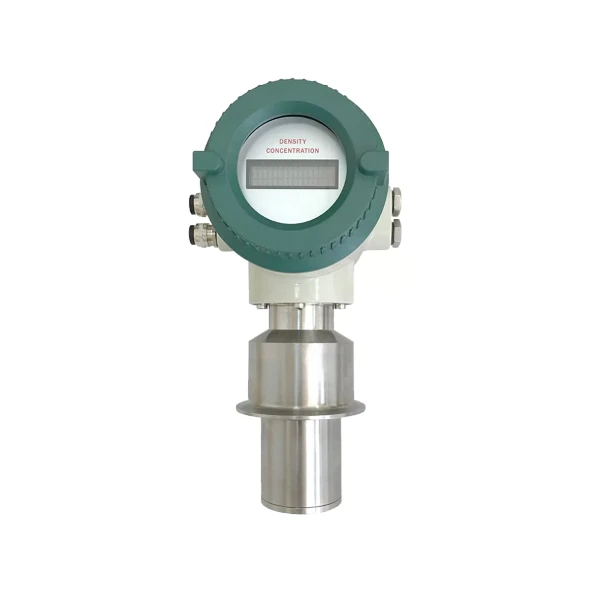 Optical Density Meter
Inline optical concentration meter for clear process liquids where light passes through the fluid.
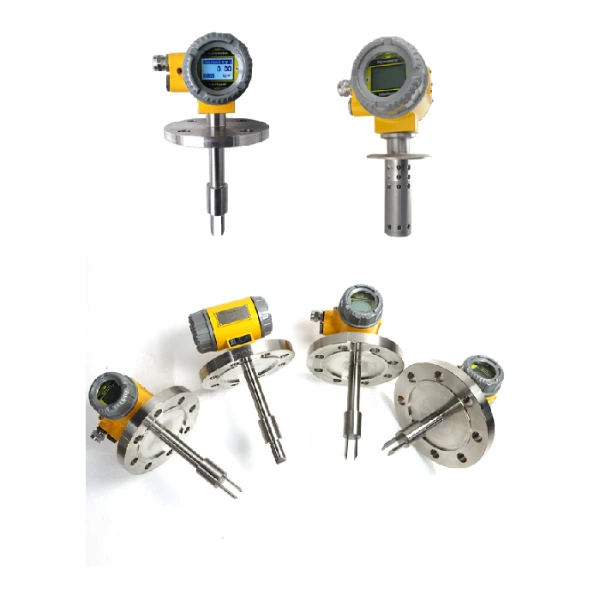 Tuning Fork Density Meter
Vibrating-fork density and concentration for in-line process liquids and light slurries.
FAQ
What is a slurry density meter?
A slurry density meter measures the density, and from it the percent solids or concentration, of a slurry or other dirty, abrasive liquid in a pipeline or tank. Because slurries foul or wear cleaner instruments, the practical technologies are hydrostatic differential pressure, nuclear (gamma), and ultrasonic. A DP slurry density meter reads density from the pressure difference across a known liquid height with flush diaphragm seals as the wetted interface, and it needs no radioactive source.
How does a DP density meter work?
It measures the hydrostatic pressure difference between two points a fixed vertical distance H apart in the same fluid. Because that difference equals density times g times H, the differential pressure transmitter outputs density directly after a built-in temperature correction. The reading depends only on density, not on flow rate, viscosity, or entrained gas.
Is a DP density meter as accurate as a nuclear density meter?
No. A nuclear gamma density gauge is usually more stable and precise and works in any pipe orientation, but it carries a radioactive source, licensing, and a radiation safety program. A DP density meter is the non-nuclear alternative: lower cost and no source to license, well suited to slurries and viscous liquids, at the cost of needing a vertical measuring column and periodic recalibration.
Where are slurry density meters used?
In mineral processing (thickener underflow, tailings, cyclone feed), pulp and paper (black liquor), chemical concentration control, dredging, flue gas desulfurization limestone slurry, and sludge handling in water and wastewater plants. They fit anywhere density or percent solids is a controlled variable on a fluid too dirty or viscous for a Coriolis or tuning-fork meter.
Request a quote
Send your fluid, tank or column height, process temperature and pressure, and wetted-material requirement. Our engineers match a DP density meter build to the application and return a drawing and quote.
About this page. Written by the Instranova engineering team. Specifications are representative; confirm the exact configuration against the datasheet for your application.