Home › Products › Pressure Instruments › Absolute Pressure Transmitters
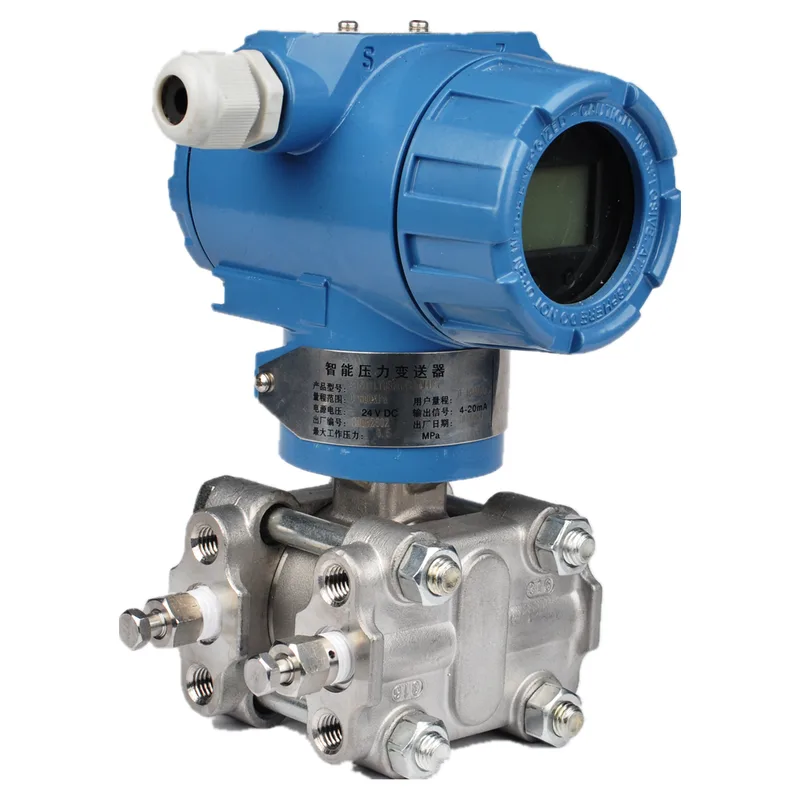
SI-3151AP Absolute Pressure Transmitter
Capacitive absolute pressure transmitter with a sealed vacuum reference chamber. Nine span groups from 3.5 kPa to 41 MPa absolute, 40:1 range compression, and a two-wire 4–20 mA HART output. Built per application from the SI-3151 series that also covers gauge and differential pressure.
- Reference: Sealed absolute vacuum chamber
- Range: 0–3.5 kPa to 0–41 MPa absolute, nine span codes
- Accuracy: ±0.1 % FS standard; ±0.075 % FS optional
- Output: 4–20 mA / HART; RS-485 Modbus
- Turndown: 40:1 range compression, no negative migration
- Hazardous area: Exd IIB T5 Gb / Exia IIC T4–T6 Ga options
Overview
A gauge transmitter reads the weather along with your process. Its reference port is open to the atmosphere, and the atmosphere drifts: standard sea-level pressure is 101.325 kPa, but a passing weather system moves the local value across roughly 98 to 105 kPa, and every 100 m of altitude takes off about 1.2 kPa. On a 10 bar line nobody notices. On a vacuum dryer at 5 kPa absolute, that swing is most of the signal.
The SI-3151AP removes the atmosphere from the measurement. The low side of its capacitive delta cell is evacuated and welded shut at the factory, so the cell compares process pressure against a fixed vacuum instead of whatever the barometer is doing that day. The reading is absolute: zero means full vacuum, and the value never goes negative. The reference decides the type. If atmospheric pressure belongs in your measurement, use the SI-3151GP gauge transmitter; if it would corrupt it, you are on this page. The rest of the lineup sits under pressure instruments.
Absolute vs gauge
Pick absolute when the process itself is referenced to vacuum, or when atmospheric swing would walk through your tolerance. That covers vacuum drying, degassing and distillation columns running below atmosphere, evaporators and crystallizers, leak testing of sealed vessels over days, vapor-pressure measurement, and packaging machines that pull a deep vacuum. It also covers any site where altitude or weather would otherwise have to be corrected out by hand. A general-purpose line or open tank does not need it; a standard gauge transmitter is simpler and cheaper there.
One number makes the point. At 5 kPa absolute working pressure, an SI-3151AP on span code 3 (0–8 kPa absolute) at ±0.1 % FS carries a fixed error of ±8 Pa. Inferring the same value from a gauge reading plus a barometer assumption hands you the full weather swing, up to a few kPa, which at a 5 kPa working point can exceed half the reading. That is not an accuracy class problem; it is the wrong reference.
For the full comparison, with worked conversions and an ISO 2533 altitude table, see our absolute vs gauge pressure guide.
Technical specifications
| Parameter | Specification |
|---|---|
| Pressure reference | Sealed absolute vacuum chamber on the low side of the cell |
| Measuring range | 0–0.10…3.5 kPa abs up to 0–4.1…41 MPa abs, nine span codes, 40:1 compression |
| Accuracy | ±0.1 % FS standard; ±0.075 % FS optional |
| Stability | ±0.1 % of maximum range per 12 months |
| Output | 4–20 mA two-wire with HART (code SF, local buttons); linear 4–20 mA (code E); RS-485 Modbus (code F) |
| Power supply | 24 VDC nominal, 12–45 VDC range |
| Damping | Time constant adjustable 0.2–32 s |
| Temperature limits | Electronics −40 to 85 °C; sensing element −40 to 104 °C; LCD −25 to 75 °C operating |
| Relative humidity | 0–95 % RH |
| Temperature effect | ±0.2 % of maximum range per 20 °C, zero plus span |
| Vibration effect | ±0.05 % of maximum range per g at 200 Hz, any axis |
| Supply voltage effect | Less than 0.005 % of span per volt |
| Mounting position effect | Zero shift up to 0.2 kPa, removable by correction; no span effect |
| Wetted parts | 316 stainless diaphragm standard; Hastelloy C, Monel, tantalum, gold-plated diaphragm options; silicone oil fill |
| Process connection | 1/4 NPT female, 1/2 NPT female, M20×1.5 male; adapter set available |
| Hazardous area | Flameproof Exd IIB T5 Gb (cert. CE16.1163); intrinsically safe Exia IIC T4/T5/T6 Ga (cert. CE15.2354X) |
| Housing | Low-copper aluminum alloy, polyurethane coated; stainless steel option; M20×1.5 or 1/2 NPT conduit entry |
Span codes and overpressure limits
Size the span to the working range, not to the maximum the vessel could ever see. Each code below compresses 40:1, so one code covers a wide band of calibrated spans; the overpressure column is what the cell survives without damage.
| Code | Calibrated span (absolute) | Overpressure limit |
|---|---|---|
| 2 | 0–0.10 to 3.5 kPa | Per datasheet |
| 3 | 0–0.8 to 8.0 kPa | 13.78 MPa (codes 3–8) |
| 4 | 0–4.0 to 40 kPa | |
| 5 | 0–20 to 200 kPa | |
| 6 | 0–70 to 700 kPa | |
| 7 | 0–210 to 2100 kPa | |
| 8 | 0–0.7 to 7.0 MPa | |
| 9 | 0–2.1 to 21 MPa | 31.29 MPa |
| 0 | 0–4.1 to 41 MPa | 51.4 MPa |
Migration follows one hard rule on this product: an absolute transmitter has no negative migration, because no process can sit below full vacuum. Positive migration is available up to 39/40 of the upper range limit at the full 40:1 compression, and after migration the calibrated span must stay inside the range limits of the code.
Features
Calibration and zeroing
Here is the trap: you cannot zero an absolute transmitter by venting it. Open the process connection to the room and a healthy SI-3151AP reads local barometric pressure, somewhere near 98 to 105 kPa, not zero. Trim it to read zero in that state and you have programmed the day’s weather into the instrument as a permanent offset.
Calibration therefore needs an absolute reference: a vacuum pump with an absolute-mode standard, or at minimum a trusted barometric reading for a one-point check. The sequence is the same one we use at the works: first a 4–20 mA trim to align the D/A converter, no pressure source needed; then a full sensor trim against the applied absolute reference so the digital reading matches the standard; then re-range, which does electronically what the zero and span screws on older housings did mechanically. The fine points are in our pressure transmitter commissioning notes, and the same logic applies across the series.
Models and ordering
The model string follows the same pattern as the SMT3151DP differential transmitter: type, span code, output, wetted set, housing, connection, options.
| Position | Code | Meaning |
|---|---|---|
| Type | AP | Absolute pressure transmitter (GP on the same table is gauge) |
| Span code | 2–9, 0 | See span table above |
| Output | E / SF / F | Linear 4–20 mA / 4–20 mA + HART with local buttons / RS-485 Modbus |
| Wetted set | 22–44 | Flange, drain valve, diaphragm and fill: 22 = all 316 stainless + silicone oil; 33 = Hastelloy C; 24/44 = Monel; 25/35 = tantalum diaphragm |
| Housing | A–D | Aluminum alloy or stainless, M20×1.5 or 1/2 NPT conduit entry |
| Connection | L1 / L2 / L3 | 1/4 NPT female / 1/2 NPT female / M20×1.5 male |
| Options | M4, B1–B3, D0–D2, C02–C45, Gd, Da, Fa, X1 | LCD head, mounting brackets, drain valve position, thread adapters, gold-plated diaphragm, Exd (Da), Exia (Fa), oil-free service (X1) |
Applications
Vacuum process service. Vacuum pumps and skids, where a gauge instrument goes blind at the deep end of the curve; vacuum packaging of food and medical product, where residual absolute pressure sets shelf life; degassing, vacuum distillation, evaporators and crystallizers. A vacuum equipment manufacturer in the United States runs combined temperature and pressure sensors with thermal mass and vortex flow meters on its process-gas skids on ANSI flanges; two purchase orders came through that route, and absolute reference on the pressure points is what makes readings comparable between its factory and customer sites at different altitudes.
Atmosphere-independent reference. Sealed-vessel leak tests that run for days, where a 2 kPa weather swing would look exactly like a leak; vapor-pressure measurement on heat-transfer fluids; toxic-gas storage where the inventory calculation needs a static reference. A European distributor came to us with an organosilicon heat-transfer loop reading OMTS vapor at 280 °C media temperature and needed 0.1–10 bar absolute; the span was ordinary, the reference and the temperature were not, and the job went to a high-temperature absolute configuration with a standoff. Tell us the application and we configure one unit, not a shelf part.
Related products
To convert a specification between gauge and absolute references, including at altitude, use our absolute and gauge pressure calculator.
Choosing absolute because the reading must ignore the weather? That is the same reference a barometer uses. Our barometric pressure guide covers how the atmosphere is measured and where an absolute reference belongs.
Browse all pressure instruments →
Not sure whether your spec should be absolute or gauge? See PSI vs PSIA vs PSIG for what the suffix means and when to choose absolute.
Absolute reference is also the right way to read process vacuum once the atmosphere itself becomes a moving error source; our guide to vacuum pressure measurement covers when to switch.
FAQ
What is absolute pressure?
It is pressure measured relative to a perfect vacuum (zero), not relative to the surrounding air. An absolute pressure transmitter like the SI-3151AP has a sealed vacuum reference behind its diaphragm, so it reads the true total pressure, including the atmospheric part.
What is the difference between absolute and atmospheric pressure?
Atmospheric pressure is the pressure of the surrounding air, about 101 kPa at sea level; absolute pressure is measured from a vacuum, so absolute equals gauge plus atmospheric. A gauge transmitter subtracts the atmosphere, while an absolute transmitter does not, which is why its reading does not drift with the weather.
How do you calculate absolute pressure?
Absolute pressure = gauge pressure + atmospheric pressure. If a gauge reads 0 and the barometer is 101 kPa, the absolute pressure is 101 kPa abs. The SI-3151AP reads absolute directly, so no barometric correction is needed.
How is absolute pressure measured?
With a sensor whose diaphragm has a sealed vacuum reference on one side; the diaphragm deflects with the total pressure against that vacuum, and the electronics output 4–20 mA. The SI-3151AP uses this to give an absolute reading that is immune to barometric change.