Home › Flow Meters › Turbine Flow Meter
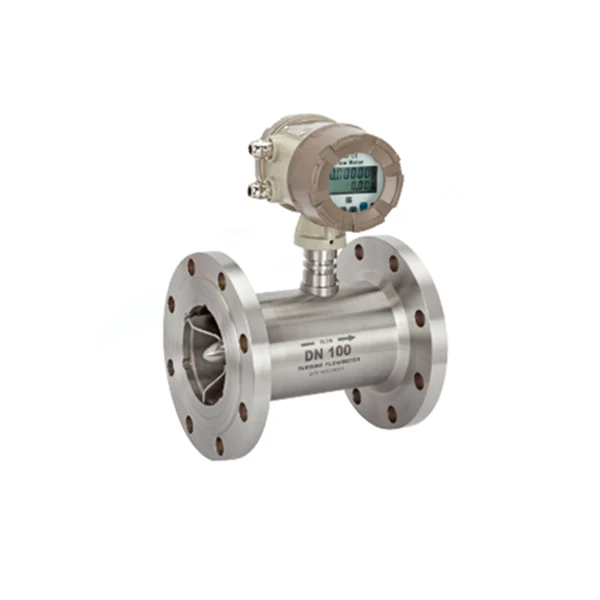
LWGY Turbine Flow Meter
A spinning rotor counts flow as pulses: clean, low-viscosity liquids move the blades, and the pulse frequency tracks the rate. Accurate, repeatable and cost-effective for water, fuel, solvents and gas, from DN4 to DN200, with a pulse or 4-20 mA output.
- Sizes: DN4 to DN200, threaded or flanged
- Accuracy: ±0.5% of reading (±0.2% special)
- Turndown: 1:10 to 1:20
- Output: pulse frequency or 4-20 mA / RS485
- Material: 304 / 316L stainless steel
- Process: -20 to 150 C; to 25 MPa; IP65, Ex option
Overview
A turbine flow meter is one of the simplest accurate ways to meter a clean liquid or gas. The flow spins a bladed rotor in the pipe; the faster the flow, the faster it turns, and a pickup coil counts each blade as a pulse. The pulse frequency is proportional to the volumetric rate, and the total pulse count is the total volume. The LWGY converts that into a local reading and a pulse, 4-20 mA or RS485 output.
It is best suited to clean, low-viscosity media: water, demineralized water, fuel, light oils, solvents and gas. On those fluids it gives high accuracy, plus or minus 0.5% of reading, a wide turndown and a compact, low-cost body. Dirty, viscous or pulsating flow wears the bearings and shifts the reading, so for slurry or heavy oil a different technology is the better choice.
Features
What the LWGY turbine meter gives you on clean, low-viscosity flow:
High accuracyPlus or minus 0.5% of reading as standard, plus or minus 0.2% on a calibrated build.
Wide turndownA 10:1 to 20:1 range covers low and high flow on one meter.
Pulse or 4-20 mARaw pulse for totalizing, or a loop and RS485 for the control system.
Battery or loop powerAn internal lithium battery runs remote sites with no wiring.
Stainless build304 or 316L wetted parts for water, fuel and mild chemicals.
Hazardous-area optionExia IIC T4 or Exd IIB T6 for fuel and solvent service.
Working principle
Flow enters through a guide that straightens it and directs it onto the rotor. The rotor sits on low-friction bearings and spins at a speed proportional to the average velocity, and therefore to the volumetric flow. A magnetic or modulated-carrier pickup over the housing senses each blade passing and produces one pulse per blade. The meter factor, or K-factor in pulses per liter, links pulse frequency to flow rate and pulse count to total volume, set at calibration for each size.
Technical specifications
Representative specifications; confirm the exact build per datasheet.
| Parameter | Specification |
|---|---|
| Sizes / connection | DN2 to DN300; threaded DN2-DN40, flanged DN2-DN300, clamp DN2-DN50 |
| Accuracy | ±1% R, ±0.5% R, or ±0.2% R (special) |
| Range ratio (turndown) | 1:10, 1:15 or 1:20 |
| Material | 304 or 316L stainless body; 2Cr13 or duplex steel impeller |
| Medium temperature | -20 to 120 C conventional; -20 to 180 C high-temperature build |
| Output signal | Pulse (high 8 V, low 0.8 V); 4-20 mA transmitter; RS485 or HART option |
| Power supply | DC 9-36 V (not below 12 V), or 3.6 V lithium battery |
| Pressure rating | Threaded to 6.3 MPa; flanged to 2.5 MPa; clamp to 1.6 MPa; 25/42 MPa special builds |
| Signal distance | Up to 1000 m |
| Explosion-proof | Exia IIC T4 or Exd IIB T6 |
| Protection | IP65 |
| Standard | JB/T 9246 |
Flow ranges by size
Each size has a normal range; the meter holds its accuracy across the turndown. Larger sizes scale up to DN200; confirm the exact range for your size on the datasheet.
| Size | Normal flow range | Extended range |
|---|---|---|
| DN2 | 30-180 L/h | – |
| DN4 | 40-250 L/h | 40-400 L/h |
| DN6 | 100-600 L/h | 60-600 L/h |
| DN10 | 0.2-1.2 m3/h | 0.15-1.5 m3/h |
| DN15 | 0.6-6 m3/h | 0.4-8 m3/h |
| DN20 | 0.8-8 m3/h | 0.45-9 m3/h |
| DN25 | 1-10 m3/h | 0.5-10 m3/h |
| DN32 | 1.5-15 m3/h | 0.8-15 m3/h |
| DN40 | 2-20 m3/h | 1-20 m3/h |
| DN50 | 4-40 m3/h | 2-40 m3/h |
| DN65 | 7-70 m3/h | 4-70 m3/h |
| DN80 | 10-100 m3/h | 5-100 m3/h |
| DN100 | 20-200 m3/h | 10-200 m3/h |
| DN125 | 25-250 m3/h | 13-250 m3/h |
| DN150 | 30-300 m3/h | 15-300 m3/h |
| DN200 | 80-800 m3/h | 40-800 m3/h |
| DN250 | 120-1200 m3/h | 60-1200 m3/h |
| DN300 | 180-1800 m3/h | 90-1800 m3/h |
Installation
A turbine meter needs a steady, full, clean flow profile. Give it straight pipe: 10 diameters upstream and 5 downstream, more after two elbows in different planes. Fit a strainer ahead of it on any line that can carry grit or scale, because particles wear the bearings and a single piece of debris can jam the rotor. Keep the pipe full and mount it so the body cannot trap air. On low-viscosity liquids and gas it is at its best; on heavy oil and slurry the rotor drags and the reading drifts, so route those to another method.
Output and wiring
The bare sensor gives a pulse train, ideal for a batch controller or totalizer that counts pulses against the K-factor. The integral transmitter version adds a two-wire 4-20 mA loop and an RS485 link for a PLC or DCS, with a local display of rate and total. Where there is no power or signal cable, the internal lithium battery runs the meter for years and logs the total. The signal carries up to 1000 m, and an explosion-proof head covers fuel and solvent areas.
Applications
The LWGY suits clean, low-viscosity liquids and gas where accuracy and cost both matter:
- Water, demineralized and deionized water in plants and semiconductors
- Diesel, gasoline and light fuel oil custody and dispensing
- Solvents, alcohols and light chemicals
- Compressed air and industrial gas with the gas build
- Batching and dosing where a pulse drives a controller
Application example
Power plant, demineralized water. A plant metering demineralized water on several 3-inch lines needed an accurate, repeatable reading with a local total and a signal to the control room, at a pressure up to 25 bar. We supplied six turbine meters with integral transmitters, each calibrated to its size, so the water is clean and low-viscosity, which is exactly the service a turbine handles best. The meters totalize locally and send 4-20 mA, and the order ran as a repeat across the line.
Related products
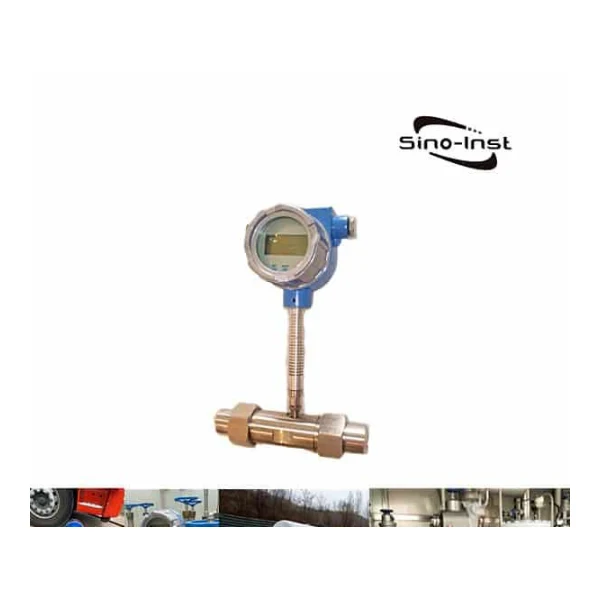 Liquid Nitrogen Flow Meter
Cryogenic turbine flow meter for LN2 and liquid gases.
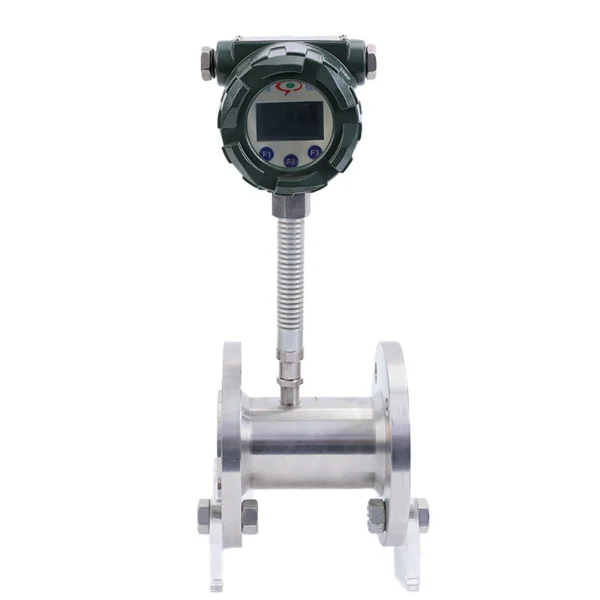 Cryogenic Turbine Flow Meter
Ultra-low-temperature turbine for LN2, LOX and LNG, rated to minus 196 C.
Related applications: Diesel.
The range tables above are really a velocity band expressed in m3/h per diameter. To see where your own flow sits in that band, run it through the pipe velocity calculator before you fix the size.
The pulse output is scaled by the K-factor on each meter's calibration certificate. For the conversion math, field verification, and the mistakes that corrupt readings, see the flow meter K-factor guide.
Because bearing wear moves the K-factor over time, plan on periodic proving; see our flow meter calibration guide for the procedure and intervals.
The pulse output is also the preferred basis for cumulative measurement, since every pulse represents a fixed volume. The flow totalizer guide shows the K-factor math.
FAQ
What is a turbine flow meter?
A turbine flow meter is a volumetric meter with a bladed rotor in the pipe. Flow spins the rotor at a speed proportional to the rate, and a pickup counts each blade as a pulse. The pulse frequency gives the flow rate and the pulse count gives the total volume. It is accurate and inexpensive on clean, low-viscosity liquids and gas.
Is a turbine flow meter the same as a vortex flow meter?
No. A turbine meter has a moving rotor that the flow spins, while a vortex meter has no moving parts and counts the shedding vortices behind a bluff body. Turbine suits clean low-viscosity liquids and gas with high accuracy; vortex tolerates higher temperatures and dirtier service, with no bearings to wear.
Request a quote
Quote checklist, send these five points: the medium and its viscosity; the flow range and line size; the process temperature and pressure; the output you need (pulse, 4-20 mA or battery); and whether you need a hazardous-area rating. Tell us the application and we configure one unit, not a shelf part.
Ordering example: LWGY, DN25 flanged, 316L, 1-10 m3/h, accuracy 0.5% R, 4-20 mA with display, Exd IIB T6.
Written and technically reviewed by the Instranova engineering team, last reviewed 2026-06-21. Based on the LWGY datasheet and JB/T 9246, plus field experience metering water, fuel and gas. Questions? Reach our application engineers.