Home › Products › Temperature instruments › Sanitary thermometer
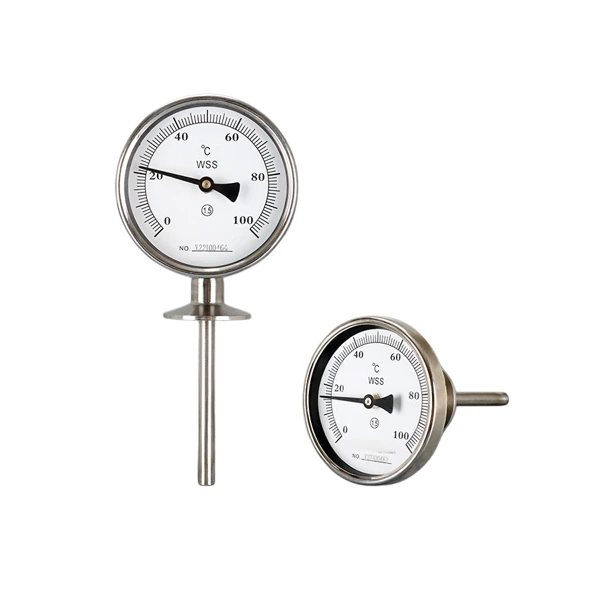
Sanitary Thermometer
A sanitary thermometer reads process temperature on a dial right at the line, with a tri-clamp connection and polished stainless wetted parts built for clean-in-place service. The SI-WSS is a bimetal dial thermometer for food, dairy, beverage, and pharmaceutical lines where a hygienic, crevice-free fitting matters as much as the reading.
- Type: Bimetal dial, no power needed
- Connection: Tri-clamp (sanitary)
- Dial sizes: 60, 100, 150 mm
- Range: 0 to 50 up to 0 to 500 °C
- Wetted parts: 304 / 316 stainless, polished
Overview
A sanitary thermometer is a dial thermometer designed for hygienic processing. It uses the same dependable bimetal movement as an industrial dial thermometer, but the wetted parts are polished stainless steel and the process connection is a tri-clamp fitting that seals without threads or crevices, so the line can be cleaned in place. The SI-WSS gives a clear local reading from 0 to 500 °C with no power and no signal wiring, which makes it the simplest way to confirm temperature on a food, dairy, beverage, or pharmaceutical line.
The instrument is a local indicator. Where the same point also has to feed a control system, pair it with a transmitter or use a sanitary RTD; this page links both at the end.
Features
Crevice-free hygienic fitting that seals without threads, for clean-in-place lines.
304 / 316 wetted parts suited to food, dairy, beverage, and pharma.
Mechanical bimetal movement keeps reading with no battery or wiring.
60, 100, or 150 mm so the reading is clear at the working distance.
Back, bottom, or adjustable angle so the dial faces the operator.
Spans from 0 to 50 °C up to 0 to 500 °C to match the process.
Working principle
Inside the stem is a coiled bimetal strip made of two bonded metals with different rates of thermal expansion. As temperature rises the coil winds or unwinds by a precise amount, and that motion turns the pointer across the dial. The movement is purely mechanical, so the thermometer needs no battery or loop power and keeps reading during a power loss. The tri-clamp version places this same movement behind a polished, hygienic process connection.
Technical specifications
| Parameter | Specification |
|---|---|
| Type | Bimetal dial thermometer, sanitary pattern |
| Dial size | 60, 100, or 150 mm |
| Scale range | 0 to 50, 100, 150, 200, 300, 400, or 500 °C |
| Accuracy class | Class 1.0 or 1.5 (percent of span) |
| Process connection | Tri-clamp (sanitary), sized to the line |
| Wetted material | 304 or 316 stainless steel, polished |
| Insertion length | 75 to 500 mm (75, 100, 150, 200, 250, 300, 400, 500) |
| Connection style | Back, bottom, or adjustable angle |
| Enclosure | Stainless case; ingress rating per model |
Tri-clamp size, exact accuracy class, and any formal hygienic certification are set per order.
Connections and ranges
Pick the connection style by where the dial has to be read, and the range by the working temperature with a little headroom.
| If the dial has to | Choose |
|---|---|
| Face along the pipe axis | Back (axial) connection |
| Face up from the top of the line | Bottom (radial) connection |
| Be aimed at the operator after install | Adjustable-angle connection |
| Range | Typical service |
|---|---|
| 0 to 100 °C | Dairy, chilled and hot water, fermentation, general process |
| 0 to 150 / 0 to 200 °C | Pasteurizing, hot CIP, cook kettles |
| 0 to 300 to 0 to 500 °C | High-temperature sterilizing and process lines |
Models and ordering
To configure a sanitary thermometer, send us five things:
- Working temperature and the scale range you need around it
- Tri-clamp size to match the line fitting
- Dial size: 60, 100, or 150 mm
- Connection style: back, bottom, or adjustable angle
- Insertion length and stem material (304 or 316), plus any hygienic certification required
Ordering example: a sanitary bimetal thermometer, 100 mm dial, 0 to 150 °C range, 1.5 in tri-clamp, 100 mm stem in 316 stainless, adjustable-angle connection, for a dairy pasteurizer line.
Applications
Sanitary thermometers fit hygienic and clean-in-place processes: dairy pasteurizing and storage, brewing and fermentation, beverage and juice lines, food cook and cooling kettles, and pharmaceutical and purified-water systems. Anywhere the process connection has to be crevice-free and washable, the tri-clamp dial thermometer gives a local reading without adding power or signal wiring.
Application example
Challenge. A beverage processor running a chilled 316 stainless juice line needed a clear local temperature reading at the line, on a fitting that could be cleaned in place without trapping product.
Solution. A sanitary bimetal thermometer with a tri-clamp connection and polished 316 wetted parts gave an at-a-glance dial reading and a hygienic, crevice-free seal.
Result. The line gained a simple, washable local indicator for routine checks, with no power or wiring to maintain.
Related products
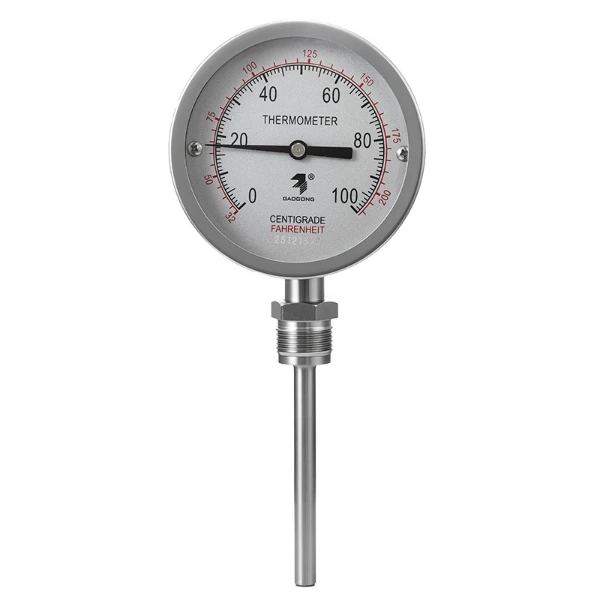 Bimetal Thermometer
Industrial dial thermometer with threaded or flanged stems.
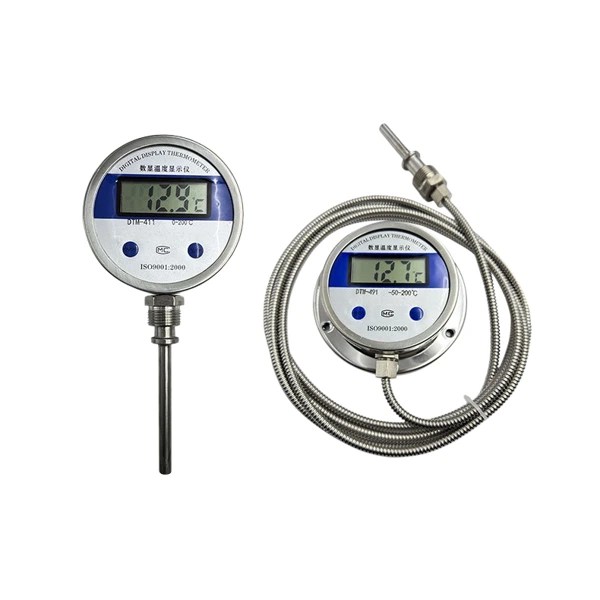 Digital Temperature Gauge
Digital LCD local readout, battery or loop-powered.
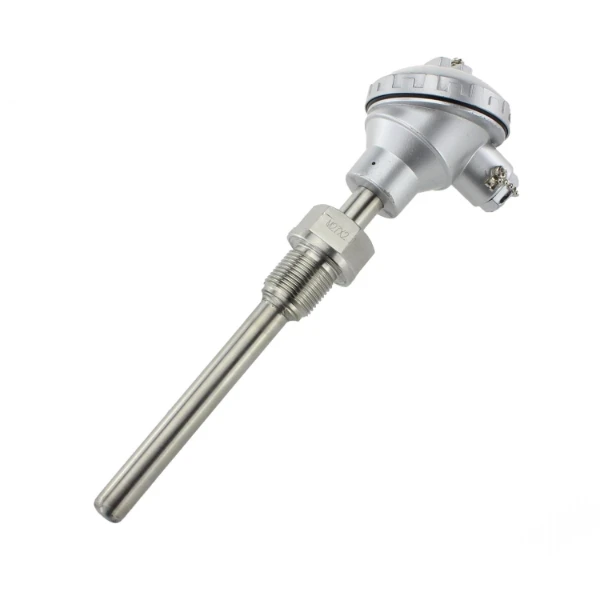 RTD (Pt100) Sensor
Resistance element where the point also feeds a transmitter.
FAQ
What is a sanitary thermometer?
A sanitary thermometer is a dial thermometer built for hygienic processing. It uses a bimetal movement like an industrial dial thermometer, but with polished stainless wetted parts and a tri-clamp connection that seals without threads or crevices, so the line can be cleaned in place.
What connection does a sanitary thermometer use?
A tri-clamp (sanitary clamp) fitting. The thermometer clamps to a matching ferrule on the line with a gasket, giving a crevice-free, quick-release seal that suits clean-in-place and steam-in-place cleaning.
Is a bimetal sanitary thermometer accurate?
The SI-WSS is built to Class 1.0 or 1.5, which is the accuracy as a percent of the dial span. For a tighter reading or a signal to a control system, use a sanitary RTD with a transmitter instead of a dial.
Can a sanitary thermometer be cleaned in place?
Yes. The tri-clamp connection and polished stainless wetted parts are designed for clean-in-place and steam-in-place cleaning, with no threads or dead space to trap product.
Sanitary dial or sanitary digital: which should I choose?
Choose the bimetal dial for the simplest, fully passive local reading. Choose a digital temperature gauge for an exact digital readout and an optional 4-20 mA output.
Request a quote
Send the range, the tri-clamp size, the dial size, the connection style, and the insertion length, and we configure one sanitary thermometer for the line.
About this page: written by Instranova application engineers from real SI-WSS sanitary thermometer data.