Home › Products › Temperature instruments › Digital temperature gauge
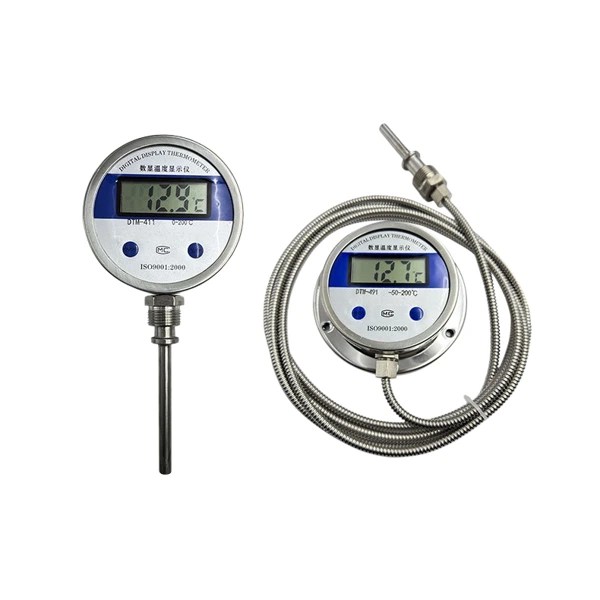
Digital Temperature Gauge
A digital temperature gauge gives a clear local readout at the process point, with no need for a control-room display. The SI-DTM uses a Pt1000 Class A sensor and a 4-digit LCD that reads in both °F and °C. Choose a battery model for stand-alone reading or a loop-powered model that also sends a 4-20 mA signal.
- Sensor: Pt1000 RTD, Class A
- Display: 4-digit LCD, dual °F / °C scale
- Range: -50 to 200 °C, or -200 to 600 °C (model dependent)
- Power: 3.6 V lithium battery (5-year life) or 9-36 VDC loop
- Protection: IP67 / NEMA 4X
Overview
A digital temperature gauge is a self-contained instrument that measures process temperature with an RTD and shows the value on a digital display right at the tapping. It replaces the dial of a bimetal thermometer with an electronic readout, so a value like 100.0 °C is read directly instead of estimated from a needle. The SI-DTM carries a Pt1000 Class A element behind a 4-digit LCD, reads in °F or °C, and is sealed to IP67 / NEMA 4X for outdoor and washdown service.
Two things set these gauges apart from a transmitter: they show the reading locally without a panel, and the battery version needs no wiring at all. That makes them a fast, low-cost way to add a trustworthy temperature reading to a skid, a header, or a storage tank where running power and signal is not worth the cost.
Features
Reads in °F or °C, switchable at the button, with no parallax error.
Stable resistance element for accurate, repeatable readings.
Stand-alone 5-year battery, or 9-36 VDC loop with 4-20 mA.
Sealed for outdoor, washdown, and humid service.
Back, bottom, or adjustable-angle mount so the display always faces the operator.
Threaded stem fits a thermowell for sensor changes without a shutdown.
Working principle
The stem holds a Pt1000 RTD whose resistance rises in a known, near-linear way with temperature. The gauge drives a small current through the element, measures the voltage, and converts resistance to temperature in its microprocessor. The result is linearized, scaled to the unit you select, and written to the LCD. On a loop-powered model the same value is also output as a 4-20 mA current. Because the conversion is digital, the reading does not drift with viewing angle or bezel wear the way a mechanical pointer can.
Battery power or loop-powered output
The single most important choice is how the gauge is powered, because it decides whether you also get a signal for the control system.
| If you need to | Choose |
|---|---|
| A local reading only, with no wiring to pull | Battery model (3.6 V lithium, ~5-year life) |
| A local reading and a 4-20 mA signal to a PLC or DCS | Loop-powered model (9-36 VDC, M12 connector) |
| A reading where no power is available at all | Battery model |
| A signal conditioned for a long cable run and remote display | Pair with a temperature transmitter |
Technical specifications
| Parameter | Specification |
|---|---|
| Sensing element | RTD, Pt1000 Ω, Class A |
| Display | 4-digit LCD, ~13 mm digit height; dual °F / °C scale |
| Measuring range | -50 to 200 °C (-58 to 392 °F) or -200 to 600 °C (-328 to 1112 °F), per model |
| Accuracy | ±(0.42 + 0.002 × |t|) °C; e.g. ±0.62 °C at 100 °C |
| Resolution | 0.1 ° (range dependent) |
| Output | 4-20 mA available (loop model), M12 connector |
| Power | 1 x 3.6 V lithium battery (5-year life, continuous) or 9-36 VDC loop |
| Ambient temperature | 0 to 50 °C (32 to 122 °F) |
| Protection | IP67 / NEMA 4X |
| Stem material | 304 or 316 stainless steel |
| Process connection | Threaded (NPT or G); back, bottom, or adjustable-angle mounting |
Accuracy is the sensor and conversion figure; field accuracy also depends on stem immersion and thermowell fit.
Range models
The gauge ships in two sensor ranges. Pick the one that brackets your working temperature with a little headroom, rather than the widest range, because a tighter range gives a more useful resolution.
| Range | Span | Typical service |
|---|---|---|
| -50 to 200 °C | -58 to 392 °F | HVAC, hot and chilled water, light process, utilities |
| -200 to 600 °C | -328 to 1112 °F | Cryogenic lines, steam, hot oil, furnaces and ovens |
Models and ordering
To configure a gauge, send us five things:
- Working temperature and the range you need around it
- Power: battery (local only) or loop-powered with 4-20 mA
- Process connection (NPT or G thread size) and whether a thermowell is used
- Stem length, set by insertion depth into the pipe or thermowell
- Mounting: back, bottom, or adjustable angle, and the unit (°C or °F) you read in
Ordering example: a battery digital temperature gauge, -50 to 200 °C range, 1/2 in NPT thread, 100 mm stem, adjustable-angle head reading in °C, for a hot-water header with no local power.
Applications
Digital temperature gauges suit any point that needs a clear, reliable local reading: HVAC hot and chilled water, boiler and steam headers, hot-oil systems, water treatment and pump skids, tank farms, food and beverage utilities, and outdoor equipment where a battery model avoids a wiring run. The loop-powered model adds a 4-20 mA signal where the same point also feeds a control system.
Application example
Challenge. A pharmaceutical purified-water utility ran a hot distribution loop near 90 °C where operators needed a dependable temperature reading at the point itself, not only on a far panel.
Solution. A digital temperature gauge with a Pt1000 sensor gave a clear local LCD reading in the operator unit, with a loop-powered option so the same value could also reach the monitoring system.
Result. The point gained a trustworthy at-a-glance reading for routine checks, with the digital display removing the guesswork of reading a dial.
Related products
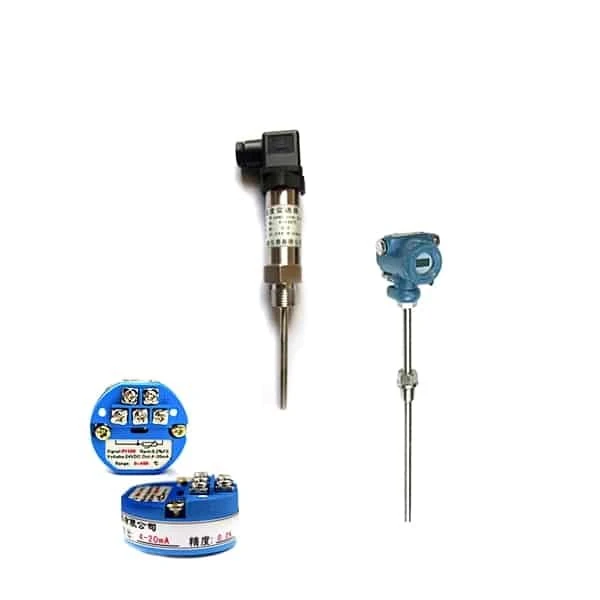 Temperature Transmitter
RTD or thermocouple to 4-20 mA with HART, for remote display.
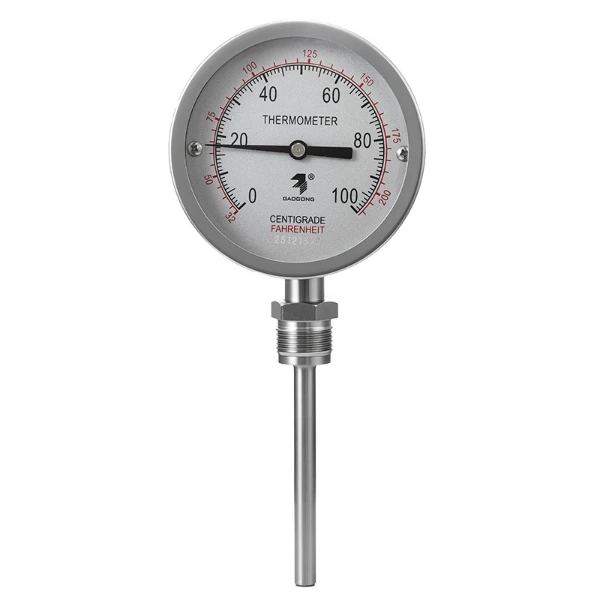 Bimetal Thermometer
Mechanical dial readout, no power needed.
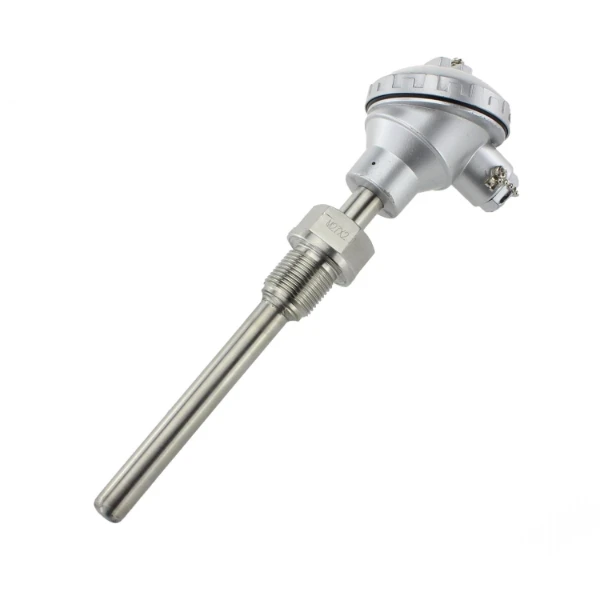 RTD (Pt100) Sensor
Resistance sensing element for transmitters and controllers.
FAQ
How does a digital temperature gauge work?
An RTD in the stem changes resistance with temperature. The gauge measures that resistance, converts it to a temperature in its microprocessor, and shows the value on an LCD. A loop-powered model also outputs the same value as a 4-20 mA signal.
How accurate is a digital temperature gauge?
The SI-DTM uses a Pt1000 Class A element with accuracy of ±(0.42 + 0.002 × |t|) °C, so about ±0.42 °C near 0 °C and ±0.62 °C at 100 °C. In the field, immersion depth and thermowell fit also affect the reading.
Is a digital temperature gauge battery or loop powered?
Both versions exist. The battery model uses a 3.6 V lithium cell with about a 5-year life and needs no wiring. The loop-powered model runs on 9-36 VDC and provides a 4-20 mA output for a control system.
Can a digital temperature gauge output 4-20 mA?
Yes, on the loop-powered model. It shows the reading locally and sends a 4-20 mA signal at the same time, so one device covers both the operator at the point and the panel.
Digital gauge or bimetal dial: which should I choose?
Choose a digital gauge for an exact, easy-to-read value and an optional 4-20 mA output. Choose a bimetal thermometer for the simplest, fully passive local readout where a dial is enough and no power is wanted.
Request a quote
Send the working temperature, the power option (battery or loop-powered), the process connection, and the stem length, and we configure one gauge for the point.
About this page: written by Instranova application engineers from real SI-DTM product data.