Products › Pressure instruments › SI-10 Liquid Pressure Sensor
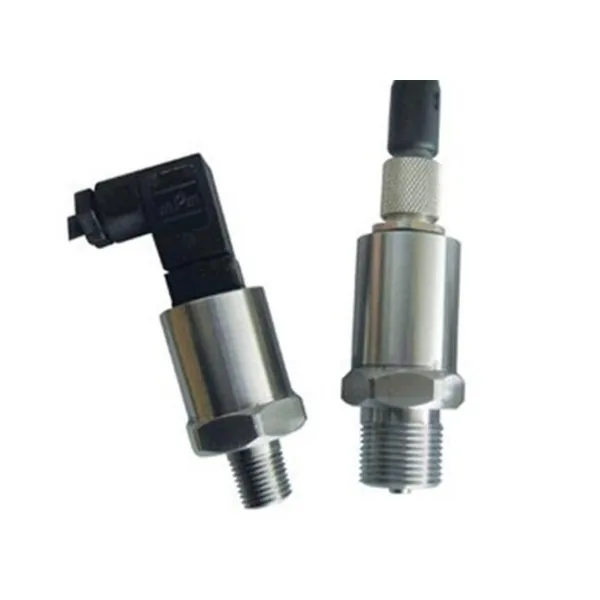
SI-10 Liquid Pressure Sensor
An IP68 piezoresistive liquid pressure sensor for water, oil and other liquids in pipes and tanks. Diffused-silicon cell, sealed cable outlet, and a 4-20 mA, voltage or HART output for pressure or hydrostatic level.
- Ranges: -0.1 MPa vacuum up to 150 MPa
- Accuracy: 0.1%, 0.25% or 0.5% FS
- Output: 4-20 mA, 0-5 / 1-5 / 0-10 V, HART
- Sealing: IP68, waterproof cable outlet
- Wetted parts: 316 stainless steel, diffused silicon
Overview
The SI-10 is a liquid pressure sensor for media that would ruin a dry sensor: water in supply mains and tanks, oil in hydraulic and lubrication lines, and process liquids compatible with 316 stainless steel. The whole body is sealed to IP68 and the cable leaves through a waterproof gland, so the unit can sit in a wet pit, a flooded valve box, or hang inside an open tank without a separate enclosure.
One sensor covers two jobs. Plumbed into a line it reads gauge pressure for pump and system monitoring; lowered into an open tank it reads the hydrostatic head, which converts directly to level once you know the liquid density. For a dedicated submersible level probe with a vented cable, the submersible pressure transducer is the closer fit; the SI-10 is the in-line and tank-top liquid-pressure workhorse.
Working principle
Liquid pressure pushes on a 316 stainless diaphragm. Behind it, a diffused-silicon (piezoresistive) chip carries a Wheatstone bridge whose resistors change with strain, so the bridge output tracks pressure. Diffused silicon is chosen for its long-term stability: the SI-10 holds 0.1% FS per year. The electronics convert the bridge signal to a 4-20 mA, voltage or HART output and compensate it over the working temperature band.
Because the cell is piezoresistive, the SI-10 reads steady and slowly varying pressure well, with a response under 1 ms for normal pump and process work. It is not a dynamic sensor for combustion or shock transients; for those, a piezoelectric or high-natural-frequency MEMS unit is the right tool.
Technical specifications
| Parameter | Specification |
|---|---|
| Measuring range | -0.1 to 0 MPa (vacuum), and 0 to 1 / 5 / 10 / 20 / 30 / 60 / 80 / 150 MPa; other ranges custom |
| Accuracy | 0.1%, 0.25% or 0.5% FS (combined non-linearity, hysteresis, repeatability) |
| Output signal | 4-20 mA (2-wire); 0-5 / 1-5 / 0-10 V (3-wire); HART |
| Supply voltage | 24 VDC nominal (9 to 36 VDC) |
| Medium temperature | -20 to 75 C |
| Ambient temperature | -20 to 65 C |
| Load resistance | Current: max 800 ohm; voltage: greater than 50 k-ohm |
| Insulation resistance | Greater than 2000 M-ohm at 100 VDC |
| Response time | Less than 1 ms |
| Long-term stability | 0.1% FS per year |
| Vibration | 20 to 1000 Hz, output change less than 0.1% FS |
| Sealing | IP68; waterproof sealed cable outlet |
| Process connection | G1/4 or M20 x 1.5; other threads custom |
| Wetted parts | 316 stainless steel diaphragm and body; diffused-silicon cell |
Representative specifications, at room temperature and rated supply unless stated. Values typical; confirm the exact build per datasheet.
Selecting the range
Pick the span by the pressure you actually see, then add margin, not the other way around. A sensor read near the top of its range loses resolution and rides closer to its overload limit. For a water main that runs at 0.4 MPa, the 0 to 1 MPa span keeps the working point near mid-scale. For hydrostatic level, size the span from depth and density: a 10 m column of water is about 0.098 MPa, so a 0 to 0.2 MPa unit (custom low range) covers a full tank with headroom. Below roughly 2.5 kPa the piezoresistive cell runs out of resolution; for inches-of-water air and gas work use the low pressure transducer instead.
Output and wiring
The SI-10 ships as a 2-wire 4-20 mA loop or a 3-wire voltage unit (0-5, 1-5 or 0-10 V), with HART available on the current loop. The 2-wire current loop is the default for long runs and noisy plants because it rejects voltage drop and interference; voltage outputs suit short cabling to a local PLC or display. Keep current-loop load under 800 ohm and voltage-output load above 50 k-ohm.
Models and ordering
Configure the SI-10 by range, output, accuracy class, process thread and cable length. Quote checklist: send these five points and we configure one unit, not a shelf part.
- Pressure range and reference (gauge, or vacuum/compound if it sees negative pressure)
- Output: 4-20 mA, a voltage range, or HART
- Accuracy class: 0.1%, 0.25% or 0.5% FS
- Process connection: G1/4, M20 x 1.5, or your thread
- Cable length and whether the unit hangs in a tank (submersible) or mounts in a line
Ordering example: SI-10, 0 to 1 MPa gauge, 4-20 mA 2-wire, 0.25% FS, G1/4, 5 m IP68 cable for a pump-discharge line.
Applications
- Water supply and booster-pump pressure in mains and tanks
- Hydraulic and lubrication oil pressure on machines and power units
- Open-tank liquid level by hydrostatic head
- Irrigation, water treatment and pump-station monitoring
- OEM equipment needing an IP68 liquid-pressure sensor
Application example
Water utilities and pump stations. A water utility rolling out remote pump-station monitoring needed sensors that could sit in flood-prone valve boxes without separate enclosures. IP68 liquid-pressure sensors on the pump discharge headers fed an IIoT gateway over the 4-20 mA loop, and the sealed cable outlet let the units run in the wet pits without extra housings. The pilot is being extended across the station network.
Related products
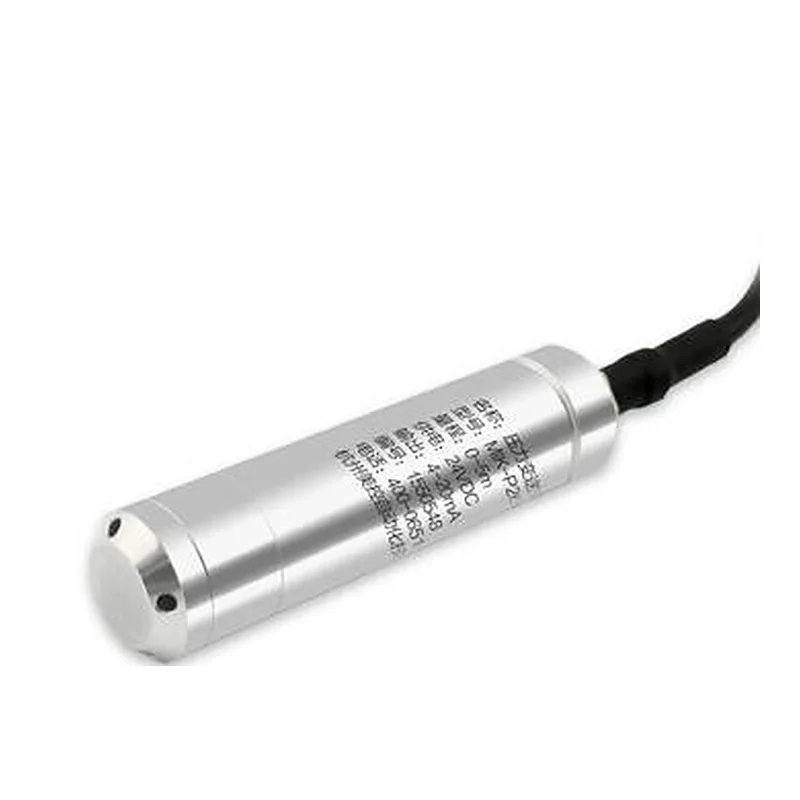 Submersible Pressure Transducers
Probe with vented cable for tank and well level by hydrostatic pressure.
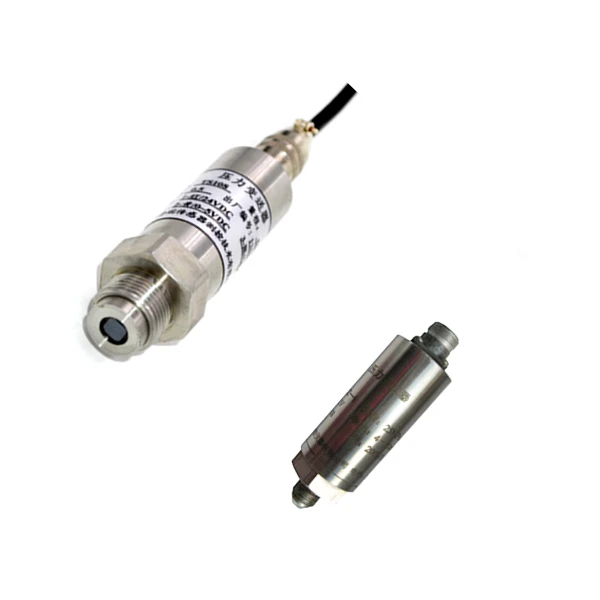 Low Pressure Transducers
kPa-range piezoresistive sensor for clean air and gas.
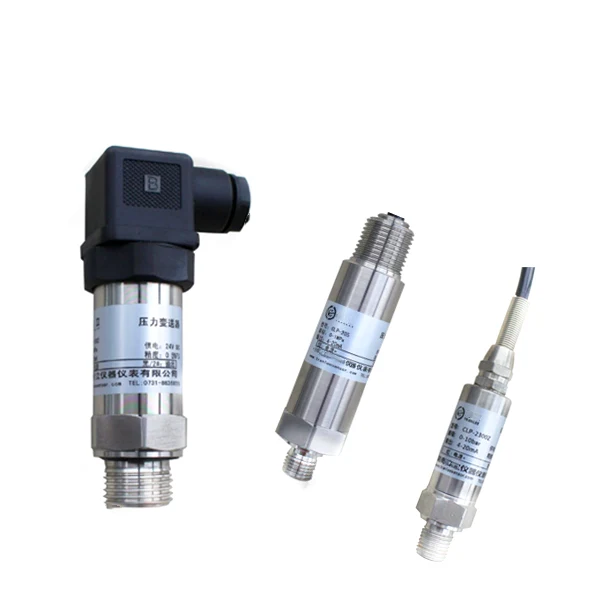 Pressure Transmitters
General-purpose gauge, absolute and differential transmitters.
Browse all pressure instruments →
FAQ
How does a fluid pressure sensor work?
The liquid presses on an isolating diaphragm; a piezoresistive element behind it turns the deflection into a millivolt signal that the electronics scale to 4–20 mA. The SI-10 is sealed for direct contact with water, oil, and other liquids.
How does liquid pressure work?
A liquid exerts pressure from its own weight, the static head (P = ρgh), plus any applied line pressure. A liquid pressure sensor reads that total pressure at its tapping point and reports it as a signal.
What does a pressure sensor do?
It converts pressure into an electrical signal for monitoring or control. The SI-10 turns the liquid pressure into 4–20 mA for a PLC, pump controller, or display.
What are the types of pressure sensors?
By sensing technology: piezoresistive (diffused silicon), ceramic, capacitive, and strain gauge; by reference, gauge, absolute, and differential. The SI-10 is a gauge liquid pressure sensor.
Request a quote
Send the five points in the checklist above and our application engineers will configure an SI-10 for your liquid, range and connection. Reach our application engineers.