Home › Products › Pressure Instruments › Submersible Pressure Transducers
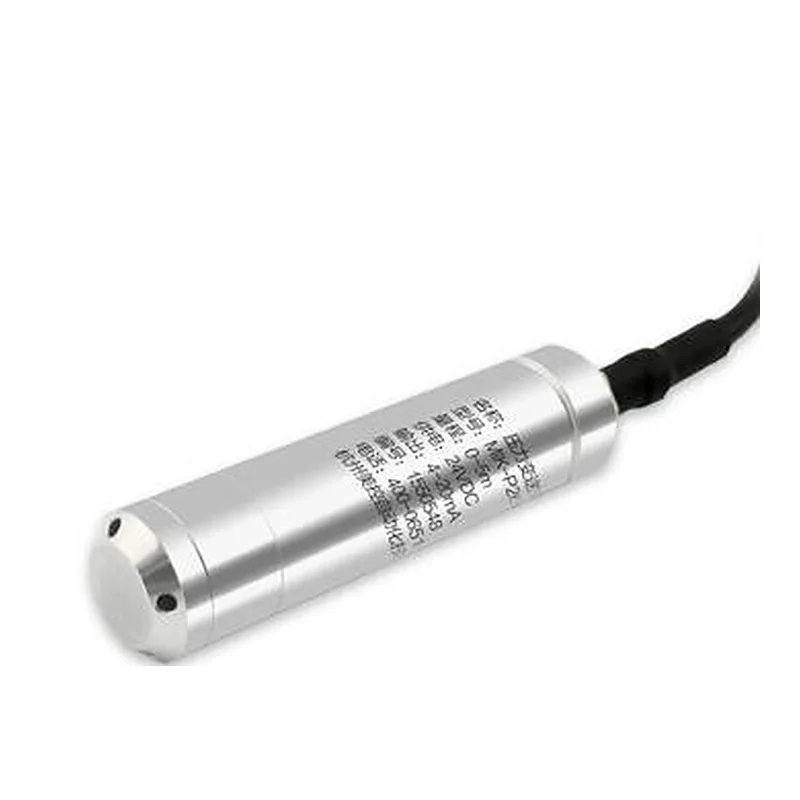
SI-PCM261 Submersible Pressure Transducer
Hydrostatic level sensor that hangs from its own vented cable and reads liquid level as static pressure at the probe. Spans from 0.5 m to 300 m of liquid column, two-wire 4–20 mA, 316 stainless wetted parts. Built per application; sized by the liquid column, not the tank drawing.
- Range: 0–0.5 m to 0–300 m of liquid column
- Accuracy: ±0.5 % FS standard; ±0.2 % / ±1.0 % FS options
- Output: 4–20 mA two-wire; 1–5 V option
- Probe: IP68, 316 stainless diaphragm, vented cable
- Supply: 24 VDC nominal, 15–36 VDC
- Options: Intrinsically safe, lightning protection, PTFE body, display head
Overview
The simplest way to read a tank or a well is to drop a sensor to the bottom and let the liquid do the work. A column of water presses on the probe at 9.807 kPa per meter, so the static pressure at the diaphragm is a direct, linear readout of how much liquid stands above it. The SI-PCM261 packages that idea for real plants: a 316 stainless probe on a vented cable, a two-wire 4–20 mA loop, and nothing in the tank to bracket, weld or stir around.
The cable is the part most people underestimate. A small vent tube runs inside it from the probe up to the junction box, so the back of the sensing cell always sees live atmospheric pressure. That makes the reading true gauge pressure: when the weather moves a few kPa, both sides of the diaphragm move together and the level value stays put. Block that tube, or let moisture condense inside it, and a perfectly healthy sensor starts drifting with the barometer. For closed, pressurized vessels this principle stops working; use a DP level transmitter there instead. The rest of the lineup sits under pressure instruments.
Sizing the span
Size the span to the liquid column, not to the cable you ordered. A chilled-water sump that never holds more than 2 m of water belongs on a 0–2 m span: at ±0.5 % FS that is a fixed error of ±10 mm of level, which is what one of our Singapore HVAC customers runs on exactly this configuration. Put the same application on a 0–10 m span and the same percentage becomes ±50 mm for no benefit. Density matters too: the probe reads pressure, so a liquid lighter or heavier than water reads proportionally low or high, and hot media change density enough to show. State the medium and its temperature in the inquiry and the span is corrected at the factory.
Technical specifications
| Parameter | Specification |
|---|---|
| Measuring range | 0–0.5 m up to 0–300 m of liquid column; deep-well variant to 1000 m |
| Accuracy | ±0.5 % FS standard; ±0.2 % FS and ±1.0 % FS options |
| Long-term stability | Less than 0.2 % FS per year |
| Temperature drift | Less than 0.5 % FS over −10 to 50 °C; less than 1.0 % FS over −20 to 85 °C |
| Output | 4–20 mA two-wire; 1–5 V option |
| Power supply | 24 VDC nominal, 15–36 VDC |
| Overload | 200 % of span |
| Compensated range | 0 to 50 °C; operating 0 to 70 °C; storage −40 to 100 °C |
| Wetted parts | 316 stainless diaphragm; stainless probe housing; PTFE body option for corrosive liquids |
| Cable | Vented, polyethylene or polyamide sheath, length to match the application (up to 300 m) |
| Sealing | Probe IP68; cast-aluminum junction box IP65 |
| Insulation | More than 100 MOhm at 500 VDC |
| EMC / RF immunity | 30 V/m, 10 kHz to 500 MHz |
| Shock / vibration | 100 g, 10 ms shock; 10 g, 10–2000 Hz vibration |
| Hazardous area | Intrinsically safe versions per nameplate; lightning-protection version for outdoor sites |
Probe styles
One electronics package, three noses. The slim probe drops down boreholes and stilling pipes. The caged probe takes the knocks in open sumps and rivers, where debris and the occasional pump intake current are part of the service. The flush-tip probe keeps the diaphragm clear of sludge and slurry so paper stock, lime slurry and sewage do not pack the pressure port.
Vented cable
The vent tube is the reference leg of the whole measurement. Atmospheric pressure at sea level wanders across roughly 98 to 105 kPa with the weather; on a 5 m span that swing is worth most of a meter of false level if the cell cannot see it. The tube lets the sensor subtract it in hardware. The price is a maintenance rule: the tube must stay open and dry. The junction box carries a dry-air moisture barrier so humid air does not condense inside the cable, and the cable must never be cut short, kinked below a 10 cm bend radius, or sealed into an airtight gland that blocks the vent. If the cable is damaged, replace it as an assembly; a splice that loses the vent turns a gauge sensor into a barometer.
Installation
- Hang the probe vertically, away from fill inlets, drains and agitators; a jet of moving liquid reads as extra pressure.
- In agitated or flowing liquid, fix a DN40–DN50 steel stilling pipe in the tank, drill small holes at several heights on the side away from the flow, and run the probe inside it.
- Keep the probe a hand above the tank or sump floor, clear of the sludge and oil residue that settle there and pack the port.
- Where the medium surges or the cable run is long, sleeve the probe so it cannot swing; a swinging probe writes its own level noise.
- Ground the screen and the junction-box terminal properly; for outdoor water plants with frequent storms, order the lightning-protection version.
Applications
Water and utility service. Water tanks, reservoirs, rivers, deep wells and groundwater monitoring, sewage treatment and overfill or dry-run protection on pump sets. A Singapore building-services contractor runs the 2 m span, 4–20 mA, 24 VDC configuration on chilled-water sumps; a United States agricultural customer specified the deep-well variant with digital displays and level-triggered relays for irrigation wells. For wells beyond the standard 300 m, the deep-well version reaches 1000 m.
Corrosive and special media. With the PTFE body and cable the same hydrostatic principle survives liquids that destroy stainless probes. A United States flow-battery company put the PTFE version into 2.6 m of corrosive electrolyte at 70 °C, where chemical compatibility decided the order before accuracy ever came up. Pick the wetted material from the medium first, then the span; the general-purpose transmitter page covers the same rule for line pressure. Tell us the application and we configure one unit, not a shelf part.
Related products
Browse all pressure instruments →
The IP68 marking on the probe is a manufacturer-declared immersion rating; our IP ratings guide explains the digits and the tests behind them.
FAQ
What is a submersible pressure transducer?
It is a sealed pressure sensor made to be lowered into a liquid, where it measures the hydrostatic pressure of the column above it and outputs 4–20 mA proportional to depth or level. The SI-PCM261 has an IP68 probe and a vented cable for an atmospheric reference.
What does a pressure transducer do?
It converts pressure into an electrical signal. A submersible transducer like the SI-PCM261 turns the head pressure of the liquid into a 4–20 mA current that a control system reads as level or depth.
What is a pressure transducer for water pressure?
A pressure transducer used to measure water pressure or depth. Submerged in the water, it reads the hydrostatic head and reports it as 4–20 mA, which suits wells, tanks, rivers, and reservoirs.
What are the three types of pressure transducers?
By reference: gauge (versus atmosphere), absolute (versus vacuum), and differential (between two points). A submersible level transducer is usually the gauge type with a vented cable.