By Wu Peng, Senior Process Instrumentation Engineer · Last reviewed October 9, 2026
One bar equals 14.5038 psi. To convert bar to psi, multiply by 14.5038; to convert psi to bar, multiply by 0.0689476 (or divide by 14.5038). The charts below run from 0.1 bar to 1,000 bar, cover the standard metric gauge ranges in psi, and show where gauge and absolute readings part ways.
Many of the bar to psi charts that rank in search were built for tire pressure and stop around 7 bar. Process lines, test benches and hydraulic circuits run far higher, and when we spot-checked the popular ones, four contained wrong values. Every value here is computed from the exact definitions, so it can go straight onto a datasheet or a dual-scale dial order.
Contents
- Bar to psi formula
- Low range chart
- High range chart
- Psi to bar chart
- Standard gauge ranges
- Gauge and absolute
- Rounding and shortcuts
- FAQ
Bar to psi formula
Both units have exact definitions. A bar is 100,000 Pa. A psi is one pound-force on one square inch, which works out to 6,894.757 Pa. Dividing one by the other gives the factor.
psi = bar × 14.5038 and bar = psi × 0.0689476
16 bar × 14.5038 = 232.06 psi; 160 bar × 14.5038 = 2,320.6 psi
The same factor applies to every pressure reference. Bar gauge converts to psi gauge, bar absolute to psi absolute, and a bar differential to a psi differential. What it cannot do is cross from one reference to another; that step needs the atmosphere, covered further down. For a converter that also handles kPa, MPa, kg/cm² and water column units, use our pressure unit converter.
Low range chart
From 0.1 to 10 bar: low pressure air, water and utility lines.
| bar | psi | bar | psi |
|---|---|---|---|
| 0.1 | 1.45 | 2 | 29.01 |
| 0.2 | 2.90 | 2.5 | 36.26 |
| 0.3 | 4.35 | 3 | 43.51 |
| 0.4 | 5.80 | 3.5 | 50.76 |
| 0.5 | 7.25 | 4 | 58.02 |
| 0.6 | 8.70 | 4.5 | 65.27 |
| 0.7 | 10.15 | 5 | 72.52 |
| 0.8 | 11.60 | 6 | 87.02 |
| 0.9 | 13.05 | 7 | 101.5 |
| 1 | 14.50 | 8 | 116.0 |
| 1.2 | 17.40 | 9 | 130.5 |
| 1.5 | 21.76 | 10 | 145.0 |
psi values rounded to 0.01 psi below 100 psi and 0.1 psi above.
High range chart
From 12 to 1,000 bar: process transmitters, steam, high pressure pumps and hydraulic circuits. The 700 bar row needs a note: hydraulic jacks and pumps rated at 700 bar are usually sold as 10,000 psi equipment, but the exact conversion is 10,153 psi. The two numbers are nominal partners, not equals.
| bar | psi | bar | psi |
|---|---|---|---|
| 12 | 174.0 | 100 | 1,450.4 |
| 15 | 217.6 | 120 | 1,740.5 |
| 16 | 232.1 | 150 | 2,175.6 |
| 20 | 290.1 | 160 | 2,320.6 |
| 25 | 362.6 | 200 | 2,900.8 |
| 30 | 435.1 | 250 | 3,625.9 |
| 35 | 507.6 | 300 | 4,351.1 |
| 40 | 580.2 | 350 | 5,076.3 |
| 50 | 725.2 | 400 | 5,801.5 |
| 60 | 870.2 | 500 | 7,251.9 |
| 70 | 1,015.3 | 600 | 8,702.3 |
| 80 | 1,160.3 | 700 | 10,152.6 |
| 90 | 1,305.3 | 1,000 | 14,503.8 |
psi values rounded to 0.1 psi.
Psi to bar chart
The reverse direction, for a US datasheet or a psi gauge reading that has to go onto a metric drawing.
| psi | bar | psi | bar |
|---|---|---|---|
| 1 | 0.0689 | 150 | 10.34 |
| 5 | 0.3447 | 200 | 13.79 |
| 10 | 0.6895 | 250 | 17.24 |
| 14.7 | 1.014 | 300 | 20.68 |
| 15 | 1.034 | 400 | 27.58 |
| 20 | 1.379 | 500 | 34.47 |
| 25 | 1.724 | 600 | 41.37 |
| 30 | 2.068 | 750 | 51.71 |
| 40 | 2.758 | 1,000 | 68.95 |
| 50 | 3.447 | 1,500 | 103.42 |
| 60 | 4.137 | 2,000 | 137.90 |
| 75 | 5.171 | 3,000 | 206.84 |
| 80 | 5.516 | 5,000 | 344.74 |
| 100 | 6.895 | 6,000 | 413.69 |
| 125 | 8.618 | 10,000 | 689.48 |
bar values rounded to 4 decimals below 1 bar, 3 decimals below 10 bar, and 2 decimals above.
Standard gauge ranges
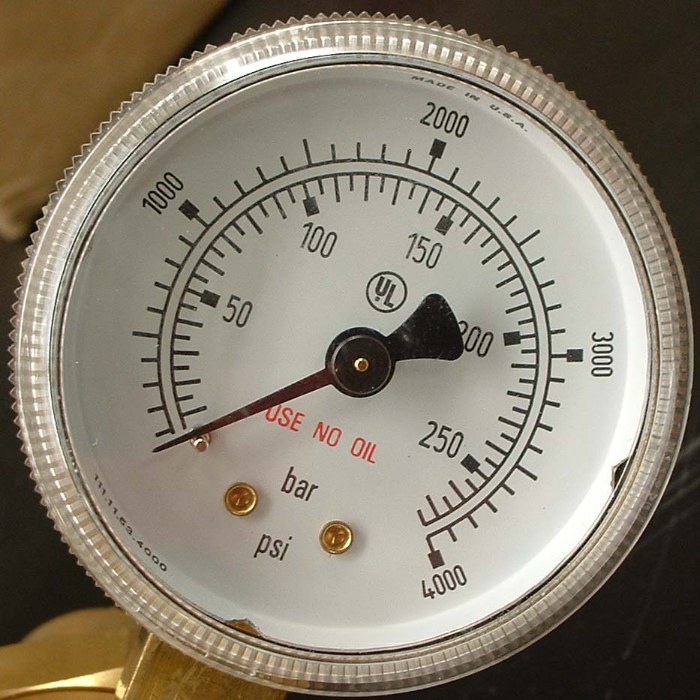
Metric dial gauges come in a fixed series of ranges under EN 837-1: 0.6, 1, 1.6, 2.5, 4, 6 and 10, repeated by decades up to 1,600 bar. A buyer who works in psi needs to know what each range covers.
The third column shows three quarters of full scale. That is the steady working limit WIKA gives for its 63 mm 23x.50 gauges, which drop to two thirds for fluctuating pressure; its larger 23x.30 series is rated to full scale for steady pressure. Check the rating on the datasheet of the gauge you buy.
| Range (bar) | Full scale (psi) | 3/4 of full scale (psi) |
|---|---|---|
| 0 to 0.6 | 8.7 | 6.5 |
| 0 to 1 | 14.5 | 10.9 |
| 0 to 1.6 | 23.2 | 17.4 |
| 0 to 2.5 | 36.3 | 27.2 |
| 0 to 4 | 58.0 | 43.5 |
| 0 to 6 | 87.0 | 65.3 |
| 0 to 10 | 145 | 109 |
| 0 to 16 | 232 | 174 |
| 0 to 25 | 363 | 272 |
| 0 to 40 | 580 | 435 |
| 0 to 60 | 870 | 653 |
| 0 to 100 | 1,450 | 1,088 |
| 0 to 160 | 2,321 | 1,740 |
| 0 to 250 | 3,626 | 2,719 |
| 0 to 400 | 5,802 | 4,351 |
| 0 to 600 | 8,702 | 6,527 |
| 0 to 1,000 | 14,504 | 10,878 |
| 0 to 1,600 | 23,206 | 17,405 |
Ranges per EN 837-1 as listed in WIKA data sheet IN 00.02. psi values rounded to 0.1 psi below 100 psi, whole psi above.
Vacuum and compound ranges follow the same pattern. A −1 bar end point is −14.5 psi, slightly less than a full vacuum at sea level (−14.7 psig), so it is a printed rounding, not the true bottom of the scale. Reading a compound dial is covered in our vacuum pressure gauge guide.
| Range (bar) | Range (psi) |
|---|---|
| −0.6 to 0 | −8.7 to 0 |
| −1 to 0 | −14.5 to 0 |
| −1 to +0.6 | −14.5 to +8.7 |
| −1 to +1.5 | −14.5 to +21.8 |
| −1 to +3 | −14.5 to +43.5 |
| −1 to +5 | −14.5 to +72.5 |
| −1 to +9 | −14.5 to +130.5 |
| −1 to +15 | −14.5 to +217.6 |
| −1 to +24 | −14.5 to +348.1 |
Gauge and absolute
A conversion only stays correct if the reference stays the same. Barg and psig read from atmospheric pressure; bara and psia read from a perfect vacuum. Standard atmosphere is 1.01325 bar, or 14.696 psi, and that offset is what separates the two.
The trap is converting a gauge value into an absolute one in the same step. 10 barg is 145.0 psig, which is 159.7 psia. 10 bara is 145.0 psia, which is only 130.3 psig. Mixing the two puts an error of 14.7 psi on the result, more than 10% at this pressure.
Convert the unit first, then add or subtract the atmosphere. The background is in our guides to psi, psia and psig and absolute vs gauge pressure, and the absolute and gauge pressure calculator applies the local atmosphere for you.
Application example
Electronics manufacturing, low temperature pressure sensors. An order for six cryogenic pressure sensors specified the range as 0–100 BG with 150 bar overpressure, a 4–20 mA output and a local display. BG stands for bar gauge, so in psi the instruments read 0 to 1,450 psig and had to withstand 2,176 psig. The order went into production with calibration and a certificate of conformity.
Rounding and shortcuts
Check for three shortcuts before a converted value goes onto a datasheet.
- Multiplying by 14.5. The error is 0.026%, or 3.8 psi at 1,000 bar. That is finer than a dial gauge can resolve, so it is fine for reading one. On a calibration certificate, use the full factor.
- Multiplying by 14.7. 14.7 is psi per atmosphere, not per bar. It overstates every result by 1.35%, so 250 bar comes out as 3,675 psi instead of 3,626.
- Reading kg/cm² as bar. 1 kg/cm² is 0.980665 bar, or 14.22 psi. Treating an older kg/cm² dial as bar overstates the pressure by about 2%.
For low ranges, convert through mbar: 1 mbar is 0.0145 psi, or about 0.40 inches of water column (the exact figure depends on the water temperature the unit is defined at). Round the converted value to the smallest graduation of the instrument you are reading; more digits than the dial can show add nothing. How to read the dial itself is in our guide on how to read a pressure gauge.
When a pressure has to become a force on a piston, the psi to lbs calculator takes over from here. For instruments that read in either unit, see our pressure gauges and pressure transmitters, both available with bar or psi ranges.
FAQ
What is 1 BAR in PSI?
One bar is 14.5038 psi. The exact factor is 14.503773773, because a bar is defined as 100,000 Pa and a psi as 6,894.757 Pa. For reading a dial, 14.50 is enough.
What is 100 PSI in BAR pressure?
100 psi is 6.895 bar. Divide psi by 14.5038, or multiply by 0.0689476. If the 100 psi is a gauge reading, the result is 6.895 barg.
What does 2.5 BAR equal to in PSI?
2.5 bar equals 36.26 psi. On a dual-scale 0 to 2.5 bar gauge, the bar full scale mark lines up with 36.26 on the psi arc.
Is 2.4 BAR equivalent to 35 PSI?
Close but not exact. 2.4 bar is 34.81 psi and 35 psi is 2.413 bar, so the two differ by about 0.2 psi, or 0.5%.
Request a quote
Send us the range in the unit your drawings use, say whether it is gauge or absolute, and we will quote the gauge or transmitter with the scale your operators read. Reach our application engineers or use the form below.
Written and technically reviewed by Wu Peng and the Instranova engineering team.