By Wu Peng, Senior Process Instrumentation Engineer · Last reviewed September 21, 2026
A grounded thermocouple has its measuring junction welded into the closed tip of its metal sheath. An ungrounded thermocouple carries the junction inside the same tip, held off the metal by compacted magnesium oxide. The welded build follows a temperature step in roughly half the time; the insulated build keeps the millivolt circuit electrically separate from the sheath and from everything the sheath touches.
That one weld decides how the probe behaves on a shared input card, what a technician can verify with a megohmmeter, and how much speed a given sheath diameter can deliver. Published comparisons mostly trade adjectives on the grounded or ungrounded thermocouple question. This guide puts numbers on it: plunge-test seconds by sheath size, the arithmetic of a ground loop, and the insulation figures an ungrounded build has to meet.
Contents
- What the terms mean
- Speed in numbers
- Ground loops explained
- Matching the instrument input
- Insulation resistance
- Exposed junction limits
- Drift and corrosion
- Testing the junction
- Choosing and specifying
- FAQ
What the terms mean
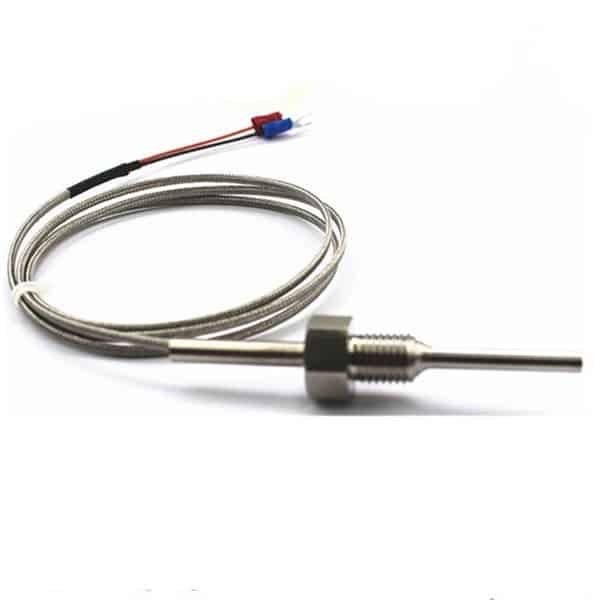
The grounded vs ungrounded thermocouple choice is really a three-way choice, because sheathed, mineral-insulated probes are built in three junction styles. Grounded means the thermocouple wires are welded into the closed end of the sheath, so wires, weld and tip form one piece of metal. Ungrounded means the junction is a separate welded bead, held away from the tip by compacted MgO powder. Exposed means the bead protrudes from an open sheath end straight into the medium.
The word grounded describes that internal weld, not an earthing conductor. A grounded-junction probe sits at whatever electrical potential its mounting point carries; an ungrounded-junction probe stays isolated even when screwed into bonded plant steel. Keeping those two senses of the word apart avoids the confusion that runs through forum threads on this subject.
For the parts of a thermocouple and how the junction produces its signal, start with our guide on what a thermocouple is. This page assumes the basics and goes straight to the junction decision.
Duplex probes add one wrinkle: two elements can share a single sheath. Order them isolated from the sheath and from each other, so a control loop and a recorder never couple through a common junction.
Speed in numbers
Response time is specified as a time constant: how long the output takes to cover 63.2 percent of a step change. Five time constants bring the reading within about 0.7 percent of the final value. A standard test plunges a probe from room air into boiling water, and the published tables from that test are worth more than any adjective.
| Sheath diameter | Ungrounded, s | Grounded, about half, s |
|---|---|---|
| 1.0 mm | 0.15 | 0.08 |
| 1.5 mm | 0.3 | 0.15 |
| 2.0 mm | 0.4 | 0.2 |
| 3.0 mm | 0.8 | 0.4 |
| 4.5 mm | 1.4 | 0.7 |
| 6.0 mm | 3.0 | 1.5 |
| 8.0 mm | 5.5 | 2.8 |
Published plunge-test figures for mineral-insulated assemblies: room air into boiling water, time to 63.2 percent. The grounded column applies the same catalog rule that a grounded junction responds in about half the insulated-junction time. Values typical; still air multiplies every figure many times over.
How much faster is grounded, exactly? Catalogs disagree. One large US catalog estimates an ungrounded response by multiplying its bare-junction curves by 1.5; the catalog rule used in the plunge table above puts the factor at about 2. Treat the difference as a band rather than a constant, and read the datasheet of the specific probe when loop timing is critical.
The table also hides the most useful decision rule on this page: dropping one sheath size buys back more speed than the junction weld gives up. A 1.5 mm ungrounded assembly reaches 63.2 percent in 0.3 s, ahead of a 3.0 mm grounded one at 0.4 s. When a loop needs both speed and isolation, shrink the sheath instead of grounding the junction.
An exposed bead sets the physics ceiling. A butt-welded junction in 0.001 in wire carries a published time constant of 0.003 s in fast-moving room air, and nothing sheathed comes close. What that speed costs is covered further down.
Ground loops explained
A ground loop needs two ground connections at different potentials. A grounded junction supplies one of them: the weld places the measuring circuit on the sheath, and the sheath lands on the pipe or thermowell it is mounted in. The instrument end, referenced to panel ground, supplies the other. A control panel and remote plant steel can sit a volt apart, and that difference drives current around the loop.
One volt matters because the signal is small. A Type K couple at 500 °C delivers 20.64 mV in total, an average of about 41 µV per degree. An interference offset of just 1 mV therefore reads as roughly 24 degrees. The offset is not steady, either: it steps when a welder strikes an arc nearby, shifts when large drives start, and differs between two instruments reading the same probe.
The wiring rule is one ground per measuring circuit, never two. A grounded junction has already spent that one ground at the tip, so everything downstream of it must float or be galvanically isolated. An ungrounded junction removes the loop at its source and leaves the grounding scheme free.
Matching the instrument input
Whether a grounded junction is safe depends on what it wires into. Isolated inputs, including head-mounted temperature transmitters, break the loop galvanically and accept either junction style. Non-isolated and multiplexed input cards share a reference across channels, and some module manuals rate them for only about 5 V of common-mode voltage. One grounded probe on such a card can disturb its own channel and its neighbors at the same time.
| Input the probe lands on | Grounded junction | Ungrounded junction |
|---|---|---|
| Isolated transmitter or per-channel isolated card | Works | Works |
| Non-isolated PLC or panel input | Avoid; loop risk | Preferred |
| Multiplexed card, shared reference | Avoid; cross-channel upset | Preferred |
When the input side is unknown at order time, ungrounded is the build that cannot create the problem. That is the reasoning behind treating it as the default choice for probes headed to shared or unfamiliar instrumentation.
Insulation resistance
An ungrounded build carries a specification a grounded one cannot have: insulation resistance between the legs and the sheath. One published catalog figure for finished ungrounded probes is 100 megohm minimum at 100 VDC at room temperature. Minimum values for mineral-insulated assemblies are set by size class in ASTM E608/E608M, ASTM E780 describes the measurement method, and IEC 61515 covers the equivalent MI cable requirements.
The specification matters in service. Compacted MgO absorbs moisture readily; a cracked seal pulls the leg-to-sheath resistance down long before the couple fails outright, and the shunted reading drifts with no alarm. On an ungrounded probe, a megohmmeter at the terminal head catches the loss in seconds. A grounded probe reads short to the sheath by construction, so the same check tells you nothing, and insulation trouble stays invisible until the reading wanders.
Exposed junction limits
The exposed bead is electrically ungrounded, and that is where its advantages end. Catalogs restrict it to clean, dry, non-corrosive gas at low pressure; the bare wires foul in anything condensing, corrode in anything aggressive, and bend at a touch. It is a lab, burner-profiling and air-survey construction, not a process one.
Isolation is also not the same thing as noise immunity. The bare bead and its open leads pick up radiated interference that a sheathed ungrounded junction is shielded from. Being ungrounded only means the noise does not arrive through plant steel; nothing shields the wire itself.
Drift and corrosion
Corrosion arguments on this subject mostly belong to the sheath. Both grounded and ungrounded builds present the same metal surface to the process, so medium compatibility is a sheath-material decision, not a junction one. Published pages contradict each other here because some of them blur grounded with exposed.
Two junction-specific effects are real. The grounded weld fuses thermocouple alloy with sheath metal, and thermal cycling works that dissimilar joint, so the EMF at the tip can shift slowly over years of service. And if a sheath ever perforates, the MgO barrier in an ungrounded build slows chemical attack on the legs, while a grounded tip has no buffer at the weld.
None of this changes the tolerance class. Class 1 or Class 2 limits come from the wire itself, as covered in our thermocouple types guide, and a grounded junction meets them as delivered. What the junction style changes is stability: how much noise rides on the reading, and how the EMF ages.
Testing the junction
One continuity check answers which build is on the bench. Set a multimeter to continuity or ohms, put one probe on either thermocouple leg and the other on the sheath. A reading near zero ohms is a grounded junction; an open circuit, shown as OL on most meters, is ungrounded.
Read the display with care: zero means grounded, and OL means ungrounded, not the other way around. The same leg-to-sheath measurement taken with a megohmmeter becomes the insulation check described above. For the rest of the bench sequence, expected loop resistance by wire gauge and millivolt values against reference points, see our guide on how to test a thermocouple.
Choosing and specifying
| Service | Junction to specify |
|---|---|
| Shared, multiplexed or unknown instrument inputs | Ungrounded |
| Fast control loop on an isolated input | Grounded, or ungrounded one sheath size down |
| Electrically heated equipment, welding areas, electrolysis | Ungrounded, on an isolated input |
| Clean dry gas where milliseconds matter | Exposed fine-wire |
| Duplex element for control plus recording | Ungrounded, elements isolated from each other |
On the RFQ, one line settles it: junction style, grounded, ungrounded or exposed. Add sheath diameter and material, thermocouple type and class, process connection, and the instrument the probe will wire into. If the junction line is missing we will ask, because the input side decides the safe answer.
Application note
What inquiries specify. Across the 330 inquiries in our log, junction construction appears exactly once: a Type T request that named a beaded measuring junction. No RFQ has arrived with grounded or ungrounded already decided. The choice surfaces when we ask what the probe wires into, which is the practical moment to settle it, because the input card, not the process, sets the safe answer.
FAQ
What is the difference between grounded and ungrounded thermocouples?
In a grounded thermocouple the measuring junction is welded into the closed tip of the sheath, so it responds faster but connects the signal to the sheath and its mounting. In an ungrounded thermocouple the junction is held off the tip by compacted MgO, which is slower but electrically isolated.
Does a thermocouple need to be grounded?
No. Grounding the junction is a construction option, not a requirement. It helps when the loop needs the fastest response and the instrument input is galvanically isolated. On shared or non-isolated inputs, an ungrounded junction prevents ground loops and is the safer choice.
How do you tell if a thermocouple is grounded or ungrounded?
Set a multimeter to continuity and measure between either thermocouple leg and the metal sheath. A reading near zero ohms means the junction is grounded. An open circuit, shown as OL on most meters, means it is ungrounded. Exposed junctions also read open, since the bead never touches the sheath.
Does polarity matter on a thermocouple?
Yes. Each leg is a different alloy, and swapping them reverses the signal, so the reading moves the wrong way as the process warms. Check polarity wherever the wiring changes over, at the head and at extension cable, and verify the leg colors against the color code for your standard.
Request a quote
Instranova supplies sheathed thermocouple assemblies in grounded, ungrounded and exposed constructions, with duplex elements, matched heads and transmitters where the input side calls for isolation. Tell us the application and we configure one unit, not a shelf part. Reach our application engineers or use the form below.
Written and technically reviewed by Wu Peng and the Instranova engineering team.