By Wu Peng, Senior Process Instrumentation Engineer · Last reviewed September 14, 2026
If you are asking how to verify a Chinese supplier of flow meters, transmitters or level sensors, the answer has three layers. Verify the company on the government registry, verify every certificate against the body that issued it, and verify the instrument itself on a test bench before it ships. The generic sourcing guides stop at the first layer. Instruments fail buyers at the second and third.
We are one of the suppliers you would be checking: a manufacturer in Sichuan with its own factory, its own test benches and more than twenty years in the trade. This guide is written from that side of the table.
It tells you which documents to ask for and where each one can be checked without trusting the seller. It also covers which checks a small instrument order needs instead of the consumer goods routine. Use it on us as well as on anyone else.
Contents
- Three layers to verify
- Manufacturer or trader
- Reading the license
- Certificates you can check
- Calibration paperwork
- Hazardous area approvals
- Factory acceptance testing
- Shipping and customs
- Payment and contract
- What we provide
- FAQ
Three layers to verify
The generic sourcing guides are right about the first layer. A Chinese company has a business license with an 18 character unified social credit code, and the code can be checked on the government registry. Match the legal name on the license to the contract, the invoice and the bank account, and most outright frauds fall away.
The second layer is where instrument buyers get hurt. A transmitter arrives with an explosion protection certificate, a calibration certificate and a CE mark, and none of the three were checked against anyone but the seller. Each of those documents has a different issuer and a different way of being verified, and at least one of them cannot be verified centrally at all.
The third layer is the instrument. A flow meter is not a batch of garments; a sample of ten out of two hundred means nothing when the order is six units. The right check is a documented test of every unit at the factory, and a repeat of the critical points on site.
Manufacturer or trader
The first question is whether the company you are talking to makes the instrument. A search for a China flow meter supplier returns dozens of sites that all say manufacturer. Some of the websites that call themselves manufacturers are trading companies that buy from two or three factories and relabel.
That is not fraud, and a good trader adds real value on small mixed orders. It does change who calibrated the meter, who holds the certificates, and who answers when it fails.
Three checks separate the two. The business scope on the license should include manufacturing, not only sales or import and export. The calibration report should name the facility and the reference standards, and the facility should be the seller’s own.
Ask for a short video of your instrument on their test bench with the order number visible. A factory can do this in an afternoon; a trader has to ask someone else.
Reading the license
Every registered company in China holds one business license. The item to copy from it is the unified social credit code: 18 characters, digits and capital letters, unique to the company and unchanged for its life. The first character identifies the registering authority and the second the entity type. The next six give the administrative region, the next nine the organization, and the last is a check character that can be a letter.
Search that code on the National Enterprise Credit Information Publicity System at gsxt.gov.cn. The record shows the legal name in Chinese, the legal representative, the registered address, the date of establishment, the business scope, and any abnormal operation or enforcement entries. English company names are not registered anywhere in China. The name a supplier uses in emails is self-chosen and may be a translation, so the Chinese name on the license is the only one that counts.
Then match. The Chinese name on the license must appear on the contract, on the proforma invoice and as the beneficiary of the bank account. A request to pay a personal account, or a company in Hong Kong with a different name, is the point at which to stop. Commercial databases such as Qichacha and Tianyancha add litigation records and shareholder history on top of the free registry, and cost little for a single check.
Certificates you can check
Certificates are where the generic guides run out. They tell you to ask for certifications and to check them, and never say where. The table below says where, for the documents that arrive with process instruments.
| Document | Issued by | How to verify it |
|---|---|---|
| IECEx certificate | An IECEx certification body | Public database at iecex-certs.com. Search the number, in the form IECEx XXX 18.0001, and read the status. A certificate that is not in the database does not exist. |
| ATEX EU type examination certificate | An EU notified body | No central database. Confirm the body exists on the EU NANDO list, then ask that body to confirm the certificate number. The four digit body number must also appear after the CE mark on the nameplate. |
| CE marking | The manufacturer, by declaration | Nothing to look up. Ask for the EU declaration of conformity naming the directives and standards, and for the test reports behind it. A “CE certificate” from a private lab is a test report, not an approval. |
| Chinese explosion protection certificate | NEPSI or another Chinese Ex body | Number in the form GYJ12.1429X, valid five years. It covers use inside China and is not an ATEX or IECEx approval. Ask for the PDF and check the model on it against the nameplate. |
| SIL capability certificate | exida, TUV or similar | exida publishes its certified equipment list online. Check the model there. A SIL number quoted without a certificate is a design claim, not a certification. |
| ISO 9001 certificate | A certification body | Check the certificate number on the certification body’s own database or on the IAF CertSearch site. Confirm the scope line covers the instruments you are buying. |
| Material certificate | The mill, per EN 10204 | A 3.1 certificate names the heat number and the chemistry. Ask for it on wetted parts in Hastelloy, titanium or tantalum; for 316L the mill certificate is routine and worth having on file. |
Certificate formats quoted from published IECEx and NEPSI examples. Model numbers on a certificate must match the nameplate exactly; a certificate for a different model in the same series is a common misuse.
One habit covers most of this table. Ask for the certificate as a PDF before you order, not after, and check the model number, the issuing body and the expiry against the quotation. The material choices behind the certificate are covered in the wetted parts guide.
Calibration paperwork
Every instrument from a serious factory ships with a calibration document. The question is what kind. A factory calibration report shows the points that were tested and the readings, and is worth having. A calibration certificate to ISO/IEC 17025 is a different document, and the standard says what it must contain.
Clause 7.8.4 requires four things. The measurement uncertainty, in the same unit as the result or as a percentage; the environmental conditions that affected the measurement; a statement of how the measurement is traceable to national standards; and the results before and after any adjustment, if one was made. It also forbids the laboratory from recommending a calibration interval unless the customer asked for one. A document without an uncertainty statement or a traceability statement is a report, whatever its title says.
For a pressure transmitter the report should show at least five points across the range with as-found and as-left values; the pressure transmitter calibration guide shows the table format. For a flow meter it should name the method, master meter or gravimetric, and the test fluid, since a water calibration does not transfer to diesel without correction. The difference between calibration, verification and adjustment is explained in the calibration vs verification guide, and it matters when you read the certificate: “verified” means checked, not corrected.
Hazardous area approvals
Explosion protection is the certificate that is easiest to misread on both sides of the deal. A Chinese factory that sells into refineries at home holds Chinese Ex certificates, and the products are marked Ex d or Ex ia in the same notation you know. Those certificates satisfy Chinese law. They do not satisfy an ATEX inspector in the EU or a Division 1 inspector in North America, and no amount of similarity in the marking changes that.
The rule for a buyer is short. Decide which approval your site needs from the zone and division guide. Write that approval into the purchase order by name, and accept only a certificate whose number you have checked as described above.
If the supplier holds a Chinese certificate and not the one you need, a good supplier says so at the quotation stage. Ask directly rather than reading it off the nameplate after delivery. The same applies to enclosure ratings, where an IP66 or IP67 claim should be backed by a test report on request.
Factory acceptance testing
Pre-shipment inspection as the sourcing industry practices it is built for cartons. An inspector samples the lot by ANSI/ASQ Z1.4 at general inspection level II and judges it against acceptable quality limits of 2.5 for major defects and 4.0 for minor ones. That routine assumes hundreds of identical units. An instrument order is six pressure transmitters and two flow meters, each configured differently, and sampling is the wrong tool.
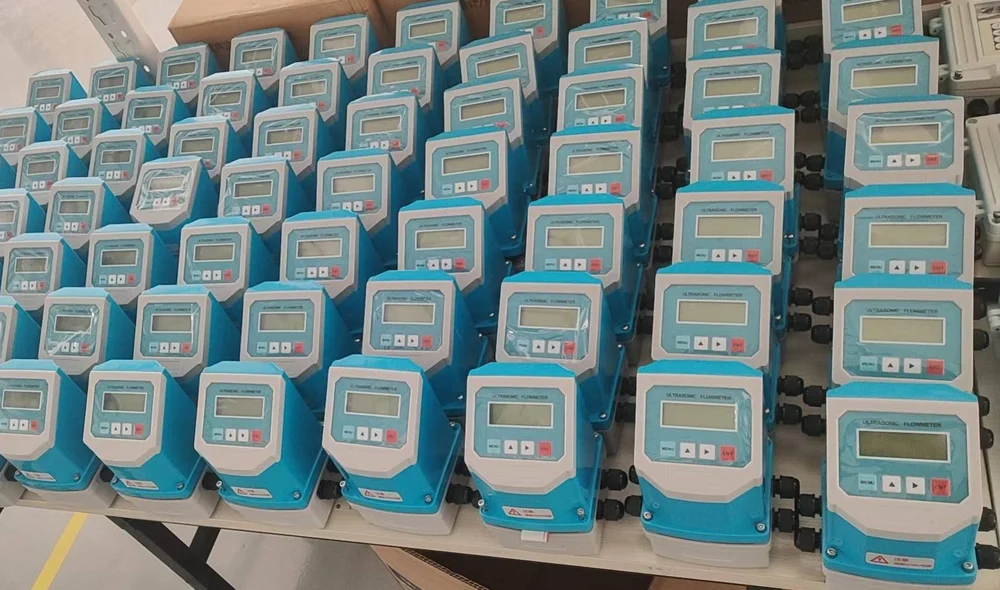
What replaces it is a factory acceptance test on every unit, with the results recorded against the order. The witness points below are the ones I would insist on, in person, by video call or as a signed record with photographs.
| Witness point | What to record |
|---|---|
| Nameplate | Model, range, output, supply, Ex marking and certificate number, all against the order line and the certificate PDF. |
| Wetted materials | Diaphragm, electrodes, liner or tube material as ordered; mill certificate reference for special alloys. |
| Calibration points | Five points up and down for a transmitter, three flow rates for a meter, with the reference instrument and its own certificate identified. |
| Output check | 4, 12 and 20 mA on a meter; pulse or Modbus register values where fitted; the NAMUR NE43 fault current on a simulated sensor failure. |
| Pressure test | Hydrostatic test of the pressure boundary on flanged meters and flanged transmitters, with the test pressure and hold time recorded. |
| Documents | Datasheet, manual in English, calibration document, certificates, packing list with dimensions and gross weight, all in one package before the balance is paid. |
After transport, repeat the nameplate check and the zero and span points on site. That is the site acceptance test, and it is the evidence that the instrument survived the journey in the condition it left the bench.
Shipping and customs
An instrument quotation is not comparable until the delivery term is fixed. Chinese quotations default to EXW or FOB, which look cheapest because freight, insurance and tariffs are all still to come. The table gives the Incoterms 2020 terms you will see and who carries the import side.
| Term | Seller delivers | Import clearance and tariffs |
|---|---|---|
| EXW | At the factory door; buyer arranges export clearance too | Buyer |
| FOB | On board the vessel at the Chinese port; risk passes there | Buyer |
| CIF | Freight and minimum cover insurance paid to the destination port; risk still passes at loading | Buyer |
| DAP | To the named place, ready for unloading | Buyer |
| DDP | To the buyer’s door, duties and taxes paid | Seller |
The customs line matters more than it used to. Flow meters and level instruments for liquids fall under HS heading 9026.10, pressure instruments under 9026.20 and thermometers under 9025.11 or 9025.19. Transmitters are classified case by case.
The general US tariff rate on these headings is low. Instruments of Chinese origin, however, have carried an additional 25 percent under Section 301 since 2018, and the rules have moved several times since. Check the current tariff line for your country before you turn a quotation into a landed cost. Ask the supplier for the HS code and the country of origin statement on the commercial invoice.
Application example
Food industry, Spain. A customer bought a high frequency pressure sensor and the shipment was already on its way when the customs broker asked for the sensor’s certificates to clear it. We issued the certificate copies for the broker after dispatch. The practical lesson: ask for the certificate package with the proforma invoice, so the broker has it before the crate does.
Payment and contract
The sourcing guides agree on payment and so do I. Thirty percent with the order and seventy percent against the acceptance record and the shipping documents is the normal term for an instrument order. A letter of credit is reasonable above a few tens of thousands of dollars. Never pay the balance before the factory acceptance record and the certificate package are in your hands, because your bargaining position ends with that transfer.
Put the technical things into the contract, not the email thread. The datasheet revision, the nameplate contents, the approval by name, the calibration document type, the witness points, the Incoterm and the HS code all belong in the order text. A bilingual contract with the Chinese legal name and the unified social credit code on it is enforceable in China. An English email chain with a self-chosen English name is much weaker.
What we provide
Since this guide asks you to check suppliers, here is what you can check about us. Our factory address and company details are on the about page. The business license with its unified social credit code can be provided on request, so that you can run the registry search yourself.
Instruments ship with an English datasheet and manual and a nameplate matching the order. A factory calibration record, or a calibration certificate with uncertainty and traceability, can be supplied when the order calls for it.
On approvals we answer the question at quotation, not after delivery. Tell us which certificate your site requires and we confirm whether the model carries it; if it does not, we tell you before you order. Witness tests by video call and a photographed test record against the order number can be arranged. Tell us the application and we configure one instrument, not a shelf part.
For what the meters themselves sell for, our flow meter price guide maps published bands by technology before freight and tariffs are added.
FAQ
How to check if a Chinese supplier is legit?
Ask for the business license, copy the 18 character unified social credit code, and search it on the government registry at gsxt.gov.cn. Confirm the Chinese legal name matches the contract and the bank beneficiary, and that the business scope includes manufacturing. Then verify each certificate with its issuing body rather than with the supplier.
How to verify a Chinese company online?
The free official source is the National Enterprise Credit Information Publicity System, gsxt.gov.cn, which returns the registration record for any unified social credit code or Chinese company name. Commercial services such as Qichacha and Tianyancha add court records, shareholding and abnormal operation flags for a small fee.
How do I buy directly from China suppliers?
Confirm the supplier is a manufacturer and set the technical scope in a bilingual contract that carries the legal name and credit code. Agree an Incoterm and a factory acceptance test, then pay a deposit with the order and the balance only against the test record and documents. Use a freight forwarder for the import side unless you buy DDP.
How to know if a company in China is real?
A real company has a live record on gsxt.gov.cn under its Chinese name and a registered address you can see on a map. It has a bank account in the same name, and a factory or office that will take a video call on request. Any one of those missing is a reason to pause; two missing is a reason to walk away.
Which certificates should an industrial instrument from China come with?
At minimum a factory calibration document and an EU declaration of conformity where CE is claimed. For hazardous areas, the IECEx or ATEX certificate your site needs, checked by number, since Chinese Ex certificates only cover China. For safety loops, a SIL certificate from a listed body; for special alloys, an EN 10204 3.1 material certificate.
Request a quote
Send us the instrument list, the approvals your site needs and the delivery term you want to compare on. We return a quotation with the certificate package listed line by line. Reach our application engineers or use the form below.
Written and technically reviewed by Wu Peng and the Instranova engineering team.