Products › Level instruments › Propane and LPG tank level
By Wu Peng, Senior Process Instrumentation Engineer · Last reviewed September 10, 2026
A propane tank level sensor on a bulk or industrial tank has to work through the wall of a sealed pressure vessel holding liquid at its own vapor pressure, near 8.4 bar absolute at 20 °C. That rules out most of what the search results for this term are selling.
This page covers propane tank level monitoring with fixed instrumentation, on bulk propane and LPG storage: autogas sites, cylinder filling plants, distributor yards, standby generator supplies and process users. It does not cover barbecue cylinders, camper and RV bottles, or the cellular telemetry services that propane dealers resell. Those are a different product and a different price.
Four instrument families do the work, and the choice is driven by whether the tank is new or already in service.
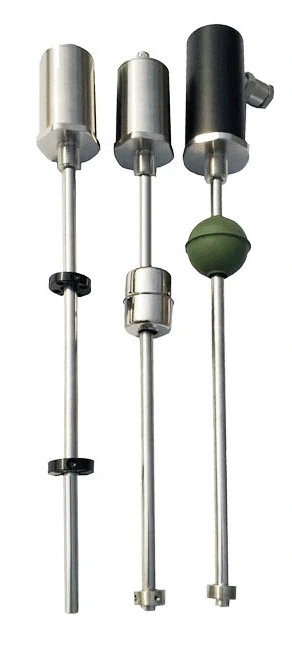 Magnetostrictive Level Transmitter
Float on a rod, millimeter resolution, continuous output. The usual replacement for a mechanical float gauge on a new or refurbished LPG tank.
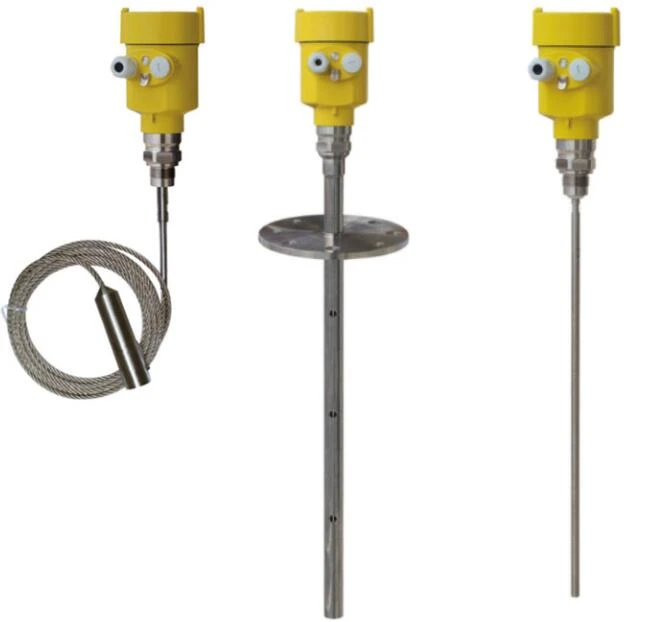 Guided Wave Radar
A coaxial probe concentrates the pulse, which is what makes a low dielectric liquid like propane readable at all.
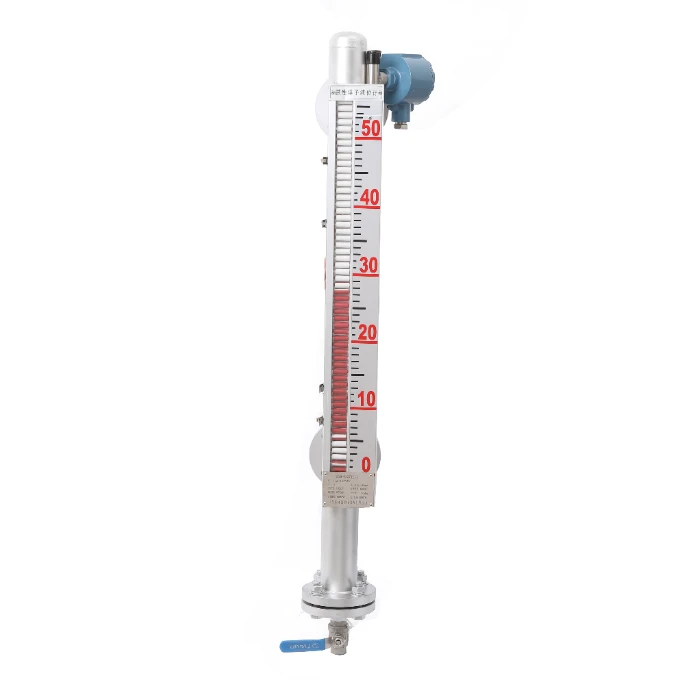 Magnetic Level Gauge
A bypass chamber outside the tank gives a visible indication plus a transmitter, and can be isolated without opening the vessel.
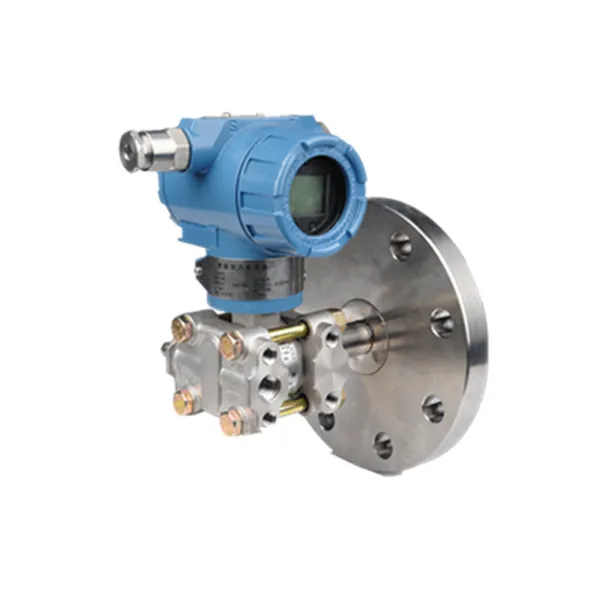 Differential Pressure Level
Works on a closed vessel only with a sealed reference leg, since the vapor space pressure has to be subtracted from the reading.
Choosing a propane level sensor
The tank is a pressure vessel. Whether a new connection can be cut into it is usually the first constraint, and it settles the technology before any accuracy argument starts.
| Situation | Practical choice |
|---|---|
| New tank | Magnetostrictive probe in a top nozzle, or guided wave radar with a coaxial probe |
| Existing tank, side flanges free | Magnetic level gauge in a bypass chamber, transmitter strapped to the outside of it |
| Existing tank, no spare connection | External ultrasonic sensor clamped to the shell, or keep the mechanical gauge and add a sender |
| Mass is what is billed | Level plus a temperature element, or weigh the tank; level alone is a volume |
| Overfill protection | A separate switch on its own connection, not a high alarm derived from the same transmitter |
Every one of these sits in a classified area, so the certification on the instrument has to match the site drawing. Our note on Class I Division 1 and Division 2 covers what the marking has to say.
Why propane is different
Three properties push propane away from the instruments that work on diesel or water. It sits under pressure, it is light, and it expands quickly with temperature.
| Temperature | Propane vapor pressure | n-Butane |
|---|---|---|
| 0 °C | 4.7 bar abs | 1.0 bar abs |
| 20 °C | 8.4 bar abs | 2.1 bar abs |
| 40 °C | 13.7 bar abs | 3.8 bar abs |
Rounded saturation pressures. A commercial blend lands between the two columns, set by how much butane is in the mix.
That pressure has two consequences for level instrumentation. Any probe entering the tank needs a process connection rated for it, and a hydrostatic transmitter reading gauge pressure is useless on its own. The vapor space pushes down on the liquid, so only a differential measurement against a sealed reference leg gives head.
The density is the other half. At 15 °C the saturated liquid sits near 507 kg/m³; by 30 °C it has dropped to about 484 kg/m³. Call it 0.3 percent per degree, which is far steeper than diesel. A level reading on its own is therefore not an inventory figure.
The eighty percent rule
Bulk propane tanks are filled to 80 percent of capacity, leaving the rest as vapor space for thermal expansion. The number is well known in the trade. Fewer people notice that it is a volume limit being read by an instrument that measures height.
On a horizontal cylindrical tank the two are not the same. Solving the circular segment for 80 percent of the cross sectional area gives a liquid depth of 74.6 percent of the tank diameter, not 80 percent. At the halfway point the two do agree, which is what makes the mismatch easy to miss.
80 percent by volume on a horizontal tank = 74.6 percent of diameter
Set the span and the high alarm on that basis. A transmitter spanned to the top of the shell and alarmed at 80 percent of its own output is alarming at a fill of roughly 86 percent by volume, which is past where the tank is supposed to stop.
The same geometry decides how much a level error is worth. Take a 1.6 m diameter bullet 10 m long, a nominal 20 m³ vessel. At the 80 percent fill point the liquid surface is 1.194 m up, the chord across it is 1.393 m, and the tank therefore holds 13.9 liters for every millimeter of level.
13.9 L/mm × 507 kg/m³ = 7.1 kg per millimeter
Ten millimeters of level error is 71 kg of propane, about 0.9 percent of the 8,112 kg the tank holds at that fill and 15 °C. That is the number to hold a sensor specification against, rather than a percentage on a data sheet.
From level to kilograms
Propane is sold by mass or by temperature corrected volume, never by raw indicated volume. The density slope is the reason.
Take the same 20 m³ tank at its 80 percent fill, 16 m³ of liquid. At 15 °C that is 8,112 kg. At 30 °C the identical liquid level represents 7,744 kg, because the liquid has expanded.
16 m³ × (507 − 484) kg/m³ = 368 kg, or 4.5 percent
Nothing has been drawn off. The tank simply warmed up, and a level only system would report a delivery that never happened. Two clean fixes exist. Add a temperature element and correct the density, which is the same arithmetic a tank gauging system runs, or meter what moves, with a flow meter on the transfer line.
The wider version of that calculation, including the volume correction chain, is set out in our guide to tank gauging. For metering the transfer rather than the contents, see LPG and propane flow meter selection.
Radar in low dielectric
Radar is the default answer on most storage tanks, and propane is the case where it needs help. Liquid propane has a relative permittivity in the region of 1.6 to 1.9, against roughly 80 for water. A weak reflector returns very little of the pulse.
Two arrangements fix it. A guided wave probe of coaxial construction keeps the whole pulse inside the probe, which is why coaxial rather than single rod is the normal specification for LPG. A non-contact instrument needs a still pipe so the signal is confined instead of spreading across a curved shell.
The physics behind the reflected fraction, and the thresholds different instruments quote, are worked through in our note on dielectric constant and radar level measurement. Pipe sizing and slotting rules are in the stilling well guide.
One more caution belongs here. Boiling at the surface and vapor stratification above it both disturb the echo, so an instrument that reads cleanly on a cold morning can lose the surface on a hot afternoon during a fill.
Retrofit on live tanks
Most propane level work is retrofit, and the constraint is rarely technical. Cutting a new connection into a vessel in service means emptying it, purging it and re-certifying it, so the instrument that needs no new penetration usually wins on cost even when it is not the most accurate option.
Three routes avoid opening the tank. Use an existing spare flange for a bypass chamber. Fit a sender to the mechanical float gauge that is already there. Or clamp an external ultrasonic sensor to the underside of the shell and read through the wall, which is covered under external ultrasonic tank level sensors.
Application example
LP-Gas operator, United States. An external ultrasonic tank level sensor reads the liquid level through the shell of a pressurized LP-Gas tank, with nothing entering the vessel and no connection cut into it. The instrument is in service and the account is on a routine maintenance follow up.
The limitation of that route is that it measures where it is clamped. It reads a level, it does not read mass, and shell condition and coating affect the coupling. On a new tank a probe in a nozzle is still the better instrument.
FAQ
How do propane tank level sensors work?
On bulk tanks, four principles cover almost everything. A float follows the surface and reports its position magnetically, and a guided wave radar times a pulse down a probe. A differential pressure transmitter weighs the liquid column against the vapor space, while an external ultrasonic sensor times an echo through the shell.
Is there a way to check a propane tank level?
On an industrial tank, read the fixed gauge or transmitter, and confirm it against the tank chart before trusting it. Level gives volume, and volume becomes mass only after a temperature correction. On a small cylinder the usual field checks are weighing it or pouring warm water down the side.
What is the best propane tank level sensor?
There is no single answer, because the tank decides. New vessels take a magnetostrictive probe or a coaxial guided wave radar. Tanks already in service usually take a bypass chamber or an external sensor, since avoiding a new penetration matters more than the last millimeter of accuracy.
Are propane tank level gauges accurate?
Mechanical dial gauges are indicators rather than measurements, and they read a percentage of a volume that also moves with temperature. A transmitter resolves millimeters, but on a 1.6 m bullet ten millimeters is still about 71 kg, so the tank geometry sets what any accuracy figure is worth.
Request a quote
Tell us the tank diameter and length, the available connections, whether the vessel can be opened, and whether the reading feeds inventory or an overfill interlock. We will match the instrument and the area certification to it. Reach our application engineers or use the form below.
Written and technically reviewed by Wu Peng and the Instranova engineering team.