Home › Tools › Pipe Velocity Calculator
This pipe velocity calculator works in three directions. Give it a flow rate and an inner diameter and it returns the flow velocity; give it a velocity and a diameter and it returns the flow rate; give it a flow rate and a velocity limit and it returns the minimum pipe size. The math behind all three is one equation, v = Q / A: velocity equals volumetric flow divided by the pipe’s cross-sectional area. Enter the flow in GPM, L/min, L/s, or m3/h, the diameter in mm or inches, and read the result in both metric and US units.
One detail decides whether the answer is right: use the inner diameter, not the nominal pipe size. A 4-inch schedule 40 steel pipe has an inner diameter of about 4.026 in, but a 4-inch schedule 80 bore is 3.826 in, and the difference moves the velocity by about 11%. Below the tool you will find the formula, worked examples, and a table of recommended velocities by service.
Calculator
Pipe velocity, flow and diameter
The grayed field is the one being solved for; the calculator writes the result back into it. Use the pipe’s real inner diameter for the schedule and material you have.
The formula
Velocity is flow divided by area. For a round pipe with inner diameter d, the cross-sectional area is A = π d² / 4, so the three rearrangements this tool solves are:
- v = Q / A (velocity from flow and diameter)
- Q = v × A (flow from velocity and diameter)
- d = √(4 Q / π v) (minimum diameter for a velocity limit)
Keep the units consistent: flow in m3/s and diameter in meters gives velocity in m/s. In US units there is a well-known shortcut, v (ft/s) = 0.4084 × Q (GPM) / d² (inches), which is the same equation with the conversion factors folded in. The calculator handles all the unit bookkeeping either way.
Worked examples
1. Velocity from flow. A DN100 line (100 mm inner diameter) carries 100 GPM, which is 22.71 m3/h. The area is π × 0.1² / 4 = 0.007854 m², so v = (22.71 / 3600) / 0.007854 = 0.80 m/s, about 2.6 ft/s. That is on the gentle side of the recommended water bands below, fine for clean water.
2. Flow from velocity. How much water does a DN80 line carry at 2 m/s? A = π × 0.08² / 4 = 0.005027 m², so Q = 2 × 0.005027 × 3600 = 36.2 m3/h, which is about 159 GPM. This is the quick capacity check when someone asks what a line “can do” at a sensible velocity.
3. Minimum diameter. You need to move 30 m3/h and want to stay under 3 m/s. d = √(4 × 0.00833 / (π × 3)) = 0.0595 m, so 59.5 mm. The next standard size up is DN65; recheck with its real bore and the velocity lands near 2.5 m/s.
Recommended pipe velocities
There is no single legal limit, but commonly published guidance for water systems clusters tightly. The ranges below follow widely used engineering references; individual specs and codes take precedence.
| Service | Typical velocity (m/s) | In ft/s |
|---|---|---|
| General water service | 0.9 to 2.4 | 3 to 8 |
| Pump suction | 0.9 to 2.4 | 3 to 8 |
| Pump discharge, process water | 1.5 to 3 | 5 to 10 |
| Cooling water | 1.5 to 2.5 | 5 to 8 |
| Boiler feed suction | 0.5 to 1.0 | 1.6 to 3.3 |
| Irrigation mains (common rule) | up to 1.5 | up to 5 |
Running faster costs pressure drop, noise, and erosion, and it makes water hammer worse when valves close. Running much slower than about 0.6 m/s in dirty water lets solids settle. Sizing near 2 m/s for water is a reasonable starting point that the table then refines by service.
Velocity is also how flow meters are sized
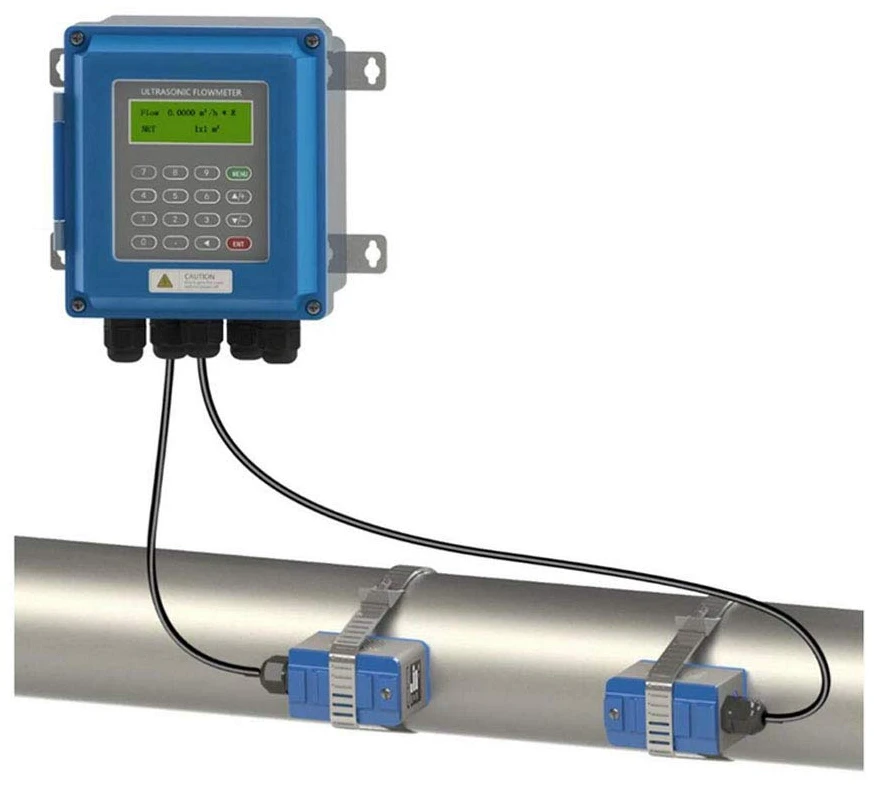
Most flow meters are velocity devices inside, so their working ranges are really velocity ranges. From our own datasheets: a vortex flow meter reads liquids from 0.15 to 7 m/s, and a clamp-on ultrasonic flow meter works on a 0 to 7 m/s span. Convert your flow to velocity with the calculator above and you immediately see whether a given meter size can register your minimum flow, or whether the line is so oversized that the meter spends its life at the noisy bottom of its range. The flow range tables on the turbine flow meter page are exactly this velocity band expressed in m3/h per diameter.
Application example
Fuel and lube-oil skid, Southeast Asia. A customer asked for one flow meter to cover 1 to 22 GPM of diesel and engine lube oil on a DN15 turbine meter documented for 0.6 to 6 m3/h. The top end checked out: 22 GPM is 5.0 m3/h, inside the documented span. The bottom did not: 1 GPM is 0.23 m3/h, well below the meter's documented 0.6 m3/h floor; in a DN15 bore that is only 0.36 m/s, too slow for the turbine to register reliably. The velocity math turned a vague “will it work” into a clear answer: one meter cannot cover a 22:1 swing here, so we recommended splitting the service into two ranges.
Related guides and tools
To convert the flow figure itself between GPM, L/min, and m3/h, see the flow rate units guide with its exact factors. To estimate flow from a differential pressure reading instead, use the flow rate from pressure calculator, and browse the rest of the engineering tools for signal and pressure conversions. For pulse-output meters, the K-factor calculator converts pulse frequency and K-factor to flow rate, or derives K from a pulse count.
Once the velocity checks out, the next question is what that velocity costs in head: the pipe pressure drop calculator turns the same flow and bore into kPa and psi of friction loss.
The velocity this page computes also sets the Reynolds number, which decides whether the flow is laminar or turbulent; our Reynolds number calculator turns the same inputs into that verdict.
FAQ
How to calculate pipe velocity?
Divide the volumetric flow rate by the pipe’s cross-sectional area: v = Q / A, with A = π d² / 4 for a round pipe. In consistent SI units, flow in m3/s over area in m² gives velocity in m/s. In US units, the shortcut v (ft/s) = 0.4084 × GPM / d² (inches) gives the same result.
What is the rule of thumb for pipe velocity?
For water, about 1 to 2.5 m/s (3 to 8 ft/s) in general service, and a 5 ft/s ceiling is a common rule for irrigation mains. Suction lines run slower, around 1 m/s, to protect pumps from cavitation; discharge and process lines tolerate up to about 3 m/s.
What is a reasonable pipe velocity?
It depends on the service, not just the fluid. A reasonable water velocity is 0.9 to 2.4 m/s for general service, 1.5 to 3 m/s on pump discharge, and 0.5 to 1 m/s on boiler feed suction. Faster costs pressure drop and erosion; much slower than 0.6 m/s lets solids settle in dirty lines.
How to convert GPM to velocity?
You need the pipe’s inner diameter, because GPM is a flow rate and velocity is flow per area. Use v (ft/s) = 0.4084 × GPM / d² with d in inches, or enter both numbers in the calculator above. 100 GPM in a 4.026 in bore is about 2.5 ft/s; to convert between GPM and other flow units, see the flow rate units guide.
Request a quote
Tell us the flow range, line size, and fluid, and we will size a meter that sits in the healthy part of its velocity band, not at the edges. Browse the technologies on the flow meters hub, or reach our application engineers directly.