Home › Products › Pressure Instruments › Industrial Pressure Transducers
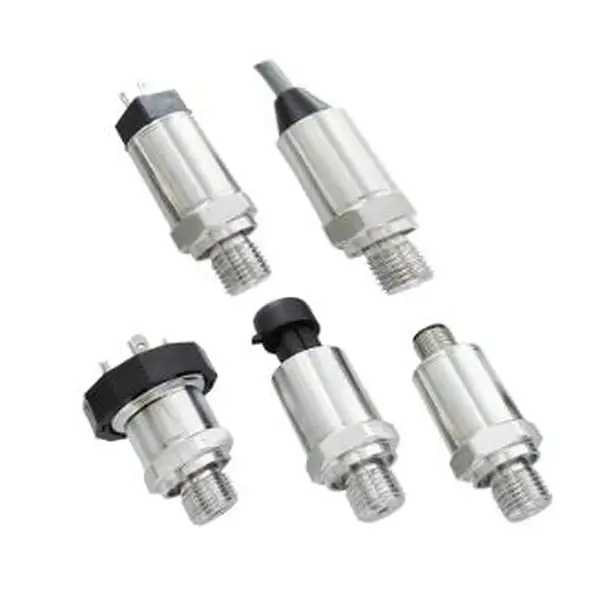
SI-390 Industrial Pressure Transducer
An equipment builder does not buy one pressure transducer; they buy the same transducer five hundred times, and the five hundredth has to read like the first. The SI-390 is our line for that job: a 316L isolation diaphragm with oil-filled coupling to the sensing element, a miniature amplifier producing current or voltage outputs, an all stainless steel body, and a parts list of threads, connectors and housings meant to be combined to a customer drawing rather than picked from a shelf.
- Spans: micro ranges up to 0–100 MPa; gauge, absolute and sealed reference
- Accuracy: ±0.25% FS typical, ±0.5% FS maximum
- Stability: ±0.1% FS per year typical
- Hazardous area: intrinsically safe Ex ia IIC T6
- Adjustment: zero and full scale adjustable
Where does it sit in our line? The SI-300 pressure transmitter is the process-instrumentation workhorse you pipe into a plant. The SI-390 is the configurable OEM transducer you design into a machine: water and natural gas equipment, hydraulic and pneumatic systems, HVAC controls, vehicle braking test rigs. Same measuring physics, different buying problem.
Technical specifications
| Parameter | Specification |
|---|---|
| Measuring medium | Liquids, gases and vapors compatible with 316L stainless steel |
| Measuring range | Spans from 0–0.01 kPa up to 0–100 MPa; vacuum and compound ranges available |
| Pressure types | Gauge, absolute, sealed reference |
| Overload | 1.5 × full scale, capped at 110 MPa |
| Accuracy | ±0.25% FS typical, ±0.5% FS maximum (including nonlinearity, hysteresis and repeatability) |
| Long-term stability | ±0.1% FS per year typical, ±0.2% FS maximum |
| Zero and span temperature coefficients | 0.03% FS per °C on spans of 100 kPa and below; 0.02% FS per °C above 100 kPa |
| Power supply | 15–30 VDC (two-wire); 15–28 VDC (three-wire) |
| Output signal | 4–20 mA two-wire; 0–10 / 0–20 mA and 0/1–5 / 0–10 V three-wire |
| Load resistance | ≤(U − 15) / 0.02 Ω on the current loop |
| Working / storage temperature | −30 to 80 °C / −40 to 100 °C |
| Adjustment | Zero and full scale adjustable; range migration completed at the factory before shipment |
| Wetted / housing materials | 316L isolation diaphragm, oil-filled coupling; stainless steel housing (1Cr18Ni9Ti) |
| Process connection | M12 × 1, M20 × 1.5 or G1/4 external thread; others to order |
| Electrical connection | Cable outlet, aviation connector or Hirschmann connector |
| Protection / hazardous area | IP65; intrinsically safe Ex ia IIC T6 |
| EMC | Resistant to vibration and radio frequency interference |
Specifications at room temperature and rated supply unless stated. Confirm the exact figure for your model and range on the order sheet.
Factory configuration
A few ordering rules come straight off the factory sheet and save a round of email. Pick the range with real migration headroom: state the actual working pressure and any expected range migration, and we complete the migration before the unit leaves the factory. Mount the transducer vertically at the pressure point with the display level facing the operator. For vacuum and compound spans, state the negative end of the range explicitly on the order. The M3 electronics option carries a −20 to 60 °C ambient rating and M4 carries −30 to 70 °C. And if your medium would clog a standard port, the same line is built with a flush face: see the SI-703 flush diaphragm pressure sensors, with flush spans of 0–70 kPa to 35 MPa available on this platform.
Zero and span adjustment
The SI-390 keeps field-adjustable zero and full scale, and that is a deliberate choice for OEM work. When a machine builder replaces a discontinued sensor from another vendor, trimming zero and span on the bench is what makes a drop-in swap actually drop in, and a service technician can re-zero a unit in place after years on a vibrating machine. If you would rather lock the calibration, say so on the order and the unit ships factory-set.
From the case file: an OEM in Austria planning roughly 22,000 units a year opened their inquiry not with a spec sheet but with two words, consistency and cost. That is the right frame for volume sensor buying: unit-to-unit repeatability across production lots matters more than any single datasheet number, and it is what the aging and screening steps in our production line are for.
Models and ordering
Quote checklist: five things to put in your inquiry
- Working pressure, the span you want, and any negative or compound range (we size for 60–80% FS)
- Pressure type: gauge, absolute or sealed reference
- Output and wiring: 4–20 mA two-wire, or a current/voltage three-wire option
- Process thread (M12 × 1, M20 × 1.5, G1/4 or custom) and electrical connection (cable, aviation, Hirschmann)
- Quantity and schedule if this is an OEM design-in, plus hazardous-area requirement if any (Ex ia IIC T6 available)
Ordering example: SI-390, 0–1.6 MPa gauge, G1/4 external thread, 4–20 mA two-wire, Hirschmann connector, for hydraulic equipment working at 1.1 MPa. The working point sits at 69% of full scale, with 1.5 × overload above it for pump transients.
Applications
OEM equipment
- Hydraulic and pneumatic machinery
- HVAC and refrigeration controls
- Vehicle braking systems and test rigs
- Machine builders replacing obsolete sensors
Plant and utility service
- Water and natural gas pressure monitoring
- Chemical and medical equipment
- Electric power auxiliaries
- General industrial process points
Related products
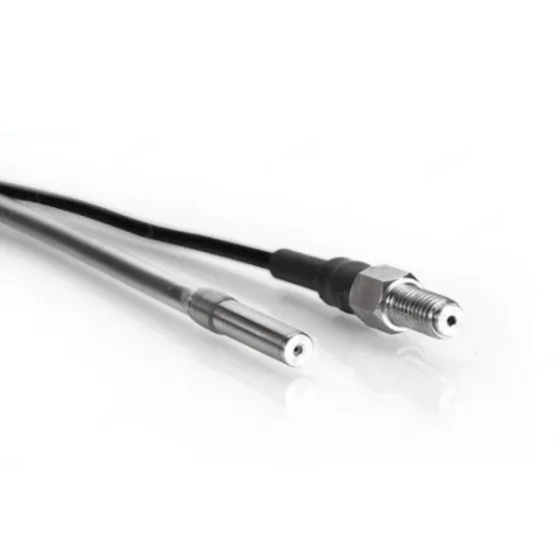 Miniature Pressure Sensors
MEMS sensor in an M6-M10 package for OEM and tight spaces.
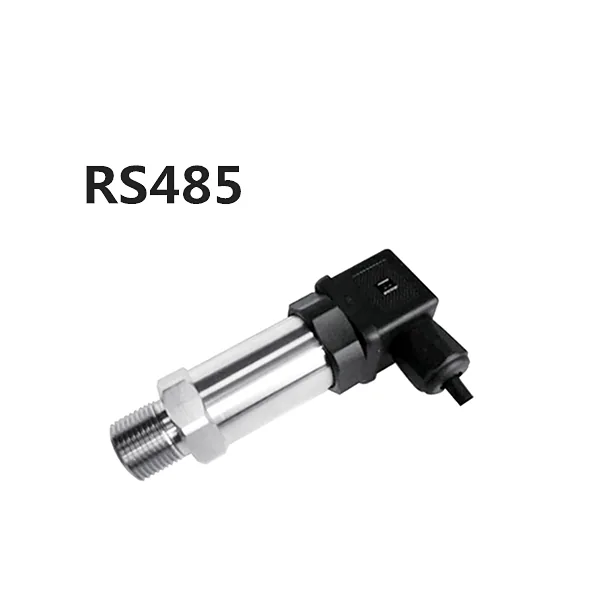 Digital Pressure Sensors
SI-520 RS485 Modbus output for PLC and SCADA.
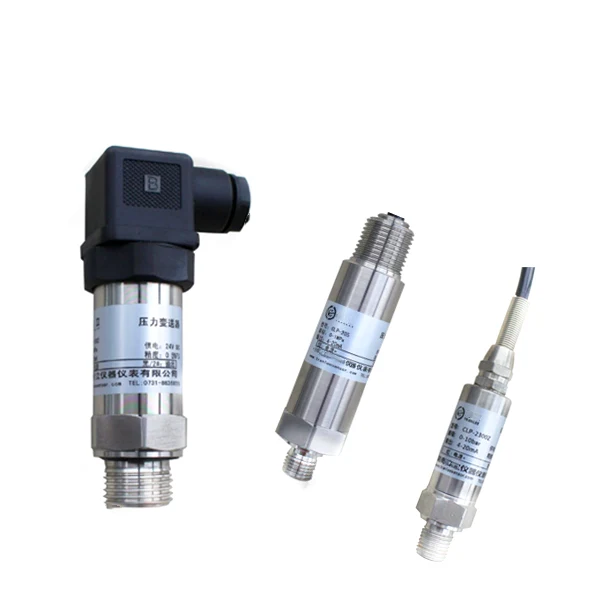 Pressure Transmitters
The process-instrumentation workhorse: gauge and absolute, -100 kPa to 100 MPa.
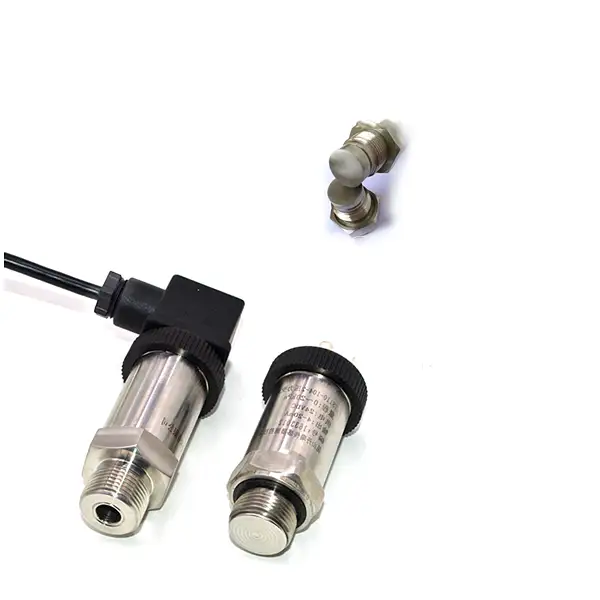 Flush Diaphragm Pressure Sensors
The flush-face version of this platform for viscous and clogging media.
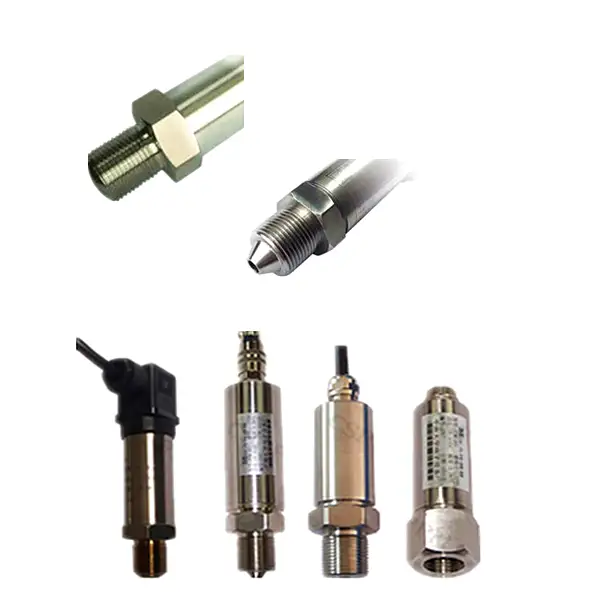 High Pressure Transducers
Above 100 MPa: cone-sealed units for water jet and hydraulic test service.
Where the receiving system takes a voltage instead, the same transducer is configured with a 1-5 V or 0-10 V output; the trade-offs are worked through in converting 4-20 mA to 0-10 V.
FAQ
What does a pressure transducer do?
It converts pressure into an electrical signal. The SI-390 senses pressure on a diaphragm and outputs 4–20 mA (or a voltage) for a control system, with options to set the zero and span.
What are the three types of pressure transducers?
By reference: gauge (versus atmosphere), absolute (versus vacuum), and differential (between two points). The SI-390 is normally a gauge transducer.
What is an industrial transducer?
A transducer built for plant service: a rugged housing, a wide temperature range, a standard 4–20 mA output, and the connections and configuration that industrial and OEM equipment need. The SI-390 is an industrial OEM pressure transducer.
What are the industrial applications of a pressure transducer?
Hydraulics, pneumatics, pumps and compressors, HVAC, water systems, and machine builds, anywhere a control system needs a continuous pressure reading. The SI-390 suits OEM integration with its configurable output and connections.
Request a quote
Tell us the working pressure, the output and wiring, the threads and the quantity. We respond with a configured model, lead time and price, usually within one working day; OEM design-in inquiries get an engineering contact, not a form letter.