Home › Products › Pressure Instruments › Differential Pressure Level Transmitters
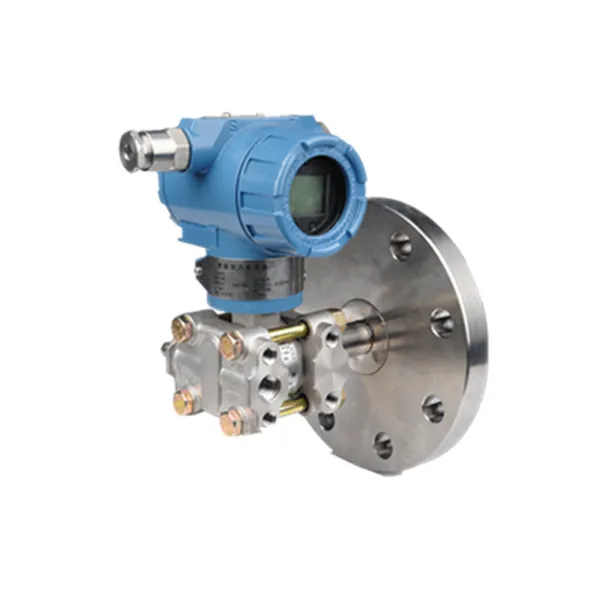
SMT3151LT Flange-Mounted DP Level Transmitter
A liquid column is a pressure gauge: height times density times gravity. The SMT3151LT bolts straight onto the tank flange, reads that hydrostatic pressure through an isolation diaphragm, and reports level as 4–20 mA; no impulse lines to plug, freeze or lie. For media that crystallize, settle or corrode, the flange mount is not a convenience; it is the only design that keeps working.
- Spans: 4 kPa to 2.1 MPa, four codes
- Accuracy: 0.1% / 0.5% FS
- Output: 4–20 mA + HART; Modbus option
- Flanges: ANSI or DIN, 1″–4″, to 900 LB / PN100
- Diaphragms: 316 SS to tantalum and titanium
- Fill fluids: to 304 °C high-temperature silicone
Single flange vs double flange
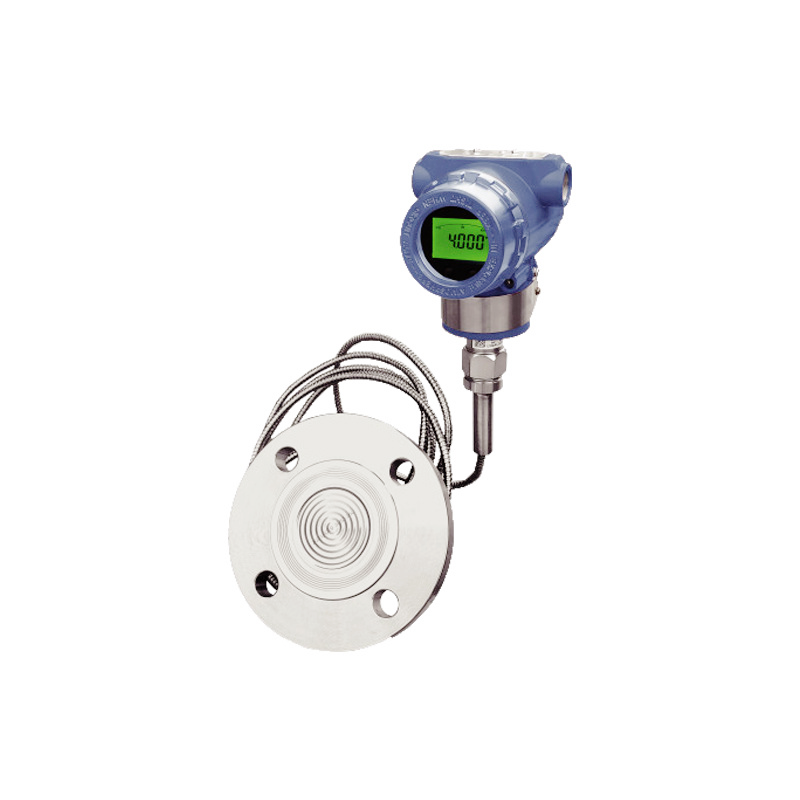
The reference side decides. On an open tank the low side vents to atmosphere, so one flange seal does the job. On a pressurized or closed tank the low side must read the vapor space: specify the S2 build with a remote seal and capillary up to the top nozzle, and the transmitter reads the difference that is pure liquid column. Both are the same instrument; the second flange and capillary are what you pay extra for, and on a closed tank they are not optional.
The cell behind the flange is the same single-crystal silicon core as the SMT3151DP differential pressure transmitter; the diaphragm seal pressure transmitters page covers the capillary systems in detail. The full range sits on the pressure instruments page.
Models and ordering
| Code position | Choices |
|---|---|
| Model | SMT3151LT flange-mounted differential pressure level transmitter (EJA210E-class) |
| Span codes | 4: 4–40 kPa 5: 20–200 kPa 6: 70–700 kPa 7: 0.21–2.1 MPa |
| Accuracy | 0.1% or 0.5% FS |
| Output | E: 4–20 mA SF: 4–20 mA + HART F: Modbus RS-485 |
| Flange standard | A: ANSI (HG20615) D: DIN (HG20592) |
| Flange size | 1″ / DN25 up to 4″ / DN100 |
| Flange rating | 150–900 LB (ANSI); PN16 to PN100 (DIN) |
| High-side diaphragm | 316 SS; Hastelloy C; Monel; tantalum; titanium; special on request |
| Insert (extended) tube | Flush, or 50 / 150 / 200 mm 316L barrel through the nozzle |
| Fill fluid (high side) | General silicone −40 to 104 °C; high-temperature silicone −40 to 304 °C; inert −40 to 204 °C |
| Low side | 316 SS / Hastelloy C / Monel / tantalum wetted sets; or S2 remote seal on the low side |
| Housing | Aluminum alloy or stainless; M20×1.5 or 1/2 NPT conduit |
| Options | M1 linear indicator; M4 LCD; top-side vent valves; CX 316 flushing ring |
| Hazardous area | Da flameproof Ex d IIB T5 Gb (cert CE16.1163); Fa intrinsically safe Ex ia IIC T4/T5/T6 Ga (cert CE15.2354X) |
Codes per the SMT3151LT order guide; working pressure and temperature follow the flange rating and fill fluid chosen at selection.
Working principle
The flange diaphragm sees the liquid column plus whatever pressure rides on the surface; the low side sees only the surface pressure. Subtract and the surface term cancels: ΔP = ρ × g × h. Water at 2 m gives 1000 × 9.8 × 2 = 19.6 kPa: span code 5 with room to rerange. Configure the 4 and 20 mA points from tank geometry and density, and the transmitter turns hydrostatics into level. Density and interface follow from the same equation once the geometry is fixed: hold h constant and ΔP tracks ρ.
An industrial-gas operator in the Middle East runs five of these duties on liquid-oxygen vessels at 17 to 20 bar: closed tanks, so the low side reads the vapor space and the difference is the liquid column alone. Cryogenic service adds its own rules at the cold end; see the cryogenic pressure transducers for that side of the problem.
Features
- Flush or extended diaphragm: the 50 to 200 mm insert barrel reaches through the nozzle so the diaphragm sits at the vessel wall, with no dead pocket for product to settle and bake in.
- Fill fluid chosen by temperature, not hope: general silicone to 104 °C, high-temperature silicone to 304 °C, inert fill where oxygen or reactive media forbid silicone.
- Diaphragm alloys from 316 SS to tantalum and titanium, matched to the medium at selection.
- HART configuration and re-ranging without opening the process; LCD and flushing-ring options for service-heavy duties.
Applications
Level on hard media
- Hot viscous products and media that crystallize in impulse lines.
- Slurries and liquids with suspended solids.
- Corrosive or toxic inventories, with the matching diaphragm alloy.
Beyond plain level
- Closed-tank level with the S2 remote low side.
- Continuous density and interface measurement.
- Sanitary vessels where wash-down and zero contamination are the spec.
Related products
Browse all pressure instruments →
FAQ
How does a differential pressure level transmitter work?
It reads level as the hydrostatic head of the liquid. The high side connects near the bottom of the vessel, where the pressure equals the tank pressure plus the head from the liquid column above. The low side connects to the vapour space at the top, so it sees the tank pressure alone. The transmitter subtracts the two, leaving only the head, which is proportional to level. With the density known you convert that head to height (P = density x g x height).
What is a differential pressure level transmitter?
It is a transmitter with two process connections that measures level from the pressure difference between the bottom and the top of a vessel. Because it cancels the tank pressure, it works on closed and pressurised tanks where a simple bottom-mounted gauge would read wrong. The SMT3151LT is built for this, with flush or extended flanges and capillary fills to suit the tank and the medium.
What is the difference between a pressure transmitter and a differential pressure transmitter?
A plain pressure transmitter has one port and reads pressure against a fixed reference, atmosphere for gauge or vacuum for absolute. A differential transmitter has two ports and reads only the difference between them. For level in an open tank a single gauge transmitter is enough; for a sealed or pressurised tank you need the differential type, so the tank pressure cancels and only the liquid head remains.
Request a quote
Tell us the five points above. Our engineers reply with a configured DP level transmitter, datasheet and price.