Home › Products › Gas Analysis Instruments › Portable Gas Detector
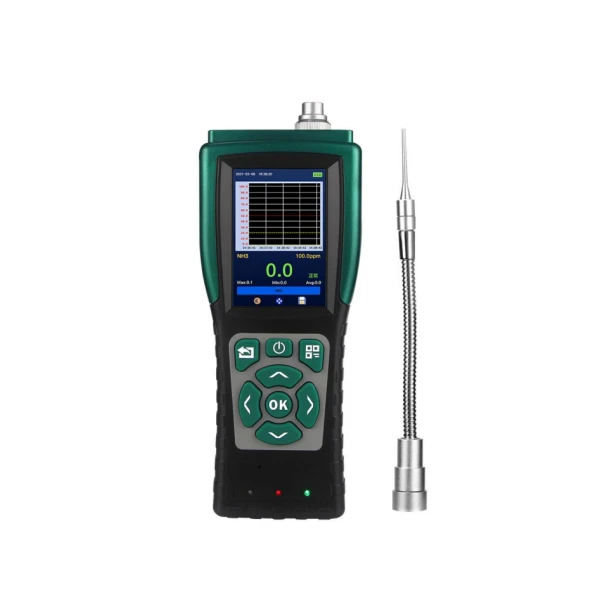
Portable Multi-Gas Detector (Pump)
A handheld, pump-suction gas monitor that detects one to six gases at once and draws a sample through a tube, so a confined space can be tested before anyone goes in. Color screen, data logging, and STEL/TWA exposure tracking.
- Detects: 1 to 6 gases (combustible, oxygen, toxic, VOC)
- Sampling: built-in pump + tube; 3-speed draw
- Ranges / units: %LEL, %VOL, ppm, mg/m3; STEL and TWA
- Power: 5400 mAh battery, ≥ 10 h; Micro-USB charge
- Build: IP65; 3.5-inch color screen; 100,000-record log
Overview
A portable gas detector is the instrument a worker carries to test the air rather than the one bolted to a wall. This unit is a pump-suction type: a built-in sampling pump pulls air through a tube so the sensors read gas from a distance, which is what makes it the right tool for a confined-space entry. Test a sewer, tank, or vessel from outside, confirm it is safe, and only then go in.
It carries one to six sensors at once, covering combustible gas in %LEL, oxygen in %VOL, and toxic gases such as CO, H2S, or ammonia in ppm. A 3.5-inch color screen shows the live reading and a trend chart, the instrument logs up to 100,000 records for download over USB, and it tracks the STEL and TWA exposure values that occupational limits are set against. For permanent area cover at a fixed point, use a fixed gas detector instead; see the comparison below.
Features
Configurable channels for combustible, oxygen, toxic, and VOC sensing.
Three-speed pump draws a sample for remote and pre-entry testing.
Tracks short-term and time-weighted exposure, not just the live value.
Live reading plus a trend chart; %LEL, %VOL, ppm, mg/m3 switchable.
Adjustable interval; download over USB for a report.
Over 10 hours per charge in a waterproof, dustproof case.
How a portable gas detector works
The sensor is matched to the gas: a catalytic element for combustible gas, an electrochemical cell for oxygen and toxic gases, infrared for hydrocarbons and CO2, photoionization for volatile organics, and thermal conductivity or semiconductor for the rest. In this pump model the internal pump pulls air over those sensors through a tube, rather than waiting for gas to diffuse in, so a sample can be taken from a manhole or a vessel before anyone enters. Each sensor turns the gas concentration into an electrical signal that the instrument scales, temperature- and pressure-compensates, and shows on screen, sounding an audible and visual alarm when a level crosses its set point.
Technical specifications
| Parameter | Specification |
|---|---|
| Type | Portable, handheld, pump suction |
| Gases | 1 to 6 of: combustible, oxygen, toxic, organic vapor |
| Sensor principle | Catalytic, electrochemical, NDIR infrared, PID, thermal conductivity, or semiconductor (by gas) |
| Range / units | 0–100 %LEL; %VOL; ppm; mg/m3 (switchable) |
| Accuracy | ≤ ±3% FS; repeatability ≤ ±1%; linearity ≤ ±1% |
| Response (T90) | ≤ 30 s (by gas); resolution 0.001 / 0.01 / 0.1 / 1 |
| Sampling | Active suction, built-in pump (low/medium/high), 270 mm tube, extendable |
| Display / log | 3.5-inch color screen with trend chart; 100,000-record log; USB |
| Exposure | Real-time, STEL, TWA, max and min; programmable alarm levels |
| Calibration | Self, zero, and multi-point; temperature and pressure compensation |
| Power | 5400 mAh lithium, ≥ 10 h; Micro-USB charge; working current ≤ 50 mA |
| Environment / build | −10 to +50°C, 10–95 %RH; IP65; anti-corrosion plastic and aluminum |
Representative specifications; the gases, ranges, and probe depend on the application, so confirm per datasheet for your order.
Sampling probes and STEL/TWA
The pump and tube are what make this a survey and pre-entry tool. The standard 270 mm tube extends for reaching down a manhole or into a vessel, and optional sampling handles cover hotter and dirtier sources: a 304 stainless handle to about 80°C, a 316L handle to about 200°C, and cooling-filter handles rated to 400, 800, and 1300°C that drop the temperature and strip water and dust before the gas reaches the sensor, so the instrument can sample a flue or duct.
Beyond the live reading, the detector keeps the STEL and TWA. STEL is the short-term exposure limit, a 15-minute average that guards against a brief spike; TWA is the time-weighted average over a full shift. Tracking both lets a safety team show that a worker’s exposure stayed within the occupational limit, not just that the alarm never sounded.
Portable vs fixed gas detection
The two answer different questions. A portable detector goes to the work and tests the air on demand; a fixed detector stays at a point and watches it around the clock.
| Your need | Use |
|---|---|
| Confined-space pre-entry, leak survey, spot checks, personal exposure | This portable detector |
| Continuous area monitoring at a fixed point, wired to a control system | Fixed gas detector |
Applications
Portable gas detectors travel with maintenance and safety crews: confined-space entry into sewers, tanks, vessels, and pits; leak surveys along pipelines and around process plant; flue and duct spot sampling with a cooling handle; safety rounds in refineries, chemical plants, utilities, and mines; and environmental and emergency-response work.
Application example
Confined-space entry, pre-entry test. Before a crew enters a wastewater sump, the standard practice is to test the atmosphere from outside rather than trust that it is safe. A worker lowers the sampling tube into the sump and runs the pump to draw air up to the detector, checking oxygen, combustible gas in %LEL, and toxic gases such as hydrogen sulfide and carbon monoxide against the entry limits. Only once all four read inside their limits does entry proceed, and the detector keeps logging with STEL and TWA while the work goes on. The alarm levels and the test sequence follow the site confined-space procedure.
Related products
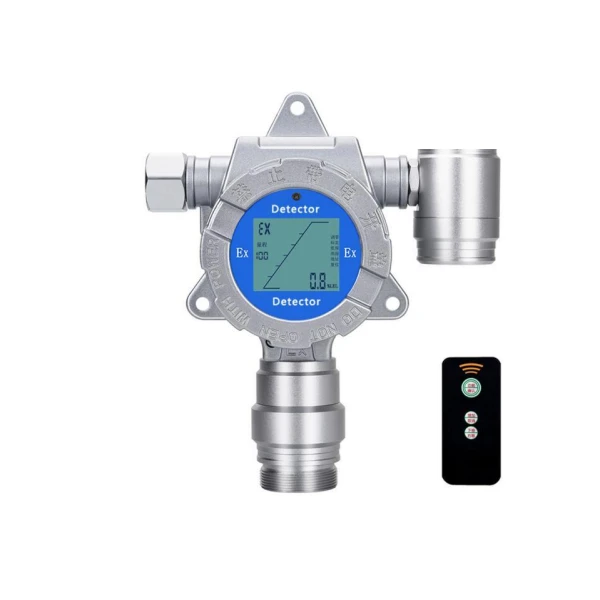 Fixed Gas Detector
Explosion-proof single and multi-gas detector for continuous area monitoring.
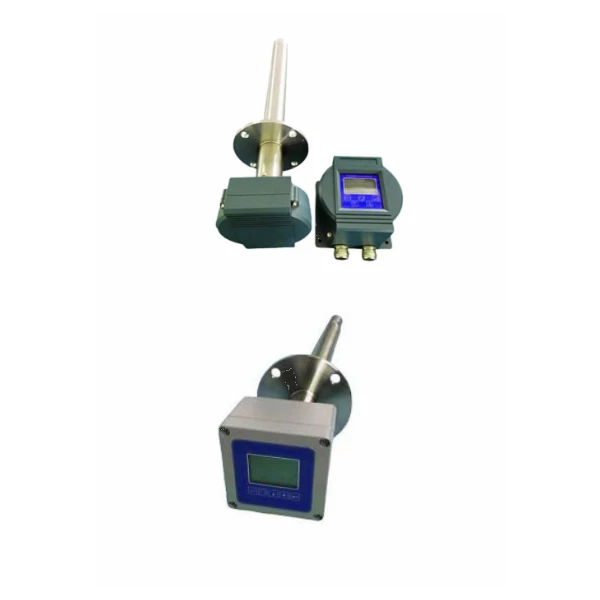 Zirconia Oxygen Analyzer
In situ flue gas oxygen analyzer for boiler and furnace combustion control.
See all gas analysis instruments, or tell us the gases and the work and we will configure the right detector.
FAQ
How does a portable gas detector work?
A sensor matched to each gas converts its concentration into an electrical signal; in this pump model an internal pump draws air over the sensors through a tube, so a sample can be taken before entering a space. The instrument shows the reading, logs it, and alarms when a level crosses a set point.
How accurate is a portable gas detector?
This detector reads within about ±3% of full scale with repeatability and linearity inside ±1%, and tighter accuracy can be specified. Accuracy holds only with a calibrated sensor, so a portable detector is bump-tested before use and calibrated against a known gas on a schedule.
What is the difference between a portable and a fixed gas detector?
A portable detector is carried to the work to test the air on demand, for confined-space entry, leak surveys, and personal exposure. A fixed detector is mounted at a point and monitors it continuously, wired to a control system. Many sites use both.
What do STEL and TWA mean on a gas detector?
STEL is the short-term exposure limit, a 15-minute average that guards against brief spikes; TWA is the time-weighted average over a full shift. The detector tracks both so exposure can be checked against occupational limits, not just the instantaneous reading.
About this product page
Specifications drawn from the portable multi-gas detector datasheet and reviewed by the Instranova engineering team — last reviewed 2026-06-30. Confined-space, sampling, and STEL/TWA guidance follow established gas-detection practice. Questions? Reach our application engineers.
Request a quote
Tell us the gases to detect, the ranges, and the work, confined-space entry, leak survey, or flue sampling, and we will configure the right portable detector and probe for the job, not a shelf part.