Products › Torque Sensors › Reaction Torque Sensor
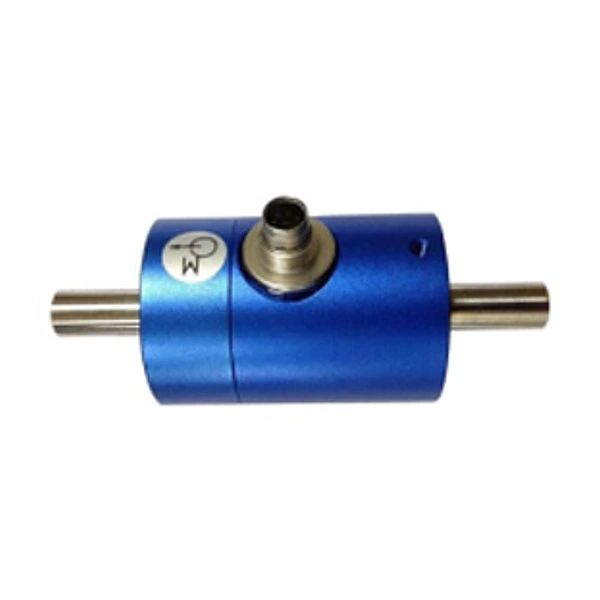
WTQ-12 Static Torque Sensor (Low Range, 0.1-3 Nm)
A reaction torque sensor measures torque on a stationary flange. It is bolted between a fixed frame and the device under test and reads the torque the casing reacts against, with no rotation and no slip rings. It suits torque-wrench calibration, motor and fastener bench tests, and any static torque check.
- Model: WTQ-12
- Range: 0.1 N·m to 3 N·m
- Type: static (reaction)
- Build: compact body
- Accuracy: ±0.1 to ±0.3% FS
- Output: 1.0-1.5 mV/V bridge
Overview
The WTQ-12 is a low-range static (reaction) torque sensor for 0.1 to 3 N·m. It does not rotate; it holds against the small reaction torque and reads it through a strain-gauge bridge, in a compact body.
It is the low-range member of the static line. For slightly higher static torque see the micro reaction torque sensor; for a turning shaft use a rotary torque sensor; for the general static range, see the reaction torque sensor.
Features
What sets this reaction torque sensor apart on the bench:
Static reaction
Holds against the torque and reads it; nothing rotates.
Low range
Reads small torque from 0.1 to 3 N·m.
Compact body
A small body for tight benches and instruments.
High accuracy
Non-linearity of ±0.1 to ±0.3% of full scale.
mV/V output
A 1.0-1.5 mV/V bridge signal, with amplified options available.
Overload protected
Safe to 150% and ultimate to 200% of full scale.
Working principle
The WTQ-12 is held fixed, so it does not turn. A small applied torque is carried as a reaction load and strains a metal-foil bridge inside the compact body. The bridge gives a 1.0-1.5 mV/V signal in proportion to torque, and an amplifier can convert it to a current or voltage output. Because the range is low, the design suits small motors, instruments and bench work where torque is only a few newton-meters.
Technical specifications
| Parameter | Specification |
|---|---|
| Measuring principle | Static reaction strain-gauge |
| Measuring range | 0.1 to 3 N·m (0.1, 0.2, 0.5, 1, 2, 3 N·m) |
| Build | Compact body, fixed mount |
| Sensitivity | 1.0-1.5 mV/V |
| Non-linearity | ±0.1 / ±0.3% FS |
| Zero output | ±1% FS |
| Hysteresis | ≤±0.05% FS |
| Repeatability | ≤±0.05% FS |
| Input resistance | 350 / 750 Ω |
| Insulation resistance | ≥5000 MΩ / 100 VDC |
| Compensated temperature | -10 to 60 °C |
| Operating temperature | -20 to 65 °C |
| Excitation | 10-15 VDC |
| Safe overload | 150% FS |
| Ultimate overload | 200% FS |
| Material | Aluminum, stainless steel or alloy steel |
Models and ranges
Standard rated torques, low range:
| Rated torque | Type |
|---|---|
| 0.1 N·m | Static, compact |
| 0.2 N·m | Static, compact |
| 0.5 N·m | Static, compact |
| 1 N·m | Static, compact |
| 2 N·m | Static, compact |
| 3 N·m | Static, compact |
Range and type
Pick by the torque you need to read:
| Model | Range | Type |
|---|---|---|
| WTQ-12 | 0.1-3 N·m | Low-range static |
| MRT | 0.1-20 N·m | Micro static, disc |
| WTQ-120 | 5-200 N·m | Keyed static |
| WTQ98 series | 0.2 N·m-50 kN·m | Flange static |
See the micro reaction torque sensor, keyed static torque sensor or reaction torque sensor.
Applications
- Small motor and instrument torque, 0.1 to 3 N·m
- Low static torque on a tight bench
- Friction and holding-torque checks on small parts
- Laboratory torque references at low range
- Quality torque verification of small assemblies
Challenge: A small-parts bench needed to read static torque of only a few newton-meters, where a larger sensor would be too coarse.
Solution: A low-range WTQ-12 sized to 3 N·m, held fixed on the bench, reading the small reaction torque through its bridge.
Result: The low range gave usable resolution on small torque, so the bench measured friction and holding torque on small parts without over-ranging a bigger unit.
Related products
FAQ
What is the WTQ-12 torque range?
From 0.1 to 3 N·m: 0.1, 0.2, 0.5, 1, 2 and 3 N·m.
How small a torque can it read?
Down to a 0.1 N·m full-scale model, which suits small motors and instruments.
Request a quote
Tell us the torque range, the mounting style and the test, and we configure one reaction torque sensor for your bench, not a shelf part. Send the details and our engineers reply with a specification and quote.