Products › Torque Sensors › Dual Range Torque Sensor (WTQ-2150)
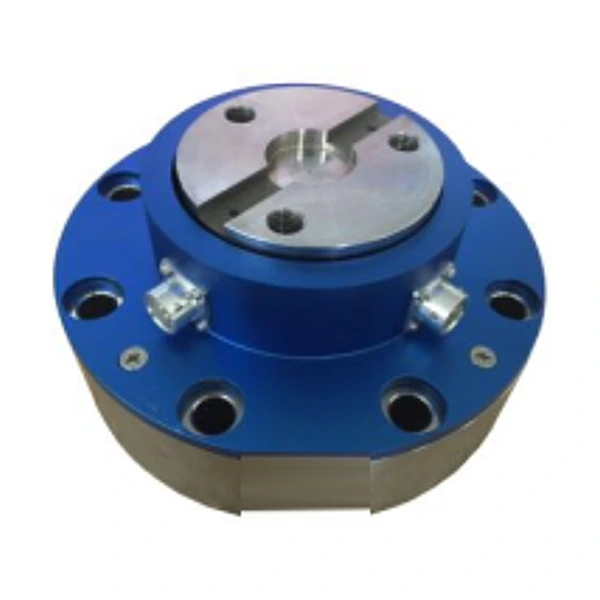
Dual Range Torque Sensor (WTQ-2150)
A reaction torque sensor measures torque on a stationary flange. It is bolted between a fixed frame and the device under test and reads the torque the casing reacts against, with no rotation and no slip rings. It suits torque-wrench calibration, motor and fastener bench tests, and any static torque check.
- Model: WTQ-2150 series
- Ranges: two calibrated (e.g. 20 / 500 N·m)
- Type: dual range, static (0 rpm)
- Mounting: keyed flange + flange plate
- Accuracy: ±0.1 to ±0.3% FS
- Output: 1.0-1.5 mV/V bridge; 4-20 mA or 0-5/10 VDC optional
Overview
The WTQ-2150 is a dual-range static torque sensor: one body holds two calibrated ranges, a fine low range and a wide high range. That lets a single unit read small operating torque with good resolution and still take large peak or test torque, without swapping sensors.
It is a reaction (static) sensor with one keyed-flange end and one flange-plate end, so there are no slip rings or bearings. The series pairs run 20/500, 30/1000, 100/3000 and 150/4000 N·m. For a single fixed range see the reaction torque sensors.
Features
What sets this reaction torque sensor apart on the bench:
Two calibrated ranges
A fine low range and a wide high range in one body, each separately calibrated.
Fine plus wide in one
Resolve small operating torque, yet still take large peaks without a second sensor.
Static (reaction)
Measures non-rotating torque, so there are no slip rings or bearings to wear.
Flange mounting
One keyed-flange end and one flange-plate end couple it in line.
Strain-gauge bridge
A metal-foil bridge at 1.0-1.5 mV/V, with amplified output optional.
Overload protected
Safe to 150% and ultimate to 200% of full scale.
Working principle
Torque applied across the flanges strains a metal-foil bridge in the body. The WTQ-2150 carries two separately calibrated measuring ranges: a low range gives fine resolution for small torque, and a high range gives headroom for large torque, so you read whichever range fits the test without changing sensors. Because it is fixed and does not rotate, there are no slip rings or bearings. An amplifier can convert the bridge output to 4-20 mA or 0-5/10 VDC.
Technical specifications
| Parameter | Specification |
|---|---|
| Measuring principle | Dual-range, reaction (static) strain-gauge bridge |
| Range pairs | 20/500, 30/1000, 100/3000, 150/4000 N·m (low / high) |
| Sensitivity | 1.0-1.5 mV/V |
| Non-linearity | ±0.1 / ±0.3% FS |
| Zero output | ±1% FS |
| Hysteresis | ≤±0.05% FS |
| Repeatability | ≤±0.05% FS |
| Response | about 100 microseconds |
| Compensated temperature | -10 to 60 °C |
| Operating temperature | -20 to 65 °C |
| Excitation | 10-15 VDC |
| Safe overload | 150% FS |
| Ultimate overload | 200% FS |
| Output options | mV/V bridge; 4-20 mA or 0-5/10 VDC optional |
| Mounting | Keyed flange one end, flange plate the other |
| Material | Alloy steel or stainless steel |
Models and ranges
Standard dual-range models (low range / high range):
| Model | Low range | High range |
|---|---|---|
| WTQ-2150 | 20 N·m | 500 N·m |
| WTQ-2151 | 30 N·m | 1,000 N·m |
| WTQ-2152 | 100 N·m | 3,000 N·m |
| WTQ-2153 | 150 N·m | 4,000 N·m |
Dual range or single range
Pick by whether you need one span or two:
| Type | Ranges | Choose when |
|---|---|---|
| WTQ-2150 dual range | Two calibrated (fine + wide) | Small operating torque with large peaks, or one unit for a wide span |
| Single-range reaction | One fixed range | The torque stays within one band |
For a single fixed range see the reaction torque sensors; for a spinning shaft see the rotary torque sensor.
Applications
- Rigs where operating torque is small but peaks or overloads are large
- One sensor covering a wide torque span without swapping units
- Calibration and test across both a fine and a coarse range
- Motor, gearbox and brake bench reaction torque
- Limited-rotation and holding torque
Challenge: A bench ran most of the time at low torque but saw occasional large peaks, and a single fixed-range sensor either lost resolution at the low end or could not take the peak.
Solution: A dual-range static torque sensor with a fine low range for the steady torque and a wide high range for the peaks, in one flange-mounted body.
Result: One unit covered both, reading the low torque with good resolution and still taking the peak without an over-range, so no second sensor or swap was needed.
Related products
FAQ
What is a dual range torque sensor?
It is a torque sensor with two separately calibrated measuring ranges in one body, a fine low range and a wide high range, so one unit covers both small and large torque. The WTQ-2150 is a static (reaction) dual-range unit.
How does it have two ranges?
The sensor carries two calibrated ranges off the same flexure; you read the low range for fine resolution at small torque and the high range for headroom at large torque.
What ranges does the WTQ-2150 cover?
Four model pairs (low / high): 20/500, 30/1000, 100/3000 and 150/4000 N·m.
Is the WTQ-2150 static or rotary?
Static. It is a reaction sensor mounted between flanges, so there are no slip rings or bearings. For a spinning shaft use a rotary sensor.
When should I use dual range instead of single range?
Use dual range when the operating torque is small but peaks are large, or when one unit must cover a wide span with good low-end resolution. Use single range when the torque stays in one band.
Request a quote
Tell us the torque range, the mounting style and the test, and we configure one reaction torque sensor for your bench, not a shelf part. Send the details and our engineers reply with a specification and quote.