Products › Torque Sensors › Micro Reaction Torque Sensor (MRT)
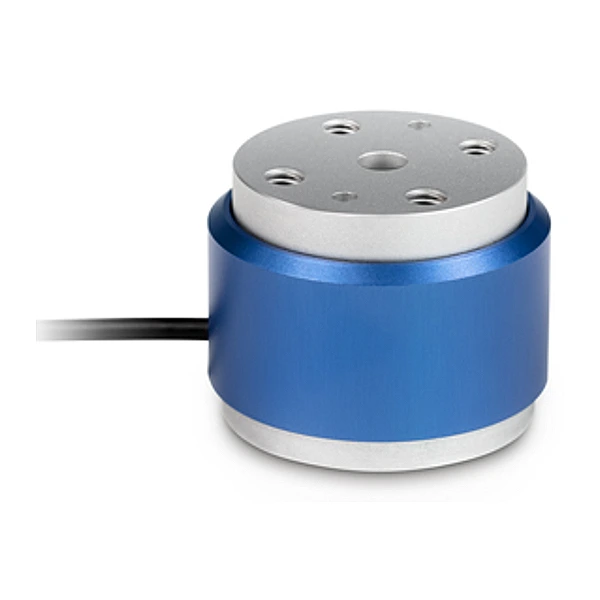
Micro Reaction Torque Sensor (MRT)
A reaction torque sensor measures torque on a stationary flange. It is bolted between a fixed frame and the device under test and reads the torque the casing reacts against, with no rotation and no slip rings. It suits torque-wrench calibration, motor and fastener bench tests, and any static torque check.
- Model: MRT
- Range: 0.1 N·m to 20 N·m
- Type: micro reaction / static (0 rpm)
- Mounting: compact dual flange
- Accuracy: ±0.1 to ±0.3% FS
- Output: 1.0-1.5 mV/V bridge; 4-20 mA or 0-5/10 VDC optional
Overview
The MRT is a compact dual-flange micro reaction torque sensor for static, non-rotating torque from 0.1 to 20 N·m. Its small disc body bolts flange-to-flange and fits close to a motor or gearhead, where a larger reaction sensor would not.
Because it is a reaction sensor, there are no slip rings or bearings, and a fast response suits closed-loop torque feedback. It suits OEM and precision work: robot joints, small actuators and gearheads, dental and surgical drives, rheometers and micro-assembly torque checks.
Features
What sets this reaction torque sensor apart on the bench:
Micro low range
Reads from 0.1 N·m, where larger reaction sensors cannot resolve the torque.
Compact dual flange
A small disc body bolts flange-to-flange and fits a motor or gearhead footprint.
Static (reaction)
Measures non-rotating torque, so there are no slip rings or bearings to wear.
Fast response
About 100 microseconds, suited to closed-loop torque feedback.
Strain-gauge bridge
A four-wire metal-foil bridge at 1.0-1.5 mV/V, with amplified output optional.
Overload protected
Safe to 150% and ultimate to 200% of full scale.
Working principle
When torque is applied across the two flanges, the small disc body strains a metal-foil bridge bonded inside it. Four strain gauges in a Wheatstone bridge turn that strain into a millivolt signal proportional to torque. The sensor is fixed and does not rotate, so there are no slip rings or bearings, and the bridge responds in about 100 microseconds. An amplifier can convert the output to 4-20 mA or 0-5/10 VDC.
Technical specifications
| Parameter | Specification |
|---|---|
| Measuring principle | Compact dual-flange, reaction (static) strain-gauge bridge |
| Measuring range | 0.1 to 20 N·m (0.1 / 0.2 / 0.5 / 1 / 2 / 3 / 5 / 10 / 20 N·m) |
| Sensitivity | 1.0-1.5 mV/V |
| Non-linearity | ±0.1 / ±0.3% FS |
| Zero output | ±1% FS |
| Hysteresis | ≤±0.05% FS |
| Repeatability | ≤±0.05% FS |
| Creep | ≤±0.03% FS / 30 min |
| Response | about 100 microseconds |
| Temperature effect | 0.03% FS / 10 °C |
| Compensated temperature | -10 to 60 °C |
| Operating temperature | -20 to 65 °C |
| Insulation resistance | ≥5,000 M-ohm / 100 VDC |
| Excitation | 10 VDC (9-15 VDC) |
| Safe overload | 150% FS |
| Ultimate overload | 200% FS |
| Output options | mV/V bridge; 4-20 mA or 0-5/10 VDC optional |
| Cable | 5.2 mm x 3 m |
| Material | Aluminum alloy / stainless steel |
Models and ranges
Standard rated torques, compact dual flange, static:
| Rated torque | Type |
|---|---|
| 0.1 N·m | Micro reaction, static |
| 0.5 N·m | Micro reaction, static |
| 1 N·m | Micro reaction, static |
| 2 N·m | Micro reaction, static |
| 5 N·m | Micro reaction, static |
| 10 N·m | Micro reaction, static |
| 20 N·m | Micro reaction, static |
Micro or standard reaction
Pick by torque range and size:
| Model | Range | Choose when |
|---|---|---|
| MRT micro | 0.1 to 20 N·m | Small torque, tight space, OEM-embedded |
| WTQ-9500 flange | 50 to 1,000 N·m | Low-profile flange reaction at higher torque |
| Reaction (keyed/square) | to 5,000 N·m | Torque-wrench or motor-bench reaction |
For higher reaction torque see the reaction torque sensor or the flange torque sensor; for a spinning shaft see the rotary torque sensor.
Applications
- Robot joint and gripper torque feedback
- Small actuator and gearhead torque measurement
- Dental, surgical and medical drive torque
- Rheometers and micro-assembly torque checks
- OEM-embedded closed-loop torque control
Challenge: A robotics builder needed compact torque feedback built into a small joint drive, where a standard torque sensor was too large.
Solution: A micro reaction torque sensor sized to the drive, reporting torque on a voltage or serial output for the control loop.
Result: The small body fitted the assembly without adapters, and the torque signal fed straight into the joint control without adding bulk.
Related products
FAQ
What is a micro reaction torque sensor?
It is a small reaction (static) torque sensor for low torque. The MRT measures non-rotating torque from 0.1 to 20 N·m in a compact dual-flange body that fits close to a motor or gearhead.
What torque range does the MRT cover?
Nine rated capacities from 0.1 to 20 N·m: 0.1, 0.2, 0.5, 1, 2, 3, 5, 10 and 20 N·m, all static (0 rpm).
Is the MRT static or rotating?
Static. It is a reaction sensor that measures torque on a fixed flange, so there are no slip rings or bearings and the response is fast.
How small a torque can it measure?
Down to a 0.1 N·m rated range, with non-linearity of ±0.1 to ±0.3% of full scale, which suits precision and OEM-embedded work.
Request a quote
Tell us the torque range, the mounting style and the test, and we configure one reaction torque sensor for your bench, not a shelf part. Send the details and our engineers reply with a specification and quote.