Flow Meters › Vortex Flow Meters › Precession Vortex Gas Flow Meter
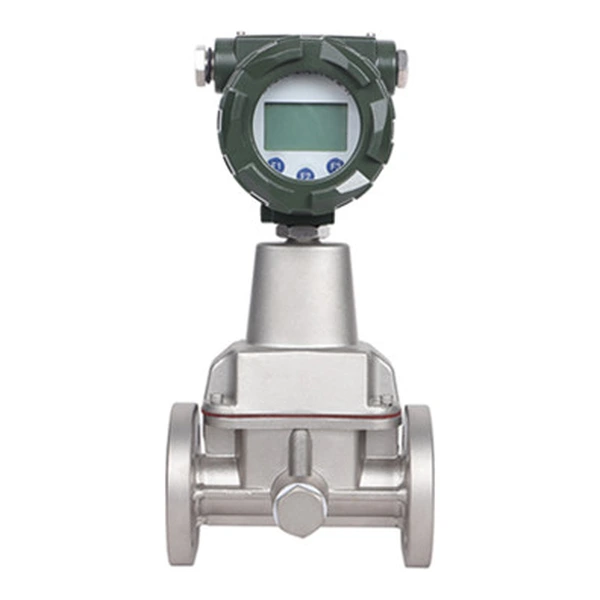
Precession Vortex Gas Flow Meter
A gas-only flow meter that reads the precession of a swirling flow. A built-in flow computer takes temperature and pressure and reports the gas in standard volume, so one unit measures and corrects on the spot. It has no moving parts and a wide flow range.
- Principle: Precession (swirl) vortex, gas only
- Size: DN15 to DN200
- Accuracy: 1.0 or 1.5 class
- Compensation: built-in temperature, pressure, compressibility
- Output: 4-20 mA, pulse, RS-485; battery option
Overview
A precession vortex gas flow meter is a velocity meter for gas. A swirler at the inlet spins the flow into a vortex, and downstream the vortex core wobbles, or precesses, around the axis at a rate that is proportional to flow. A sensor reads the precession frequency, and a built-in flow computer takes temperature and pressure to report the gas in standard volume. It measures gas only: compressed air, natural gas, nitrogen, oxygen, carbon dioxide, argon, LPG, biogas, and coal gas, but not corrosive or wet gas such as chlorine, hydrogen, steam, or ammonia.
It shares the velocity-meter family with the Karman vortex flow meter, but the principle and the job differ. The vortex meter handles steam, gas, and liquid; the precession meter is gas only, and its strength is a self-contained gas meter with temperature, pressure, and compressibility correction on board, at a lower cost than a vortex meter plus a separate flow computer. For steam or liquid, use the vortex meter. For a large clean-gas duct, an insertion meter or a gas turbine flow meter may fit better.
Features
Everything here follows from one idea: a self-contained gas meter that reads swirl precession and corrects to standard volume.
Swirl precession sensing
A swirler spins the gas and the vortex core precesses; its frequency tracks flow, with no moving parts.
Built-in flow computer
Onboard temperature, pressure, and compressibility correction reports the gas in standard volume.
Gas only, wide range
Natural gas, air, nitrogen, oxygen, CO2, argon, LPG, and biogas, across a wide flow range.
Anti-vibration signal
Signal processing rejects disturbance from vibration and pressure pulsation, so the count stays clean.
4-20 mA, pulse, RS-485
Analog, pulse, and Modbus outputs with an alarm, on 24 V DC or a 3.6 V lithium battery.
Aluminum or 304 body
An aluminum alloy or 304 stainless body to the pressure rating the line needs, to PN25.
Working principle
A fixed swirler at the inlet spins the incoming gas into a strong vortex. As that vortex passes through the converging-diverging bore, its core stops running straight and begins to spiral, or precess, around the axis. The rate of precession is proportional to the flow rate over a wide range, so a sensor that reads the precession frequency gives the volume flow. A built-in flow computer then takes the measured temperature and pressure, applies the gas compressibility, and reports the flow in standard volume. Because the swirl fixes the flow pattern, a precession meter tolerates a shorter straight run than a Karman vortex meter, and signal processing rejects vibration and pressure pulsation so the reading stays stable.
Technical specifications
| Parameter | Specification |
|---|---|
| Measurement principle | Precession (swirl) vortex; velocity, gas only |
| Medium | Compressed air, natural gas, nitrogen, oxygen, CO2, argon, LPG, biogas, coal gas; not corrosive or wet gas (chlorine, hydrogen, steam, ammonia) |
| Size | DN15 to DN200 |
| Accuracy | 1.0 or 1.5 class |
| Repeatability | Within 1/3 of the basic error limit |
| Nominal pressure | 1.6, 2.5, 4.0, 6.3, 10.0, 16.0, or 25.0 MPa, by build |
| Pressure loss | Rises with gas density and line pressure: dP = (rho / 1.205) x PN |
| Compensation | Built-in temperature, pressure, and compressibility to standard volume |
| Medium temperature | -20 to 80 C (representative; confirm at order) |
| Body material | Aluminum alloy or 304 stainless steel |
| Outputs | 4-20 mA; pulse; RS-485; alarm |
| Power | 24 V DC, or 3.6 V lithium battery (removable) |
| Display | LCD: rate, standard-volume total, temperature, pressure |
| Protection | IP65, by build |
| Explosion protection | Flameproof Ex d IIB T4, by build |
Representative specifications; confirm per datasheet for the size, gas, pressure, and temperature you need.
Ordering example. Precession vortex gas flow meter for natural gas on a DN50 line, 4.0 MPa, temperature and pressure compensation, 4-20 mA and RS-485, flameproof.
Flow ranges by size
A precession meter is sized by the gas flow at working conditions. The table gives the nominal volume range for each size; keep the working flow inside the band so the precession signal stays strong.
| Size | Flow range (m3/h) | Size | Flow range (m3/h) |
|---|---|---|---|
| DN15 | 0.6 to 12 | DN65 | 8 to 400 |
| DN20 | 1 to 15 | DN80 | 15 to 500 |
| DN25 | 2 to 40 | DN100 | 40 to 1000 |
| DN32 | 3 to 70 | DN125 | 50 to 1200 |
| DN40 | 4 to 80 | DN150 | 100 to 2000 |
| DN50 | 6 to 130 | DN200 | 360 to 3600 |
Precession or vortex
Both are velocity meters and both can correct to standard volume, but they sense flow differently and suit different jobs:
- Precession vortex (this page). Gas only. A swirler makes the flow precess, and a built-in flow computer corrects temperature, pressure, and compressibility. It tolerates a shorter straight run and is a cost-effective self-contained gas meter.
- Karman vortex. Steam, gas, and liquid. A bluff bar sheds a vortex street; it covers a wider range of media and larger sizes, and it is the choice for steam and for liquid. See the vortex flow meter.
- Gas turbine. For clean dry gas and custody-grade totals on a budget, a gas turbine flow meter is an alternative; it has a moving rotor but a tight repeatability.
Applications
Precession vortex meters suit clean industrial gas where a standard-volume total matters:
- Natural gas sub-metering and distribution branches
- Compressed air and plant nitrogen consumption metering
- Oxygen, argon, and CO2 in metallurgy and chemical plants
- Biogas and coal gas on energy and utility lines
- LPG vapor and other clean process gas
Application example
Natural gas and oxygen branch metering. A European distributor specified DN40 precession vortex meters for natural gas and oxygen service, where the customer wanted a single instrument that read flow and corrected to standard volume without a separate flow computer. The built-in temperature and pressure compensation gave a standard-volume total on the meter head, and the flameproof build suited the gas area. One unit per branch kept the install simple.
Related products
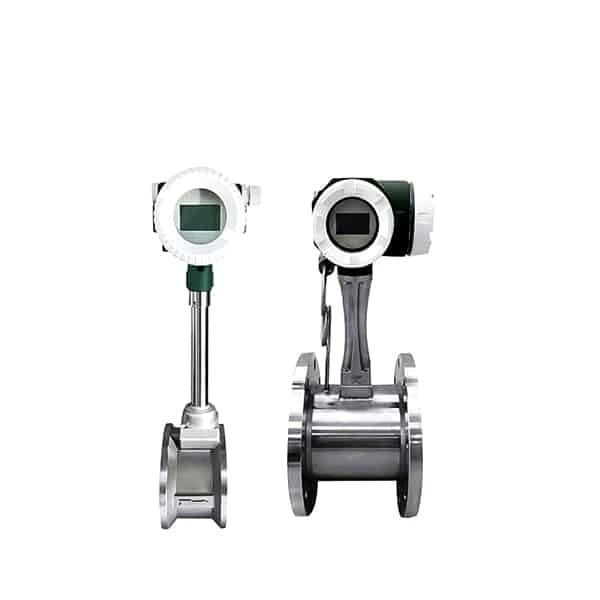 Vortex Flow Meter
Karman vortex for steam, gas, and liquid, DN15 to DN1000.
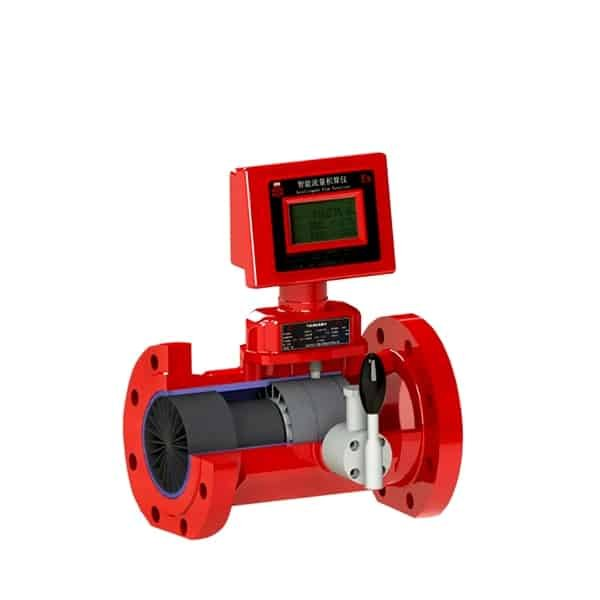 Gas Turbine Flow Meter
Clean dry gas with temperature and pressure compensation.
Browse all vortex flow meters →
On LPG service the phase decides the meter; our guide to metering LPG and propane maps the liquid and vapor sides of the system.
FAQ
What is a precession vortex gas flow meter?
It is a velocity flow meter for gas. A swirler spins the gas into a vortex whose core precesses around the axis, and the precession frequency is proportional to flow. A built-in flow computer takes temperature and pressure and reports the gas in standard volume, with no moving parts.
What is the difference between a precession vortex and a vortex flow meter?
The principle and the scope differ. A Karman vortex meter sheds a vortex street from a bluff bar and measures steam, gas, and liquid across a wide size range. A precession vortex meter swirls the flow and reads its precession, measures gas only, tolerates a shorter straight run, and carries an onboard flow computer at a lower cost than a vortex meter plus a separate computer.
How is it powered?
By 24 V DC, or by a removable 3.6 V lithium battery for sites with no power. The battery build drives the local LCD with the standard-volume total; the wired build adds the 4-20 mA, pulse, and RS-485 outputs.
Request a quote
Send us the gas, the size, the flow range, and the temperature and pressure, and we set the pressure rating, the compensation, and the outputs.