Flow Meters › Ultrasonic Flow Meters › Portable Ultrasonic Flow Meter
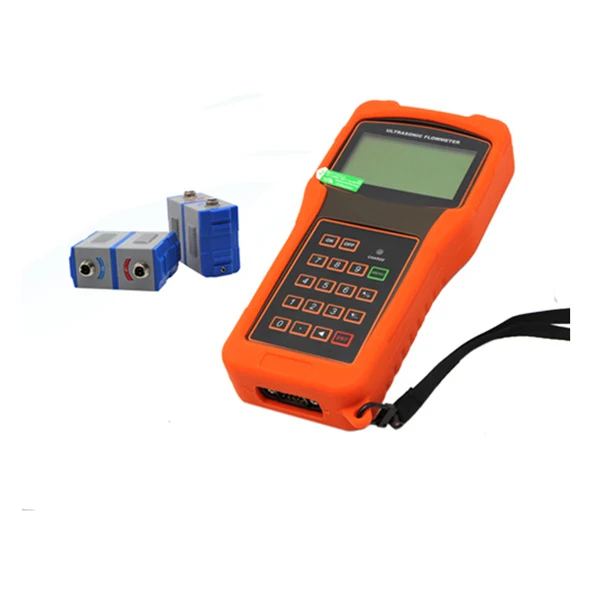
Portable Ultrasonic Flow Meter (TUF-2000H)
A battery-powered, handheld transit-time flow meter. Clamp the two transducers on the outside of a full pipe and read the flow in minutes, with no cutting, no shutdown, and no wetted parts. Built for spot checks, balancing surveys, and verifying meters already in the line.
- Principle: transit-time, clamp-on (non-invasive)
- Pipe size: DN25 to DN1200 (1 to 48 in)
- Accuracy: ±1% of reading, typical
- Power: rechargeable 3000 mAh battery, about 16 h per charge
- Logging: 16 GB SD card; 4-20 mA and Modbus RS485
Overview
A portable ultrasonic flow meter is the tool you reach for when you need a flow number from a pipe you cannot, or do not want to, open. The TUF-2000H sends an ultrasonic pulse diagonally across the pipe in both directions through clamp-on transducers; the pulse travelling with the flow arrives a little sooner than the one travelling against it, and that small time difference converts directly to velocity, then to flow once you enter the pipe size. Because nothing touches the liquid, the same handheld unit reads water, treated effluent, oils, and chemicals across a wide span of pipe sizes, and moves from line to line in a single shift.
It covers DN25 to DN1200 (1 to 48 in) at about ±1% of reading, logs to a 16 GB SD card for balancing and energy work, and runs about 16 hours on a charge. For a permanently installed clamp-on point use the fixed clamp-on ultrasonic flow meter; for a permanent reading on a large or thick-walled line, the insertion ultrasonic flow meter is the better choice. This page covers the portable, carry-it-with-you version.
Features
What you actually use a portable meter for shapes its design: fast clamp-on setup, untethered power, and data you can take back to the office.
Non-invasive clamp-on
Transducers strap to the outside of a full pipe. No cutting, no shutdown, no wetted parts.
Battery powered
Rechargeable 3000 mAh cell runs about 16 hours, so a full day of surveying needs no mains.
Onboard logging
16 GB SD card stores readings at intervals from 1 to 99999 s for balancing and energy audits.
Wide pipe range
One transducer set spans DN25 to DN1200, so a single kit covers most lines on a site.
4-20 mA and RS485
Analog and Modbus outputs let the unit feed a logger or PLC during a temporary tie-in.
Survey and verify
Drop in to check an existing meter, find a baseline demand, or trace where flow is going.
Working principle
Transit-time metering times two pulses. One transducer fires a pulse diagonally downstream while the other fires upstream along the same path. The downstream pulse is carried by the flow and arrives sooner; the upstream pulse fights the flow and arrives later. The difference between the two travel times is proportional to the average velocity along the path, and the meter multiplies that by the pipe cross-section to give volumetric flow. Because the method depends on a clean acoustic path through the liquid, it wants a single homogeneous liquid: heavy suspended solids or entrained air scatter the signal. For solids-laden or aerated streams a Doppler or electromagnetic meter is the right tool.
Technical specifications
| Parameter | Specification |
|---|---|
| Measurement principle | Transit-time, clamp-on (non-invasive) |
| Pipe size | DN25 to DN1200 (1 to 48 in) |
| Velocity range | ±0.01 to 7 m/s (±0.03 to 23 ft/s) |
| Accuracy | ±1% of reading, typical |
| Liquid | Single homogeneous, sound-conducting liquid; low suspended solids and bubbles |
| Pipe materials | Carbon steel, stainless steel, copper, PVC, and other dense sound-conducting pipe |
| Outputs | 4-20 mA (max load 750 ohm); Modbus RS485 |
| Data logging | 16 GB SD card; storage interval 1 to 99999 s |
| Display and keypad | 240 x 128 backlit LCD; sealed film keypad |
| Power | Rechargeable 3000 mAh lithium battery, about 16 h per charge; charger included |
| Operating temperature | Transmitter -40 to 60 C; standard transducer -40 to 80 C; high-temperature transducer optional |
| Transducer cable | Twisted-pair shielded, 5 m standard |
| Protection | Transmitter IP65; transducer IP68 |
Representative specifications at room temperature and rated charge unless stated. Values typical; confirm per datasheet. High-temperature transducer upper limit confirmed at order.
Ordering example. TUF-2000H portable kit, standard clamp-on transducer set for DN25 to DN1200, 5 m cables, 16 GB SD logging, and charger, supplied in a carrying case.
Portable or fixed install
The portable TUF-2000H and a fixed clamp-on meter share the same transit-time physics; the difference is how long the meter stays on the pipe and how it is powered. Pick by the job, not the principle.
| Need | Use this |
|---|---|
| Spot check, balancing survey, or verifying an existing meter | Portable TUF-2000H (this page): battery, SD logging, carried between lines |
| Permanent reading on a pipe you cannot cut | Fixed clamp-on ultrasonic flow meter |
| Permanent reading on a large or thick-walled line where a clamp-on signal is weak | Insertion ultrasonic flow meter |
| Permanent reading on conductive water or dirty water | Magnetic flow meter |
Getting a good reading
A portable meter rewards a few minutes of care at the clamp-on point. Three things decide whether the reading is trustworthy:
- Pick the pipe, not just the spot. The pipe must be full and made of a dense, sound-conducting material. A lined, badly corroded, or mortar-lined pipe scatters the signal; move to a sound section if you can.
- Enter the pipe data correctly. Transit-time accuracy depends on the outside diameter, wall thickness, and material you key in. A guessed wall thickness is the most common cause of a reading that looks plausible but is several percent out.
- Give it straight run and couplant. Aim for roughly 10 diameters of straight pipe upstream and 5 downstream, away from pumps and part-open valves, and use enough acoustic gel so the signal strength the meter reports sits in its healthy band.
Applications
The portable unit fits wherever a permanent meter is not justified or not yet installed:
- Heating and cooling balancing, test-and-balance commissioning, and chilled-water energy checks
- Water and wastewater spot checks and baseline demand surveys
- Verifying an installed flow meter against an independent reading
- Leak and loss investigations, tracing where flow is going on a network
- Temporary monitoring during a trial, a tie-in, or a plant change
Application example
Leisure and aquatics facility, water survey. A site needed flow figures on several circulation and supply lines that ranged from DN50 to DN700, with no way to cut into the pipework or take the plant offline. A portable clamp-on set, a wall-bracket transmitter plus strap-on transducers, was walked from line to line: the operator entered each pipe size, clamped the transducers, and logged the reading. One kit covered the full DN50 to DN700 span with no pipe penetration and no downtime, and the logged figures gave the facility the per-line picture it had been missing.
Related products
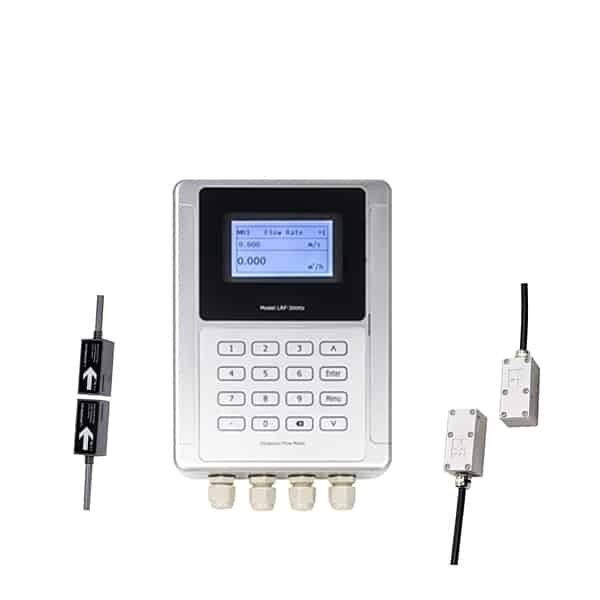 Clamp-On Ultrasonic Flow Meter
Permanent non-invasive metering for a fixed point.
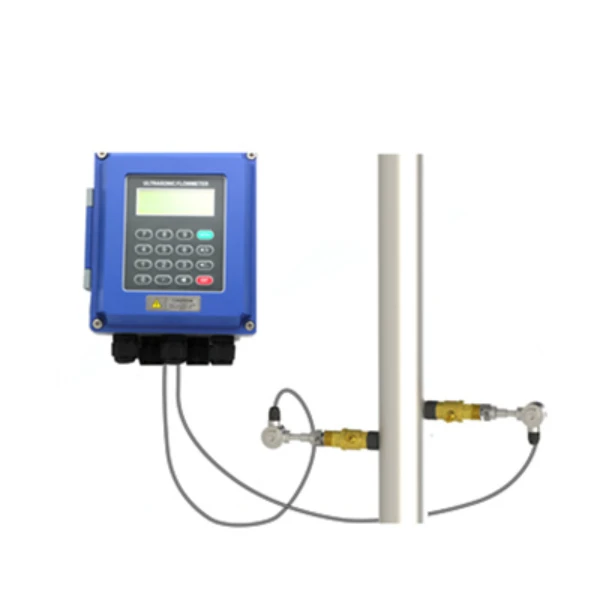 Insertion Ultrasonic Flow Meter
Probe-in-pipe metering for large or thick-walled lines.
Browse all ultrasonic flow meters →
FAQ
How accurate is a portable ultrasonic flow meter?
A clamp-on transit-time meter like the TUF-2000H reads to about ±1% of reading on a good full pipe with the pipe data entered correctly. Accuracy slips if the wall thickness is guessed, the pipe is lined or corroded, the liquid carries solids or air, or the transducers sit in disturbed flow near a pump or valve. Most field error comes from the install, not the instrument.
How does a portable clamp-on ultrasonic flow meter work?
Two transducers strap to the outside of the pipe and send ultrasonic pulses diagonally across it, one with the flow and one against it. The pulse travelling with the flow arrives sooner; the meter measures that time difference, converts it to average velocity, and multiplies by the pipe area to give flow. Nothing enters the pipe, so there is no cutting and no shutdown.
What are the limitations of a portable ultrasonic flow meter?
It needs a full pipe of dense, sound-conducting material and a single homogeneous liquid. Heavy suspended solids, entrained air, mortar liners, or badly corroded walls scatter the signal and degrade the reading. It also relies on correct pipe data and a stretch of straight pipe. For dirty conductive water a magnetic meter is steadier, and for slurries a Doppler meter is more suitable.
Can a portable ultrasonic flow meter measure any pipe size?
The TUF-2000H covers DN25 to DN1200 (1 to 48 in) with one transducer set, which spans most pipes on a typical site. Very small or very large lines, or unusual pipe materials, may need a specific transducer; tell us the outside diameter, wall thickness, and material and we confirm the set.
When should I choose a portable meter over a fixed one?
Choose portable when the reading is temporary: a spot check, a balancing survey, a baseline demand study, or verifying a meter already in the line. When you need a permanent reading, a fixed clamp-on or insertion ultrasonic meter, or a magnetic meter for conductive water, is the better long-term choice.
Request a quote
Send us the pipe outside diameter and wall thickness, the pipe and liner material, the liquid and its approximate temperature, and whether this is a one-time survey or a permanent point. We confirm the transducer set and configure one kit for the lines you actually need to read.