Home › Products › Level Instruments › Ultrasonic Level Sensors › External Ultrasonic Tank Level Sensor
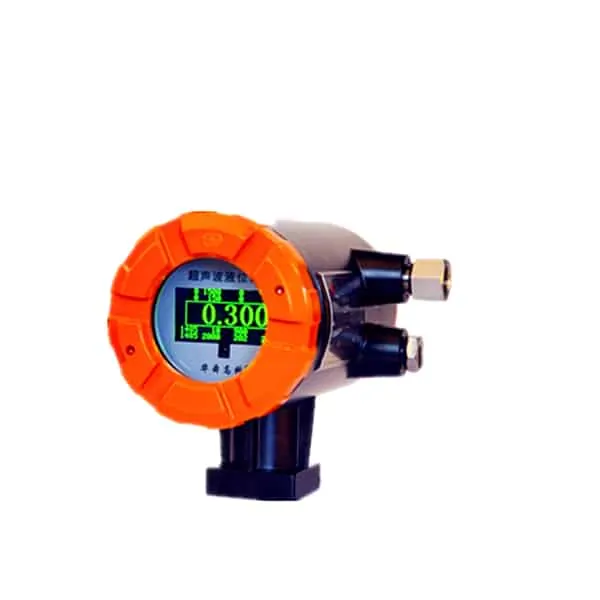
External Ultrasonic Tank Level Sensor (HS-2000)
A non-invasive level meter that bonds to the outside bottom of a tank and reads the level up through the wall. Nothing is drilled and nothing enters the tank, and the explosion-proof Ex d IIC T6 build makes it the answer for sealed, pressurised tanks of toxic, corrosive or flammable liquid.
- Mount: external, bottom of tank, no penetration
- Range: 3, 5, 10, 20, 30 m; resolution 1 mm
- Error: plus or minus 0.1% FS
- Protection: Ex d IIC T6, IP67
- Output: 4-20 mA (750 ohm), RS-485, IrDA
Overview
An external ultrasonic tank level sensor measures level from the outside of the tank. The probe bonds to the bottom of the tank wall and sends an ultrasonic pulse up through the steel and the liquid to the surface, timing the echo to give the level. Because nothing is drilled and nothing enters the tank, it retrofits onto a tank that is already in service, including a sealed, pressurised or coded vessel that cannot be opened.
The HS-2000 uses high-speed signal processing to overcome the tank wall and read the level inside a hermetic tank. It is explosion-proof to Ex d IIC T6 and sealed to IP67, which is why it is used on tanks of toxic, strongly acidic, strongly alkaline and flammable liquid, where opening a nozzle is out of the question. It reads from 3 to 30 m to plus or minus 0.1% FS with a 1 mm resolution, outputs 4-20 mA and RS-485, and sets up by infrared with self-calibration and self-test.
Features
Why a non-invasive, explosion-proof sensor suits a sealed tank:
Explosion-proof Ex d IIC T6
Rated for a flammable atmosphere, with an IP67 housing, so it fits LPG and solvent tanks.
No penetration
The probe bonds outside, so nothing is drilled and nothing enters the tank or the product.
Retrofit in service
Fit it to a full, sealed or pressurised tank without a shutdown or any hot work.
Reads toxic and corrosive
Ammonia, chlorine, acids and solvents are read through the wall, never touching the probe.
Infrared setup, self-test
Self-calibration, infrared debugging in service, self-test and one-key recovery.
4-20 mA and RS-485
On-site OLED display plus 4-20 mA and RS-485 to a PLC or SCADA, set up over IrDA.
Working principle
The probe is bonded to the outside of the tank bottom with a couplant, so its ultrasonic pulse passes into the steel and on into the liquid above. The pulse travels up to the liquid surface, reflects, and returns to the probe; the time of flight through the liquid gives the height of liquid, which is the level. Nothing crosses the wall but sound, so the tank stays sealed and the explosion-proof boundary is never broken.
Because the pulse must cross the wall and travel through one body of liquid, the method suits a solid metal wall and a single, settled liquid. A very thick wall, heavy sediment on the bottom, a layered or foaming product, or unstable temperature and pressure weaken or shift the echo, so for those a top-mounted radar or a wetted sensor reads more steadily. A small blind area near the probe sets the lowest level it can read.
Technical specifications
| Parameter | Specification |
|---|---|
| Model / type | HS-2000 external (non-invasive) ultrasonic liquid level meter |
| Measuring range | 3 m, 5 m, 10 m, 20 m, 30 m |
| Resolution / repeatability | 1 mm; short-time repeatability 1 mm |
| Measuring error | Plus or minus 0.1% FS (thick wall, unstable pressure or temperature may affect) |
| Span shift | Plus or minus 10 m |
| Output / communication | 4-20 mA (max load 750 ohm); RS-485; IrDA infrared |
| Display | Four-digit OLED (unit: m) |
| Ambient temperature | Panel −30 to 70 °C; probe −50 to 100 °C (wider on request) |
| Ambient humidity | 15% to 100% RH |
| Explosion-proof / ingress | Ex d IIC T6; IP67 |
A small blind area near the probe sets the lowest level the meter can read; allow for it when siting the probe.
Applied media and industries
Because the pulse never touches the liquid, the HS-2000 reads media that would attack or foul a wetted sensor: liquefied gases and refrigerants such as LPG, liquid ammonia, liquid chlorine, dimethyl ether and freon; strong acids and alkalis such as sulfuric, nitric and hydrochloric acid and caustic; and hydrocarbons and solvents such as gasoline, diesel, kerosene, plant oil, toluene, xylene and acetone. It serves the petrochemical, chemical, oil-refining, pharmaceutical, food, marine and refrigeration industries.
Installation
Pick a clean, flat spot on the tank bottom away from welds, the sump and internal structure, and clean it to bare metal. Apply the couplant and bond the probe, by magnet on a ferromagnetic tank or by an adhesive transfer plate and then magnet on others. Set the range and the liquid in the panel over the infrared link, route the cable and wire the 4-20 mA or RS-485 output and the power. Confirm the reading against a known level, and keep clear of the blind area near the probe.
Applications
- LPG, ammonia and chlorine tanks where no penetration is allowed
- Sealed fuel, diesel, kerosene and plant-oil tanks
- Strong-acid and caustic tanks retrofitted in service
- Pressurised and explosive-atmosphere vessels (Ex d IIC T6)
- Marine, refining and pharmaceutical tanks reporting to SCADA
Challenge: An LP-gas operator needed level on pressurised LPG tanks, where drilling or opening the vessel for a probe was not an option and the area was classified.
Solution: Explosion-proof HS-2000 sensors bonded to the outside bottom of each tank, reading up through the wall and feeding 4-20 mA, with nothing crossing the pressure boundary.
Result: Continuous level on sealed tanks with no penetration, no shutdown and the pressure rating and Ex boundary untouched.
Related products
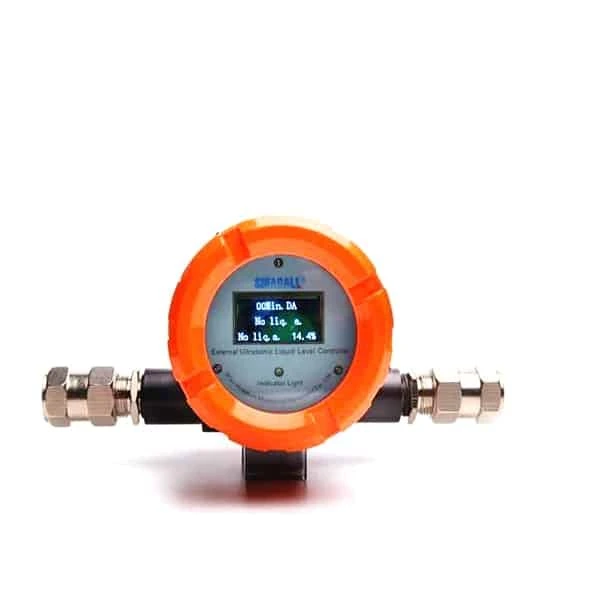 Ultrasonic Level Switch
External, non-contact control (HS-ULC) with relay output for high or low level alarm.
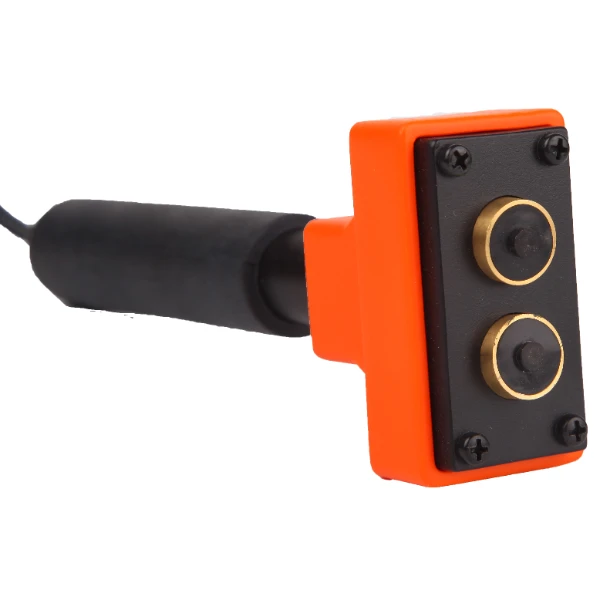 Ultrasonic CO2 Level Indicator
Portable handheld tool (SI-ML) to check CO2 and clean-agent cylinder level from outside.
Browse all ultrasonic level sensors →
Pressurized LP-Gas tanks are the classic case for reading through the shell, since a new penetration means taking the vessel out of service. The full set of options for those tanks is compared under propane and LPG tank level sensors.
FAQ
How does an external ultrasonic tank level sensor work?
The probe bonds to the outside bottom of the tank and sends an ultrasonic pulse up through the wall and the liquid to the surface, timing the echo to give the level. Nothing crosses the wall but sound, so the tank stays sealed.
Is the HS-2000 explosion-proof?
Yes. The HS-2000 is rated Ex d IIC T6 with an IP67 housing, and because it is non-contact and never opens the tank, it suits LPG, solvent and other flammable or pressurised tanks in a classified area.
Can ultrasonic measure level through a tank wall?
Yes, through a solid metal wall with a couplant between the probe and the wall. A very thick wall, heavy sediment or a foaming, layered product weakens the echo, so the method suits a settled single liquid in a clean-bottomed tank.
What are the disadvantages of external ultrasonic level measurement?
A very thick wall, bottom sediment, a layered or foaming liquid, or swinging temperature and pressure can weaken or shift the echo, and there is a small blind area near the probe. Choosing a clean mounting spot and a settled liquid handles most cases; where they cannot, a top-mounted radar or a wetted sensor is the better choice.
Request a quote
Tell us the tank wall material and thickness, the liquid and the height, and whether the area is classified, and we configure one external sensor for the tank, not a shelf part.