By Wu Peng, Senior Process Instrumentation Engineer · Last reviewed July 30, 2026
Home › Tools › Tank Volume Calculator
This tank volume calculator covers vertical cylindrical tanks and rectangular tanks. Enter the tank dimensions and the measured liquid level, and it returns the total capacity, the liquid volume at that level, the percent full, and, if you enter a density, the weight of the contents. It also builds a five-step dip chart for your tank, so one reading converts to volume without reopening the page. The math is V = π × d²/4 × h for a cylinder and V = L × W × h for a rectangle.
Use internal dimensions where you can; wall thickness on a small tank easily costs a few percent. The calculator assumes a flat bottom, a level tank, and a level taken from the bottom. For a horizontal cylinder, where half depth is not half volume, use the horizontal tank volume calculator instead.
Calculator
Tank volume and contents
Results update as you type. Assumes a flat-bottom tank on level ground, internal dimensions, and level measured from the tank bottom. Cone bottoms, domed tops, and heads are not included.
Method and formulas
Both shapes share the same logic: the liquid volume is the tank cross-section multiplied by the liquid height. For a vertical cylinder the cross-section is a circle, so capacity and contents come from one formula each. For a rectangular tank it is simply length times width.
Vcylinder = π × d²/4 × h Vrectangular = L × W × h
Because the cross-section does not change with height, the percent full always equals the level divided by the tank height: a vertical tank filled to 40 percent of its height holds 40 percent of its capacity. That convenient rule breaks for horizontal cylinders, where the cross-section widens toward the middle; that case has its own calculator with the circular-segment math.
For gallons, remember that one cubic foot holds 7.48 US gallons. A classic shop check: a vertical cylinder 36 inches across and 72 inches tall works out to 73,287 cubic inches, which is 317 US gallons. Type those numbers into the calculator above and it returns 317.3 US gallons.
Worked example
A vertical storage tank is 2 m in diameter and 3 m tall, and a level transmitter reads 1.2 m of liquid.
- Capacity = π × 2²/4 × 3 = 9.42 m³ = 9,425 liters
- Liquid volume = π × 2²/4 × 1.2 = 3.77 m³ = 3,770 liters
- Percent full = 1.2 / 3 = 40 percent
- If the liquid is diesel at 840 kg/m³, the contents weigh 3.77 × 840 = about 3,167 kg
A rectangular water-treatment tank 2 m long and 1.5 m wide, 2 m deep and filled to 0.8 m, holds 2 × 1.5 × 0.8 = 2.4 m³, which is 2,400 liters and again 40 percent of its 6 m³ capacity. The calculator above opens with the vertical example preloaded; switch the shape to rectangular to reproduce the second one.
Application example
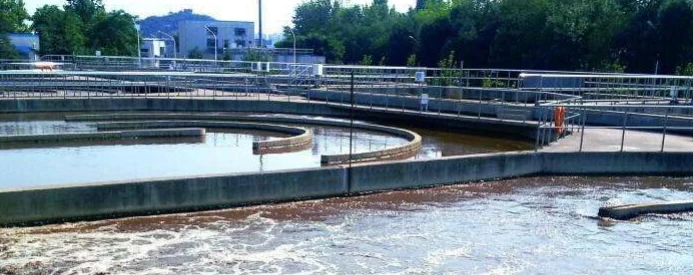
Rubber manufacturer, Malaysia. A water-treatment plant needed level measurement on an open, atmospheric tank holding water and treatment chemicals. We proposed a non-contact radar level transmitter for the service: nothing touches the liquid, and the level reading converts to tank contents with exactly the math on this page. The selection is with the customer.
Reading the level
The calculator is only as good as the level number you feed it. On a small tank a dipstick or a sight glass is fine: lower a clean rod to the bottom, read the wetted length, and enter it above. On process tanks a level transmitter does the same job continuously.
A hydrostatic level sensor reads the pressure of the liquid column, which itself depends on density; our guide to hydrostatic pressure walks through that conversion. Radar and ultrasonic level sensors measure from the top without touching the liquid. Many transmitters can also do this volume conversion internally once you enter the tank geometry, so the output signal reads directly in liters or gallons; browse the full range of level instruments to match one to your tank.
Related guides and tools
For lying-down cylindrical tanks, the horizontal tank volume calculator handles the circular-segment geometry, including 2:1 elliptical and hemispherical heads. If you are converting a pressure reading into a level before using this page, the hydrostatic pressure guide covers the P = rho g h math with worked numbers. All our calculators live under engineering tools.
FAQ
What is the formula for the volume of a tank?
For a vertical cylindrical tank, volume = pi times diameter squared divided by 4, times height. For a rectangular tank, volume = length times width times height. To get the liquid contents instead of total capacity, use the measured liquid level in place of the tank height.
How to calculate volume to gallons?
Work the volume out in cubic feet and multiply by 7.48 to get US gallons, or work it out in liters and divide by 3.785. One cubic meter is 1,000 liters, which is 264.2 US gallons. The calculator on this page outputs US gallons, UK gallons, liters, cubic meters, cubic feet, and oil barrels directly.
How do you measure tank volume manually?
Measure the internal diameter (or length and width) and the height with a tape, then lower a clean, dry rod to the tank bottom and read the wetted length as the liquid level. Apply the formulas above, or enter the numbers in this calculator. A printed dip chart made the same way turns every future rod reading straight into volume.
How to calculate rectangular tank volume?
Multiply length by width by height in the same unit, then convert: cubic meters times 1,000 gives liters; cubic feet times 7.48 gives US gallons. A tank 2 m long, 1.5 m wide, and 2 m tall holds 6 cubic meters, or 6,000 liters. For the liquid contents, use the liquid level instead of the full height.
Request a quote
If the level number for this calculator still comes from a rod and a flashlight, we can fix that. Send us the tank shape, dimensions, medium, and temperature, and we will propose a level transmitter that reports level or volume directly. Reach our application engineers or use the form below.
Written and technically reviewed by Wu Peng and the Instranova engineering team.