Flow Meters › Vortex Flow Meters › Nitrogen Flow Meter
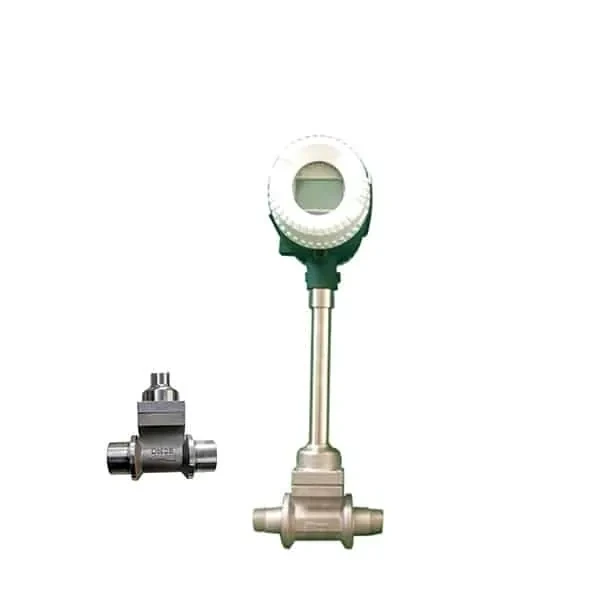
Vortex Nitrogen Flow Meter
A vortex flow meter for nitrogen. It counts the vortices a bluff bar sheds into the gas, with no moving parts, and built-in temperature and pressure compensation reports the nitrogen in standard volume. A threaded body suits the small lines of inerting and blanketing, with wafer and flange for larger pipe.
- Principle: Karman vortex shedding
- Size: DN15 to DN300, threaded, wafer, or flange
- Accuracy: ±1.0% or ±1.5% of rate
- Compensation: optional built-in T and P, standard volume
- Output: 4-20 mA, pulse; IP65; Ex ia or Ex d
Overview
A vortex nitrogen flow meter measures N2 by counting the vortices a bluff bar sheds into the gas. The shedding frequency gives the velocity, and the meter scales it to volume; because gas density moves with temperature and pressure, built-in temperature and pressure sensing corrects it and reports the nitrogen in standard volume, in Nm3/h. There are no moving parts to wear, and a threaded body fits the small lines that nitrogen inerting and blanketing usually run on, with wafer and flange for larger pipe.
It suits a steady nitrogen line where you want a cost or balance total. A vortex meter needs a minimum velocity to shed cleanly, so for very low blanketing flows or leak-level detection a thermal mass meter reads where a vortex cannot. For a general vortex selection across steam, gas, and liquid, see the vortex flow meter; for plant air, see the compressed air flow meter.
Features
Everything here follows from one job: metering nitrogen on a small line, with no moving parts.
Threaded for small lines
A threaded body fits the small-bore lines of nitrogen inerting and purging, with wafer and flange above.
Standard volume, Nm3/h
Built-in temperature and pressure correct the gas density and report the nitrogen in standard volume.
No moving parts
A fixed bar in the flow means nothing wears, for a long life on clean dry nitrogen.
Hot gas to 400 C
A capacitive-sensor build reads hot nitrogen and process gas to 400 C.
4-20 mA, pulse, battery
An LCD head drives analog and pulse, with a 3.6 V lithium battery for a local total.
Ex ia or Ex d
Intrinsically safe or flameproof builds suit a nitrogen line in a classified area.
Working principle
A bluff body, the shedder bar, sits across the bore. As nitrogen passes it sheds vortices alternately from each side, the Karman vortex street, and the shedding frequency is proportional to the flow velocity. A sensor counts the frequency, and the meter scales velocity to volume flow from the known bore. Gas density changes with temperature and pressure, so an integrated temperature and pressure measurement corrects it and gives the flow in standard volume. The bar needs a developed profile and a minimum velocity to shed reliably, so the meter asks for straight pipe and is weak at very low flow.
Technical specifications
| Parameter | Specification |
|---|---|
| Measurement principle | Karman vortex shedding; volumetric, with optional T and P compensation to standard volume |
| Medium | Nitrogen and other clean, dry gas |
| Standard | JB/T 9249 vortex flow meter |
| Size | DN15 to DN300; DN300 to DN1000 insertion |
| Connection | Threaded, wafer, or flange |
| Nominal pressure | DN15 to DN200 to 4.0 MPa; DN250 to DN300 to 1.6 MPa |
| Medium temperature | Piezoelectric -40 to 150, 260, or 330 C; capacitive sensor to 400 C |
| Body material | 1Cr18Ni9Ti stainless steel; other materials by agreement |
| Accuracy | ±1.0% or ±1.5% of rate; insertion ±2.5% |
| Turndown | 1:6 to 1:25 |
| Outputs | 4-20 mA; voltage pulse (high ≥5 V, low ≤1 V) |
| Power | DC 12 V or 24 V; 3.6 V lithium battery for local display |
| Pressure loss coefficient | Cd ≤ 2.4 (JB/T 9249) |
| Protection | IP65 (IP68 for submersible install) |
| Explosion protection | Intrinsically safe Ex ia IIC T2-T4; flameproof Ex d IIC T2-T5 |
Representative specifications; confirm per datasheet for the size, pressure, and temperature you need.
Ordering example. Vortex nitrogen flow meter for a DN25 blanketing line, threaded, temperature and pressure compensation for Nm3/h, 4-20 mA and pulse, Ex ia.
Threaded, wafer, or flange
Nitrogen lines run from a small purge line up to a large supply main, so the connection is set by the pipe:
- Threaded. For small-bore lines, the size most nitrogen inerting and blanketing runs on. A threaded body is simple to fit and detach, DN15 to DN50.
- Wafer or flange. For larger supply lines, a wafer body clamps between flanges and a flange body bolts in, up to DN300.
- Insertion. For a large nitrogen main, an insertion probe meters the duct from one tapping, DN300 to DN1000, at a lower cost than a full-bore body.
Applications
Vortex nitrogen meters suit steady N2 lines where a standard-volume total matters:
- Tank and vessel blanketing to keep oxygen out
- Reactor and line inerting and purging
- Nitrogen generator output and distribution
- Food and beverage packaging gas
- Electronics and soldering process nitrogen
Application example
Nitrogen blanketing. A plant blanketing several storage tanks with nitrogen wanted a standard-volume total on each small supply line, to track gas use and confirm each tank held its blanket. Threaded vortex meters fitted the small lines and, with temperature and pressure compensation, totalized the nitrogen in Nm3. Where a tank breathed only a trickle of make-up gas overnight, a thermal mass meter read the low flow that a vortex meter would miss, and the two split the work by flow.
Related products
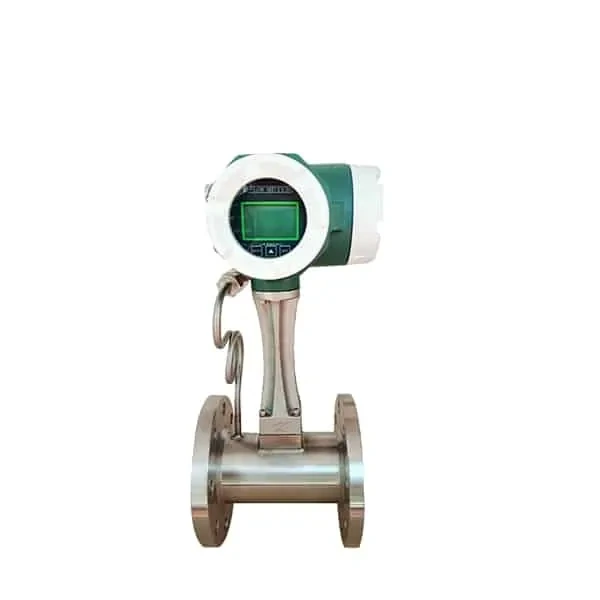 Compressed Air Flow Meter
The same vortex meter set up for plant compressed air.
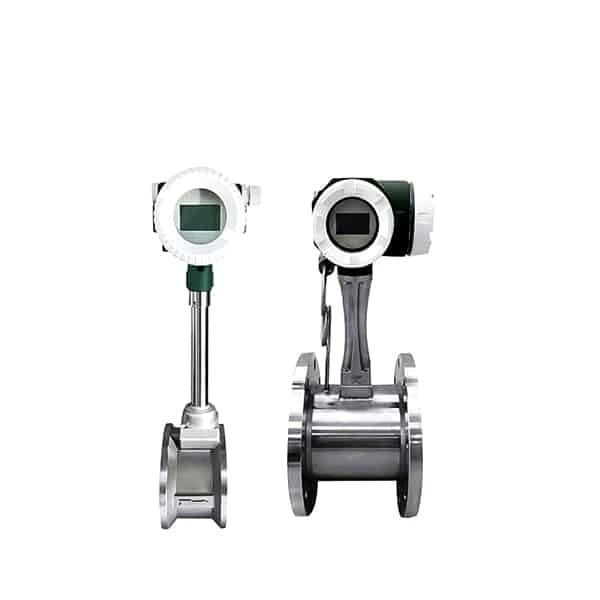 Vortex Flow Meter
General vortex selection for steam, gas, and liquid.
Browse all vortex flow meters →
FAQ
How do you measure nitrogen flow?
With a vortex or a thermal mass meter. A vortex meter counts the vortices a bar sheds in the gas and, with temperature and pressure, reports the nitrogen in standard volume; it suits a steady line. A thermal mass meter reads mass directly and down to low flow, which suits a trickle of blanketing gas.
What flow meter is used for nitrogen?
For a steady nitrogen line a vortex meter is a robust, no-moving-parts choice with a standard-volume total, and a threaded body fits the small lines of inerting and blanketing. For very low flow or leak detection, a thermal mass meter reads lower. Many plants use both by line.
Can a vortex flow meter measure nitrogen?
Yes. Nitrogen is a clean dry gas, which suits the vortex principle well. The meter needs a minimum velocity to shed cleanly, so it works best on a line carrying a steady flow rather than a near-static blanket.
How much straight pipe does it need?
40 diameters upstream and 20 downstream, so the flow profile is developed where the bar sheds. Flow conditioners can shorten the upstream run where space is tight.
Request a quote
Send us the line size and connection, the nitrogen pressure and temperature, and the flow range, and we set the body, the compensation, and the outputs.