Home › Products › Flow Meters › Turbine Flow Meters › Insertion Turbine Flow Meter
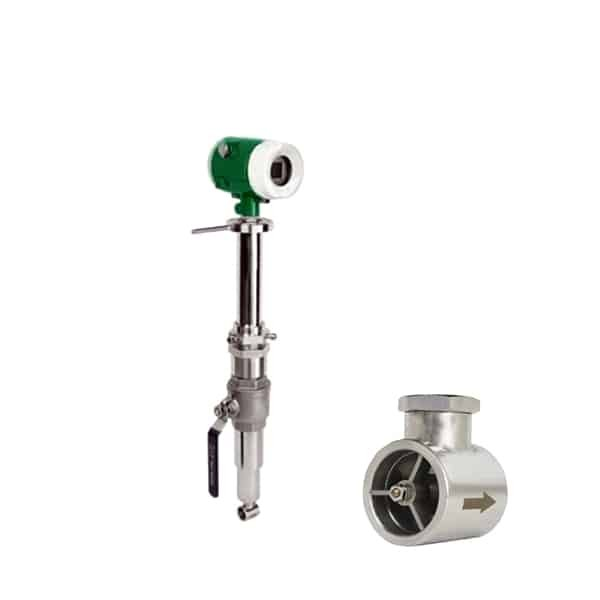
Insertion Turbine Flow Meter
A turbine flow meter on a probe that inserts through a tap into a large pipe, so it meters a big main at a fraction of the cost of a full-bore meter. A tangential impeller reads the local velocity, and the impeller and bearing swap out without changing the meter coefficient.
- Type: insertion probe, tangential impeller (LWCQ / LWCB)
- Pipe: DN100 to large mains, hot-tap install
- Accuracy: plus or minus 2.5% of range
- Medium: minus 20 to 120 C, to 1.0 MPa
- Remote: display up to 1000 m from the probe
Overview
An insertion turbine flow meter puts a small turbine on the end of a probe that reaches into the pipe through a tap. Instead of a meter body the size of the line, you drill and tap the pipe once and slide the probe in, so a DN600 main costs about the same to meter as a DN100 one. The tangential impeller turns with the local velocity, and the meter scales that to the flow across the whole pipe.
It reads to plus or minus 2.5% of range on liquids from minus 20 to 120 C, up to 1.0 MPa, and the display can sit up to 1000 m from the probe. The impeller is built to shed debris rather than wind it on, and the impeller and bearing can be replaced without changing the meter coefficient, so a worn meter goes back into service without a recalibration.
Features
Why an insertion turbine suits a large pipe:
Low cost on big pipe
One probe and tap meters a large main, so the cost barely changes as the pipe grows.
Hot-tap install
A probe goes in through a tap, so a running line is metered without a full shutdown.
Anti-debris impeller
A tangential impeller sheds suspended debris rather than winding it onto the blades.
Coefficient holds
Replace the impeller and bearing and the meter coefficient stays, so no recalibration.
Remote display
The display sits up to 1000 m from the probe, and the probe can stay submerged.
Wide turndown
A wide flow range with a low lower limit, sized to the pipe diameter and rod length.
Working principle
The probe carries a small turbine at its tip, set at a depth that puts the impeller at the average-velocity point of the pipe. Flow turns the tangential impeller at a speed proportional to the local velocity, and a pickup counts it. The meter knows the pipe diameter and the insertion depth, so it scales the local velocity to the flow across the full cross-section. The depth matters, so the probe is set to a fixed insertion for the pipe size on installation.
Because it samples one point rather than the whole bore, an insertion meter is less accurate than a full-bore turbine and needs a developed, symmetric flow profile to read well. That is why it asks for a long straight run, and why a short run is corrected by an on-site calibration of the meter coefficient. It suits a large line where a full-bore meter is too costly, not a small line where the inline meter is both cheaper and more accurate.
Technical specifications
| Parameter | Specification |
|---|---|
| Models | LWCQ, LWCB insertion turbine |
| Accuracy | Plus or minus 2.5% of range (plus or minus 5% on the wide range) |
| Insertion depth | Set to the pipe size on install; pipe DN up to 1050 mm and above |
| Nominal pressure | 1.0 MPa |
| Medium temperature | Minus 20 to 120 C |
| Ambient temperature | Minus 20 to 70 C |
| Sensor to display | Up to 1000 m or more |
| Straight run | Upstream 20 DN, downstream 7 DN; on-site K calibration if shorter |
Flow ranges by pipe size
| Pipe DN (mm) | Flow range (m3/h) |
|---|---|
| DN100 | 6 to 150 |
| DN150 | 13 to 200 |
| DN200 | 23 to 300 |
| DN250 | 36 to 450 |
| DN300 | 52 to 650 |
| DN350 | 70 to 900 |
| DN400 | 92 to 1100 |
Insertion or full-bore
The choice comes down to pipe size and accuracy. On a small line a full-bore turbine is both cheaper and tighter, so there is no reason to insert. On a large main a full-bore meter gets expensive and heavy fast, and the insertion probe holds its cost while the pipe grows, at the price of accuracy: plus or minus 2.5% of range instead of plus or minus 0.5%. So insert on a big line where a 2.5% reading is good enough and the budget rules out a full-bore meter; use the inline turbine flow meter on a small line, or where the reading must be tight.
Installation
Drill and tap the pipe, fit the isolation valve, and insert the probe to the depth set for the pipe size with the flow arrow correct. Give it a long straight run, at least twenty diameters upstream and seven downstream, because a single-point meter needs a developed profile; if the run is short, calibrate the meter coefficient on site. The probe can stay submerged, so an open-air or below-grade chamber is fine, and the display goes up to 1000 m away.
Applications
- Large water-distribution and raw-water mains
- Irrigation and canal feed metering
- Cooling-water and circulation lines in plant
- District heating and large circulation loops
- Retrofit metering on an existing big pipe by hot tap
A site needed flow on a large raw-water main but could not justify a full-bore meter or a long shutdown. An insertion turbine went in through a hot tap on the running line, set to the pipe depth, with the display in the control room well away from the pipe. The plus or minus 2.5% reading was enough for the balance, and a later impeller swap went back in without a recalibration.
Related products
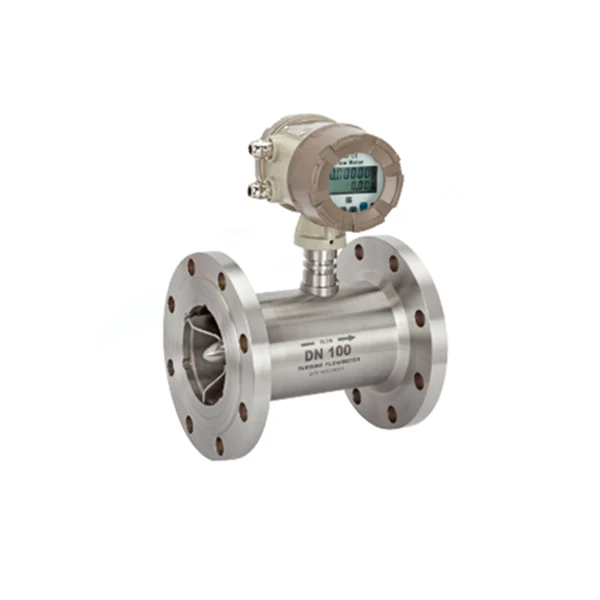 Turbine Flow Meter
The full-bore inline LWGY for clean liquids, to plus or minus 0.5% on a small line.
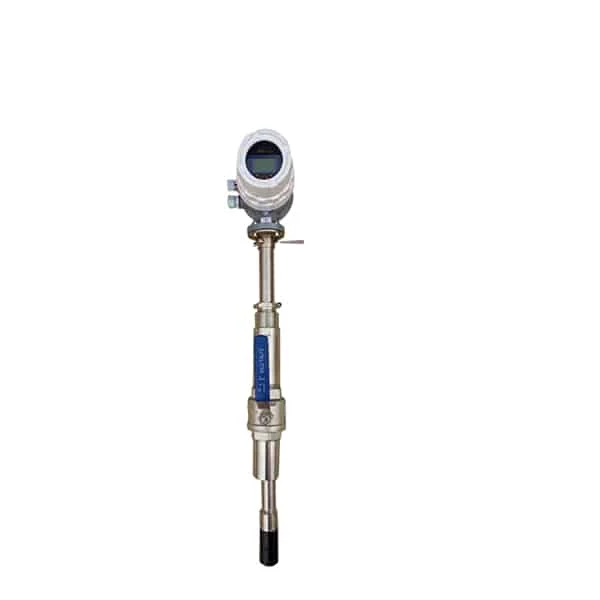 Insertion Magnetic Flow Meter
The insertion mag option for a conductive liquid on a large main, with no moving parts.
Browse all turbine flow meters →
FAQ
How does an insertion turbine flow meter work?
A small turbine on a probe sits at the average-velocity point of the pipe. Flow spins the impeller at a speed proportional to the local velocity, and the meter scales that to the flow across the whole pipe using the pipe diameter and insertion depth.
How accurate is an insertion turbine meter?
About plus or minus 2.5% of range, less tight than a full-bore turbine because it samples one point rather than the whole bore. A long straight run, correct insertion depth and an on-site calibration all help it read well.
Can it be installed without shutting the line down?
Yes. With an isolation valve fitted to the tap, the probe is inserted and withdrawn under a hot-tap procedure, so a running main is metered without a full shutdown.
When should I use a full-bore turbine instead?
On a small line, where a full-bore meter is cheaper and more accurate, or wherever the reading has to be tight. Insertion is the better choice on a large main where a full-bore meter is too costly.
Request a quote
Tell us the pipe size, the liquid, the temperature and the pressure, and we configure one insertion meter for the application, not a shelf part.