Flow Meters › Variable Area Flow Meters › Gas Rotameter
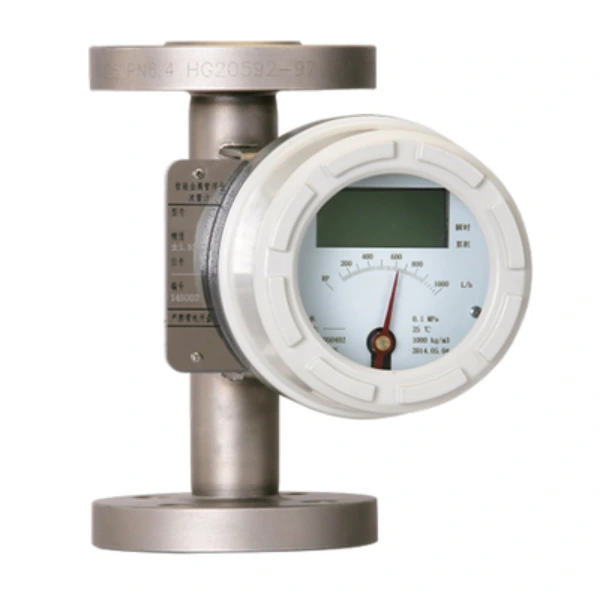
Gas Rotameter
A metal tube variable area flow meter for gas, with built-in temperature and pressure compensation. It reads the live temperature and pressure and corrects the reading to standard volume, so a gas flow shows as normal cubic meters on the dial, not raw actual volume.
- Principle: Variable area, with T and P compensation
- Medium: gas and steam
- Size: DN15 to DN200
- Compensation: live T and P to standard volume and mass
- Output: 4-20 mA and HART; graphic LCD; IP67
Overview
A gas rotameter is a metal tube variable area flow meter built for gas, with temperature and pressure compensation inside the indicator. A float rides in a tapered tube the same as any rotameter, but the head also reads the live gas temperature and pressure and corrects the flow to standard conditions. So instead of raw actual volume, which changes with temperature and pressure, the meter shows standard volume in normal cubic meters, which is what a gas line is usually billed and balanced on.
Gas volume is sensitive to temperature and pressure, so an uncompensated reading drifts as conditions change. Building the compensation into the meter removes the need for a separate flow computer, and it reads well on small and low-velocity gas flows where that correction matters most. For a non-gas line, the metal tube rotameter in stainless is the base meter; for a very small gas dosing line, see the low flow rotameter.
Features
Everything here follows from one idea: correct the gas reading to standard conditions inside the meter.
Built-in T and P compensation
The head reads live temperature and pressure and corrects the gas flow in real time, by patent design.
Standard volume, not actual
The reading is normal cubic meters at standard conditions, so it holds steady as temperature and pressure change.
Graphic LCD, multi-parameter
A dot-matrix display shows standard and actual flow, velocity, pressure, temperature, and total, in English menus.
Strong on low gas flow
The correction matters most on small and low-velocity gas, where actual volume swings hardest.
4-20 mA and HART
Two-wire 4-20 mA with HART, plus Modbus, pulse, batch, and limit alarms.
All-metal, rugged
An all-metal tube with no glass, rated IP67, with Ex ia or Ex d for hazardous gas areas.
Working principle
Flow enters the bottom of a tapered tube and pushes up on a float. As the float rises in the tapering bore, the open area grows and the drag falls, until lift balances weight and the float settles at a height that tracks the actual flow. A magnet couples the float to the indicator. For gas, the indicator also takes a live temperature and a live pressure, and applies the gas law to convert actual volume to standard volume, and to mass. The corrected value is what the LCD shows and what the 4-20 mA or HART output sends.
Technical specifications
| Parameter | Specification |
|---|---|
| Measurement principle | Variable area with integrated temperature and pressure compensation |
| Medium | Gas and steam |
| Accuracy | 1.5, 2.5, or 4.0 grade (percent of full scale) |
| Flow range | Air 0.5 to 2000 m3/h (at 20 C, 0.1013 MPa) |
| Size | DN15 to DN200 |
| Turndown | 10:1 standard, 20:1 special |
| Compensation | Online temperature and pressure to standard gas volume and mass |
| Tube material | 304 or 316L stainless |
| Medium pressure | Absolute 0 to 4.0 MPa |
| Medium temperature | -50 to +450 C (by build) |
| Output | Two-wire 4-20 mA plus HART; pulse, frequency, batch, OC or relay alarm |
| Communication | HART or Modbus |
| Display | Graphic dot-matrix LCD, English or Chinese menu |
| Power | 24 V DC or 220 V AC |
| Protection | IP67 |
| Explosion protection | Flameproof Ex d IIC T1-T6 Gb; intrinsically safe Ex ia IIC T1-T6 Gb |
Representative specifications; confirm per datasheet for the gas, size, and conditions you need.
Ordering example. Gas rotameter, DN50, compressed air, 20 to 200 m3/h at standard conditions, 4-20 mA plus HART, graphic LCD, Ex d.
Temperature and pressure compensation
The compensation is the point of this meter, and it is worth being clear on what it does:
- Why gas needs it. A gas expands and contracts with temperature and pressure, so the actual volume passing the meter is not a fixed amount of gas. A reading in standard volume, corrected to a reference temperature and pressure, is a true measure of how much gas flowed.
- How it works here. The indicator takes a live temperature and a live pressure at the meter and applies the gas law to convert actual volume to standard volume and to mass, in real time, so no separate flow computer is needed.
- Auto or manual. The compensation can run automatically from the live sensors, or on fixed manual values where a process holds a steady temperature and pressure. Sensor faults and over-range raise an alarm.
Applications
Gas rotameters with compensation suit measured gas where conditions move:
- Compressed air and plant gas distribution
- Nitrogen, oxygen, and inert gas feed
- Process and reaction gas in chemical plants
- Steam and low-velocity gas metering
- Gas dosing where standard volume must be billed or balanced
Application example
Process gas in new materials. A chemical manufacturer measuring a process gas in battery-material production found an uncompensated meter could not track the gas as its temperature and pressure shifted. A gas rotameter with built-in temperature and pressure compensation read the live conditions and reported standard volume directly, which held the reading steady. The plant ran a small trial before standardizing on the type across many lines.
Related products
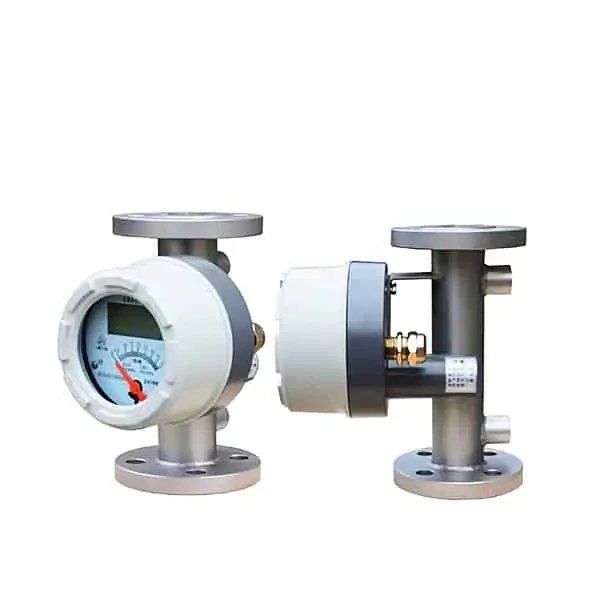 Metal Tube Rotameter
The standard stainless variable area meter for liquid and gas.
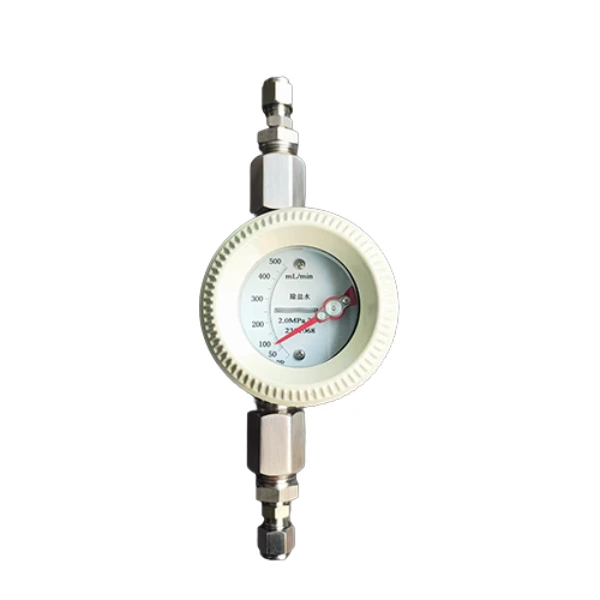 Low Flow Rotameter
For very small gas and liquid dosing lines, down to 0.1 L/h.
Browse all variable area flow meters →
On argon and other inert gas lines, the argon flow meter guide works through scale corrections and welding flow settings.
FAQ
What is a gas rotameter?
It is a metal tube variable area flow meter set up for gas, usually with built-in temperature and pressure compensation. A float in a tapered tube tracks the flow, and the indicator corrects the reading to standard volume, so it shows normal cubic meters of gas rather than raw actual volume.
Why does a gas reading need temperature and pressure compensation?
Gas expands and contracts with temperature and pressure, so the actual volume passing the meter is not a fixed quantity of gas. Compensating to standard conditions gives a true measure of how much gas flowed, which is what a line is usually billed and balanced on.
What is the difference between standard and actual volume?
Actual volume is the gas volume at the meter at its real temperature and pressure; it changes as those change. Standard volume is corrected to a reference temperature and pressure, so it is a stable measure. This meter computes and displays standard volume from the live conditions.
How accurate is it, and does it need a flow computer?
Accuracy is 1.5 to 4.0 grade by build, with the compensation handled inside the indicator, so no separate flow computer is required. Tell us the gas, the flow range, and the conditions and we set the size, the float, and the reference.
Request a quote
Send us the gas, the size, the flow range, and the temperature and pressure, and we set the float, the compensation, and the output.