Products › Torque Sensors › Rotary Torque Sensors › Dynamic Torque Sensor (WTQ2050)
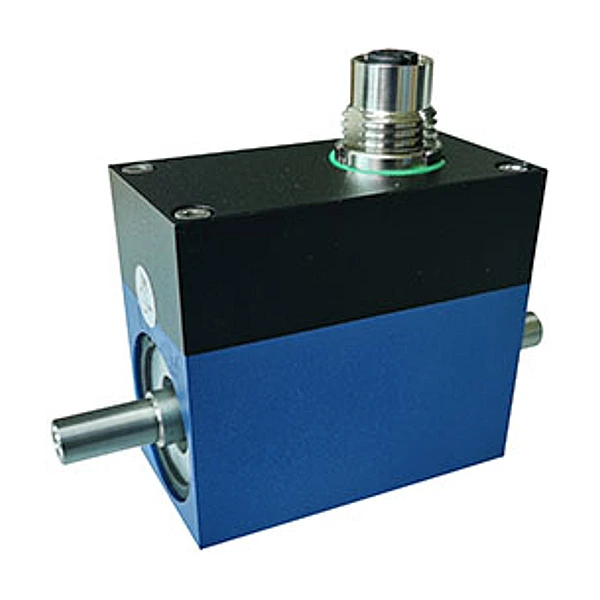
Dynamic Torque Sensor (WTQ2050)
A micro torque sensor measures very small rotational torque, from 0.1 N·m up to about 10 N·m, on a turning shaft. A strain-gauge bridge on a stainless-steel shaft section reads the twist, and the signal is taken off through brushes. It suits micro-motors, viscometers and small gear or actuator tests where a full-size rotary sensor is too coarse.
- Model: WTQ2050
- Range: 0.1 N·m to 5 N·m
- Type: compact non-contact rotary
- Speed: up to 8,000 rpm
- Accuracy: ±0.1 to ±0.2% FS
- Output: kHz, 4-20 mA, voltage, RS485 / RS232
Overview
The WTQ2050 is a compact dynamic torque sensor that reads torque on a turning shaft from 0.1 to 5 N·m at up to 8,000 rpm. It is non-contact, so the signal leaves the rotor without slip rings, and the small body fits tight benches and instrument drives.
It is the small-range member of our dynamic line. For a contact (brush) micro unit see the micro torque sensor; for higher torque see the non-contact torque sensor to 5,000 N·m or the general rotary torque sensors.
Features
What sets this micro torque sensor apart:
Compact body
A small non-contact body fits tight benches and instrument drives.
Non-contact
The signal crosses the rotor-to-stator gap with no slip rings, so nothing wears at speed.
0.1 to 5 N·m
Small-range dynamic torque for low-torque motors and actuators.
Up to 8,000 rpm
Fast enough for small motor and instrument drives, with an optional speed pickup.
Many outputs
Frequency, 4-20 mA, ±5 or ±10 VDC, RS485 and RS232 to match your controller.
Stable reading
Zero and span temperature effect stay within ±0.02% FS over the compensated range.
Working principle
A metal-foil bridge bonded to the shaft strains under torque. The bridge power and signal cross the rotor-to-stator gap without contact, so there are no slip rings or brushes to wear. With a small flexure the sensor resolves low torque from 0.1 N·m while still running to 8,000 rpm. An optional pickup counts shaft rotation for speed, and torque multiplied by speed gives power.
Technical specifications
| Parameter | Specification |
|---|---|
| Measuring principle | Compact non-contact rotary strain-gauge shaft |
| Measuring range | 0.1 to 5 N·m (0.1 / 0.2 / 0.5 / 1 / 2 / 3 / 5 N·m) |
| Accuracy | ±0.1 / ±0.2% FS |
| Zero temperature effect | ±0.02% FS |
| Span temperature effect | ±0.02% FS |
| Compensated temperature | -10 to 60 °C |
| Operating temperature | -20 to 75 °C |
| Maximum speed | Up to 8,000 rpm |
| Speed option | Optional speed pickup |
| Torque output | 10 ±5 kHz, 4-20 mA, ±5 VDC, ±10 VDC, RS485, RS232 |
| Supply | 12-24 VDC, under 100 mA |
| Overload protection | 200% FS |
| Material | Shaft 17-4PH stainless steel; housing aluminum |
Models and ranges
Standard rated torques, compact non-contact:
| Rated torque | Maximum speed |
|---|---|
| 0.1 N·m | 8,000 rpm |
| 0.5 N·m | 8,000 rpm |
| 1 N·m | 8,000 rpm |
| 2 N·m | 8,000 rpm |
| 3 N·m | 8,000 rpm |
| 5 N·m | 8,000 rpm |
Compact or higher range
Pick by torque range and signal transfer:
| Model | Range | Choose when |
|---|---|---|
| WTQ2050 compact | 0.1 to 5 N·m | Small torque, non-contact, tight space |
| Micro (brush) | 0.1 to 10 N·m | Low cost, low speed, contact signal |
| Non-contact WTQ2051 | 5 to 5,000 N·m | Higher torque, continuous running |
See all builds, including the encoder and pulley units, on the rotary torque sensors page.
Applications
- Small motor, servo and stepper torque tests
- Instrument and laboratory drives at low torque
- Micro-gearbox and small actuator characterization
- Benches where space is tight and slip-ring wear is unwanted
- Torque, speed and power on a small turning shaft
Challenge: A small-motor test bench needed torque well under 5 N·m on a shaft spinning a few thousand rpm, in a space too tight for a standard sensor.
Solution: A compact non-contact dynamic torque sensor in the 0.1 to 5 N·m range, with a voltage or frequency output to the bench data system.
Result: The small body fitted the bench, and the contactless signal ran without slip-ring wear, so the motor could be characterized over long runs.
Related products
FAQ
What is a dynamic torque sensor?
It is a torque sensor that reads torque on a rotating shaft, also called a rotary torque sensor. The WTQ2050 is a compact non-contact unit for 0.1 to 5 N·m at up to 8,000 rpm.
What torque range does the WTQ2050 cover?
From 0.1 to 5 N·m (0.1, 0.2, 0.5, 1, 2, 3 and 5 N·m), at speeds up to 8,000 rpm.
Is the WTQ2050 contact or non-contact?
Non-contact. The signal crosses the rotor-to-stator gap without slip rings, so nothing wears at speed. For a lower-cost contact (brush) unit see the micro torque sensor.
How does it differ from a micro torque sensor?
The WTQ2050 is non-contact and runs to 8,000 rpm; the micro torque sensor uses brush signal transfer and runs to 4,000 rpm. Both cover small torque ranges.
Can it measure speed and power?
Yes, with the optional speed pickup. Torque multiplied by angular speed gives mechanical power, so it can report torque, speed and power.
Request a quote
Tell us the torque range and shaft speed, and we configure one micro torque sensor for your drive, not a shelf part. Send the details and our engineers reply with a specification and quote.