Home › Products › Density meters › Portable density meter
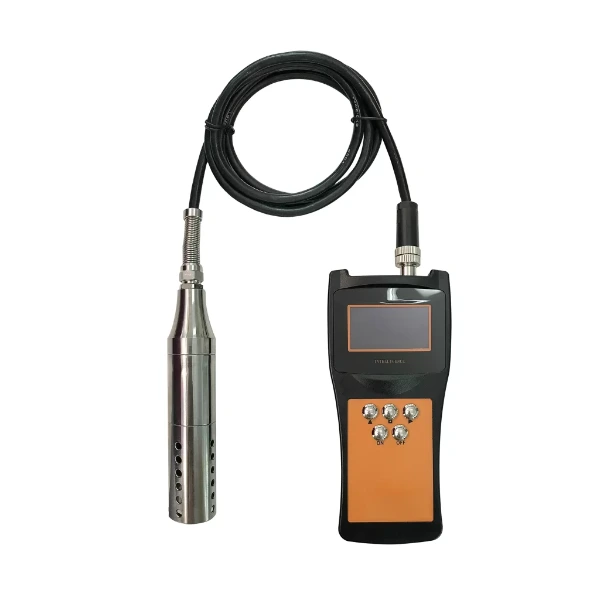
Portable Density Meter
A portable density meter is a battery-powered, handheld instrument that reads the density of a liquid, and the concentration it implies, on the spot. The probe dips into a tank, drum, or sample, so one unit checks many points in the field without a permanent installation.
- Type: Portable tuning fork, handheld
- Range: 0 to 3 g/cc (0 to 3000 kg/m³)
- Accuracy: ±0.003 g/cc (±3 kg/m³)
- Process temp: -20 to +100 °C
- Wetted: 316L, Hastelloy, zirconium
Overview
A portable density meter brings the density reading to the sample instead of routing the sample to a lab. The handheld unit drives a small tuning fork probe that you dip into the liquid; the fork vibrates, the liquid changes its frequency, and the meter shows density on a screen, along with the concentration that density represents for a known fluid. Because it runs on battery and needs no fixed mounting, one instrument checks incoming drums, blending tanks, and finished batches across a site.
This is the field counterpart to a fixed meter. Where a point has to be measured continuously and fed to a control system, use the inline tuning fork density meter; where the job is spot checks and quick concentration verification by hand, the portable meter is the right tool.
Features
Carry it to the tank or drum; no wiring or fixed install.
Reads density and the concentration it implies for a known fluid.
The fork dips straight into a tank or sample, with no bypass or cell.
A built-in PT100 corrects the reading as sample temperature varies.
316L, Hastelloy, or zirconium probe for acids and caustics.
Check incoming, in-process, and finished batches with a single meter.
Working principle
The probe is a tuning fork driven at its resonant frequency. When the fork is immersed, the liquid moves with the tines and adds mass, which lowers the frequency in a known way: the denser the liquid, the lower the frequency. The meter measures that frequency and converts it to density, while a built-in temperature sensor corrects the small effect of temperature on the fork. The handheld then displays density, or the concentration that density maps to for the selected fluid.
Because the reading is a frequency rather than a float position or a flowing stream, the portable meter does not need a steady flow or a fixed installation: wet the fork in a sample, let the tines settle, and it reports density. A calibration ties the frequency to density in engineering units, and the same reading converts to specific gravity or to the concentration that density maps to for the fluid being checked.
Technical specifications
| Parameter | Specification |
|---|---|
| Measuring principle | Portable tuning fork (resonant frequency) |
| Measuring range | 0 to 3 g/cc (0 to 3000 kg/m³) |
| Accuracy | ±0.003 g/cc (±3 kg/m³) |
| Repeatability | ±0.001 g/cc (±1 kg/m³) |
| Temperature effect (corrected) | ±0.0005 g/cc (±0.5 kg/m³) |
| Process temperature | -20 to +100 °C |
| Ambient temperature | -20 to +85 °C |
| Temperature coefficient | 0.1 kg/m³ per °C after calibration |
| Temperature sensor | Built-in PT100 |
| Wetted materials | 316L, Hastelloy, or zirconium probe |
| Power | Rechargeable battery (portable) |
Density and concentration
For a known fluid the meter converts density to concentration, so it doubles as a field concentration checker. Typical uses are confirming the strength of an acid or caustic, checking a blend or dilution before it goes into the process, and verifying a delivered batch against spec. Set the fluid once and the meter reads out percent by weight, Brix, Baume, or a custom scale. For a mixture of more than two components, density still gives a reliable trend but concentration should be confirmed against a lab result.
Materials and corrosion
The probe material is chosen for the fluid. The guide below summarizes common media; tell us the exact fluid, concentration, and temperature and we confirm the probe.
| Medium | 316L | Hastelloy | Zirconium |
|---|---|---|---|
| Hydrochloric acid, 0-40% (no HF) | Not suitable | Within limits | Recommended |
| Sulfuric acid, 0-50% | Within limits | Within limits | Recommended |
| Sulfuric acid, 75-98% | Within limits | Within limits | Within limits |
| Nitric acid, 0-100% | Within limits | Within limits | Recommended |
| Sodium hydroxide, 0-100% | Within limits | Recommended | Not suitable |
| Hydrogen peroxide, 0-90% | Recommended | Recommended | Not suitable |
Recommended = best choice; within limits = use within stated concentration and temperature; not suitable = do not use.
Applications
Portable density meters suit field and quality-control work across chemical, petrochemical, food and beverage, and pharmaceutical sites: checking acid and caustic strength, verifying blends and dilutions, confirming delivered batches, and spot-checking density or concentration where a fixed meter is not justified. The same unit moves between incoming storage, process tanks, and finished product.
Application example
Challenge. An operation needed to check liquid density and concentration at several tanks and drums in the field, and a fixed meter at each point was not practical.
Solution. A portable density meter, configured to the customer specification, let one operator dip and read density and concentration at each point in turn.
Result. The site got consistent density and concentration checks across many points from a single handheld unit, without installing or wiring a meter at each tank.
Related products
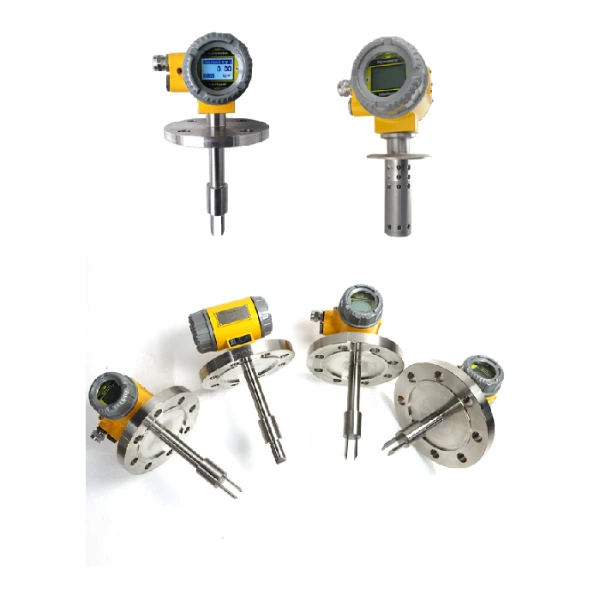 Tuning Fork Density Meter
Fixed inline density and concentration with 4-20 mA, Modbus, HART.
 Handheld Density Meter
Portable digital density meter for petroleum: reads density and API gravity from a sample on site.
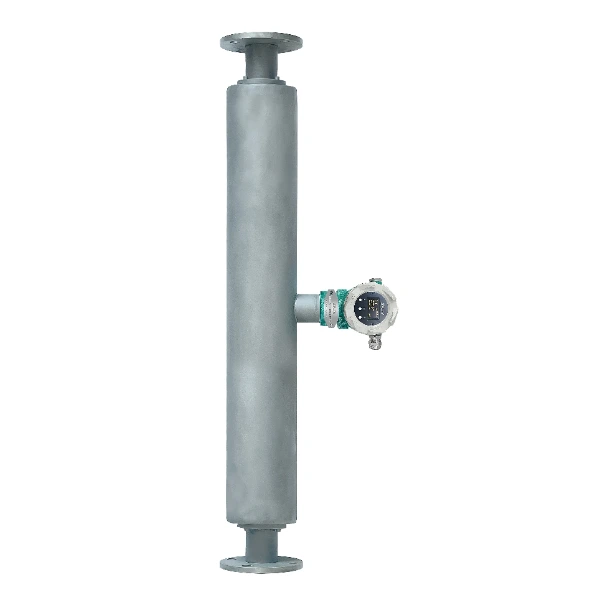 Coriolis Density Meter
High-accuracy inline density and concentration.
FAQ
How does a portable density meter work?
A handheld unit drives a small tuning fork probe that you dip into the liquid. The liquid adds mass to the vibrating fork and lowers its frequency in proportion to density. The meter measures that frequency, compensates for temperature, and shows density or concentration on screen.
How accurate is a portable density meter?
This portable meter reads to ±0.003 g/cc (±3 kg/m³) with ±0.001 g/cc repeatability. For tighter, continuous measurement on a fixed point, the inline tuning fork density meter reaches ±0.001 g/cc.
Can a portable density meter read concentration or Brix?
Yes, for a known fluid. Once the fluid is selected, the meter converts density to concentration and can show percent by weight, Brix, Baume, or a custom scale, which is the usual reason to use one in the field.
What is the difference between a portable and an inline density meter?
A portable meter is a battery handheld for spot checks across many points; an inline meter is permanently mounted and outputs a continuous signal to a control system. Use portable for field and quality-control checks, inline for process monitoring and control.
Which probe material should I choose?
316L suits most neutral and mildly corrosive fluids; Hastelloy handles many acids and caustics; zirconium is preferred for strong acids such as hot sulfuric or nitric. Send the fluid and concentration and we confirm the probe from the compatibility table above.
Request a quote
Send the fluids you need to check, the density or concentration range, and the temperature, and we configure a portable density meter for the work.
About this page: written by Instranova application engineers from real portable density meter product data.