Home › Products › Density meters › Tuning fork density meter
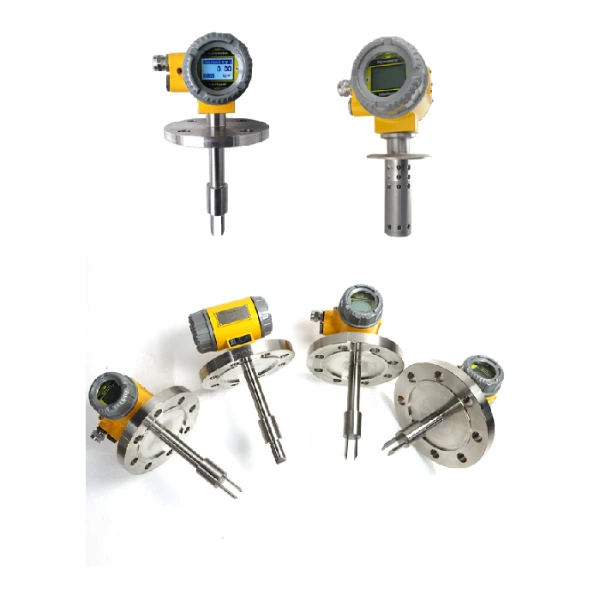
Tuning Fork Density Meter
A tuning fork density meter measures the density of a liquid in the line, in real time, from the resonant frequency of a vibrating fork. With no moving parts in the flow and no bypass loop, it gives a continuous density reading, and the concentration that density implies, for blending, mixing, and quality control.
- Range: 0 to 2.5 g/cc (0 to 2500 kg/m³)
- Accuracy: ±0.001 g/cc (±1 kg/m³)
- Process temp: -50 to +150 °C, up to 4 MPa
- Output: 4-20 mA, RS-485 Modbus, HART
- Wetted: 316L, Hastelloy C, titanium, PTFE/PFA
Overview
A tuning fork density meter is an inline instrument that reports the density of a process liquid continuously. A fork-shaped sensor is held in the flow and vibrated at its natural frequency; as the density of the surrounding liquid changes, that frequency shifts in a known way, and the electronics convert it to density. Because the same density value maps directly to concentration for a known mixture, one meter covers both density and concentration control on a blending, dosing, or crystallization line.
The fork has no moving parts in the stream and needs no sampling or bypass loop, so it installs directly in a pipe or tank. It reads from -50 to +150 °C and up to 4 MPa, with a built-in temperature element that compensates the reading so it stays stable as the process warms or cools.
Features
Mounts straight in the pipe or tank, with no sampling loop to build or maintain.
One reading gives density and the concentration it implies for a known mixture.
±0.001 g/cc accuracy with temperature compensation built in.
Works on slurries and viscous liquids up to 2000 cP.
316L, duplex, Hastelloy C, titanium, or PTFE/PFA coated forks.
4-20 mA, RS-485 Modbus RTU, and HART for any control system.
Working principle
The sensor is a tuning fork driven at its resonant frequency by a piezo element, with a second piezo element reading the vibration. When the fork is immersed, the liquid moves with the tines and adds mass, which lowers the resonant frequency. Denser liquid adds more mass and lowers the frequency more, so the measured frequency is a direct, repeatable function of density. A built-in temperature sensor corrects the small effect of temperature on the fork itself, leaving a clean density signal. The result is output as 4-20 mA, a frequency, or a digital value over Modbus or HART.
Because the reading comes from a frequency rather than a moving float or a flowing stream, it is largely independent of flow rate and tolerant of moderate pressure changes, and a calibration ties the frequency to density in engineering units. The same signal yields specific gravity, concentration, or percent solids, and the fork keeps reading through light slurries and coating-prone liquids that foul some other in-line sensors.
Technical specifications
| Parameter | Specification |
|---|---|
| Measuring principle | Vibrating tuning fork (resonant frequency) |
| Measuring range | 0 to 2.5 g/cc (0 to 2500 kg/m³); 0 to 100% |
| Accuracy | ±0.001 g/cc (±1 kg/m³); ±0.5% of reading |
| Repeatability | ±0.001 g/cc |
| Operating temperature | -50 to +150 °C |
| Working pressure | Up to 4 MPa |
| Viscosity range | 0 to 2000 cP |
| Temperature coefficient | 0.1 kg/m³ per °C after compensation |
| Output | 4-20 mA, 0-1000 Hz, RS-485 Modbus RTU, HART |
| Output accuracy | ±0.1% of reading or ±0.05% FS |
| Power supply | 24 VDC, ≥50 mA |
| Wetted materials | 316L, 2205/2507 duplex, Hastelloy C, titanium, PTFE/PFA lined |
| Process connection | DIN flange (DN50 PN16), G1.5 thread, or tri-clamp |
Density and concentration
For a known two-component mixture, concentration follows directly from density, so the meter doubles as a concentration analyzer. Once the relationship for a fluid is set, the meter can read out percent solids, percent by weight, Brix, Baume, or a custom concentration scale. This is the usual reason to fit one: holding a blend ratio, tracking the strength of an acid or caustic, following a sugar or starch slurry, or confirming that a dosed stream is on spec. Where the mixture is more than two components or the relationship is not stable, density still gives a reliable trend but concentration should be confirmed against a lab check.
Materials and corrosion
The fork and wetted parts are selected for the medium. Standard 316L suits most water-based and neutral fluids; 2205 or 2507 duplex and Hastelloy C handle chlorides and stronger acids; titanium covers seawater and some oxidizers; and a PTFE or PFA coating protects the fork in aggressive acids such as sulfuric or hydrofluoric. Matching the wetted material to the fluid is the single most important step for a long, drift-free service life.
Applications
Tuning fork density meters fit blending and concentration control across chemical, petrochemical, food and beverage, pharmaceutical, and mineral processing: acid and caustic strength, alcohol and solvent blends, sugar and starch slurries, fuel blending, and slurry density in flotation and tailings. They suit any line where a continuous density or concentration reading replaces grab samples and lab turnaround.
Application example
Challenge. A chemical process blended water and isopropanol to a target ratio, but the mix ratio drifted during the run and a lab sample was too slow to correct it.
Solution. An inline tuning fork density meter read the blend density continuously, and the known density-to-concentration relationship let the meter report isopropanol concentration in real time.
Result. Operators could see and hold the blend on target from the reading itself, instead of waiting on grab samples, tightening concentration control on the line.
Related products
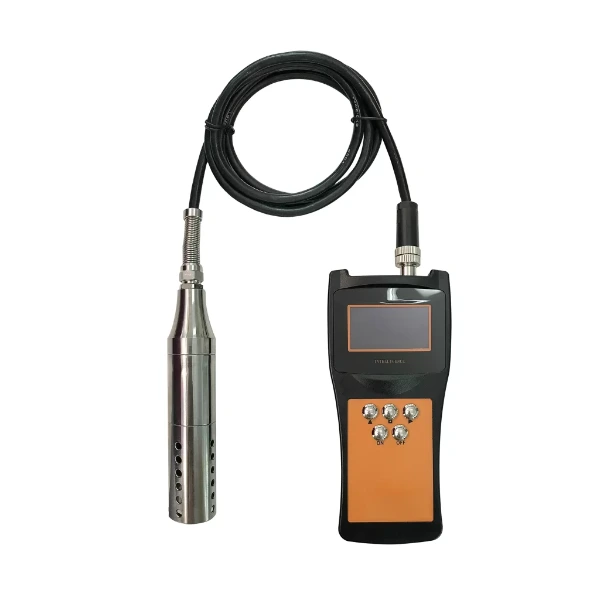 Portable Density Meter
Handheld field density and concentration; battery powered.
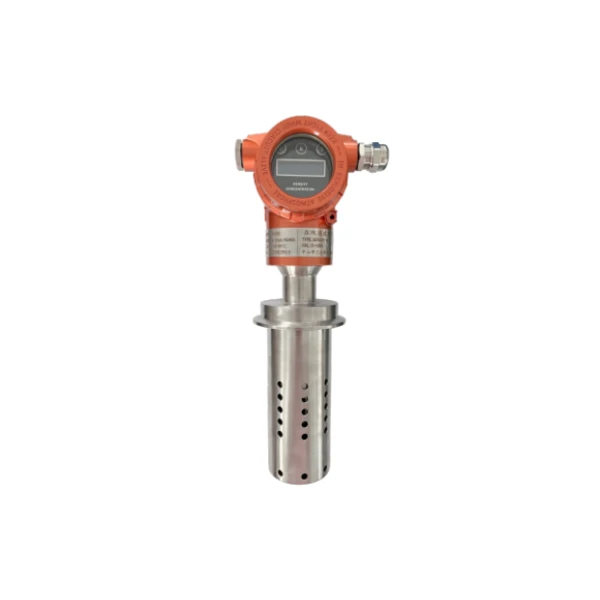 Alcohol Density Meter
Inline alcohol density / concentration meter: reads ethanol % at 20 C for spirits and brewing.
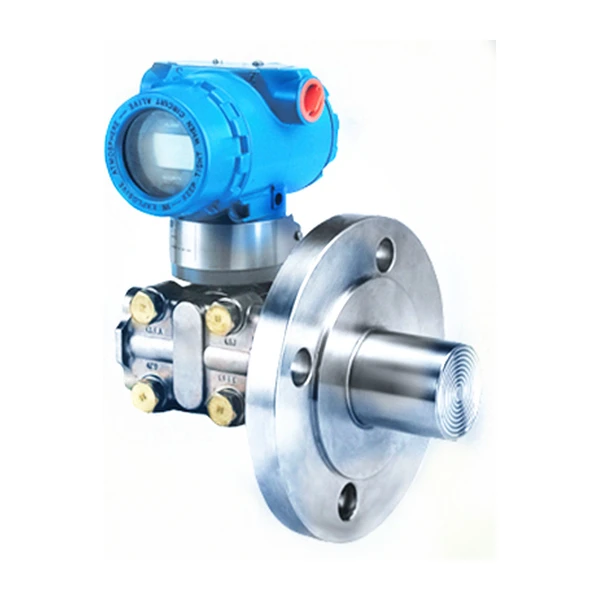 DP Density Meter
Hydrostatic DP density for slurry, acid, and viscous fluids where Coriolis and tuning fork foul.
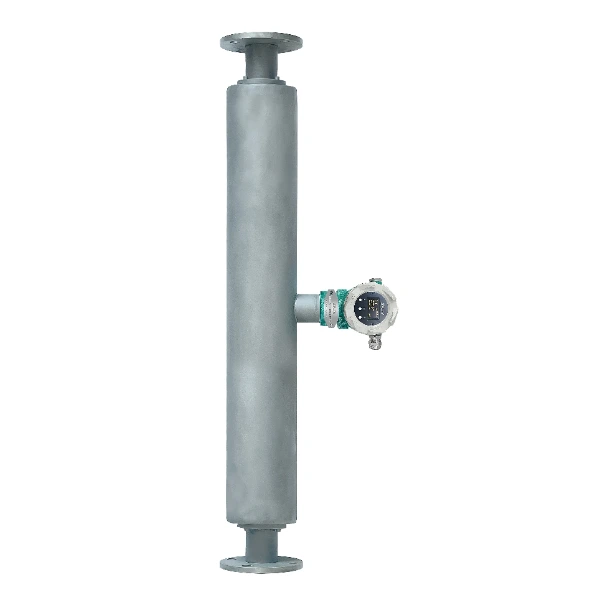 Coriolis Density Meter
High-accuracy inline density and concentration.
FAQ
How does a tuning fork density meter work?
A fork-shaped sensor is vibrated at its resonant frequency in the liquid. The liquid adds mass to the vibrating tines, which lowers the frequency in proportion to density. The electronics measure that frequency and convert it to density, with built-in temperature compensation.
How accurate is a tuning fork density meter?
This meter reads to ±0.001 g/cc (±1 kg/m³), about ±0.5% of reading, with the same repeatability. A built-in temperature sensor compensates the fork so the reading stays stable across the process temperature range.
Can a tuning fork density meter measure concentration or Brix?
Yes, for a known mixture. Because concentration maps to density, the meter can output percent solids, percent by weight, Brix, Baume, or a custom scale once the relationship is set for the fluid.
What is the difference between a tuning fork and a Coriolis density meter?
A Coriolis meter measures mass flow and density together and is a full flow meter; a tuning fork density meter is a dedicated, lower-cost density and concentration probe that installs inline without being a flow meter. For density or concentration alone, the fork is the simpler choice.
Can it measure slurries and viscous liquids?
Yes. The fork handles slurries and viscous fluids up to about 2000 cP, which makes it common in mineral processing and food slurries where other density methods clog or foul.
Request a quote
Send the fluid, the density or concentration range, the process temperature and pressure, and the connection, and we configure one density meter for the line.
About this page: written by Instranova application engineers from real tuning fork density meter product data.