Home › Temperature instruments › Bimetal thermometer
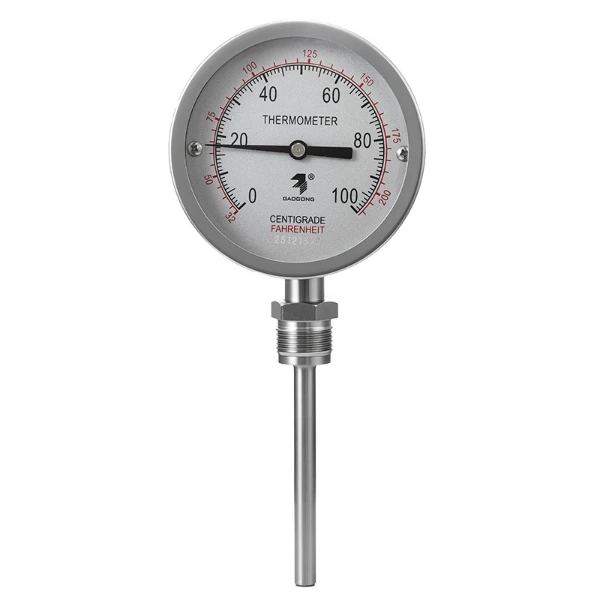
Bimetal Thermometer (WSS Series)
A mechanical dial thermometer that reads temperature on the spot, with no power and no wiring. A coiled bimetallic strip turns the pointer as it heats, so an operator gets a clear local reading on a pipe, tank, or duct. When the value also has to reach a control system, pair it with a temperature transmitter or use an RTD instead.
- Range: -80 to +500 °C
- Dial: 60, 100, or 150 mm
- Accuracy: Class 1.0 or 1.5 (% of span)
- Connection: axial, radial, or adjustable angle
- Wetted parts: 304 or 316 stainless steel
- Protection: IP55; electric-contact (alarm) option
Overview
A bimetal thermometer is the simplest way to read temperature at the process. Two bonded metals with different expansion rates form a strip wound into a coil; as it heats, the coil twists and turns a pointer over a dial. There is no power, no signal wire, and nothing to fail electronically, so it is the standard local gauge on water, steam, and oil lines from -80 to +500 °C.
It is a local indicator, not a transmitter: it shows the value where it is mounted but sends nothing to the control room. For a reading the control system needs, add a temperature transmitter with an RTD or thermocouple, or order the electric-contact version for a simple high or low alarm. Always install the stem in a thermowell on pressurized or aggressive lines so the gauge can be removed without breaking into the process.
Features
Local dial reading
Clear at-a-glance temperature right at the pipe or tank.
No power needed
Purely mechanical; nothing to wire, energize, or lose in a power cut.
Wide range
-80 to +500 °C across 60, 100, and 150 mm dials.
Any reading angle
Axial, radial, or adjustable head so the dial faces the operator.
Stainless and rugged
304 or 316 stainless case and stem; IP55 against dust and splash.
Electric-contact option
Add SPDT contacts for a simple high or low temperature alarm.
Working principle
Bond two metals with different thermal expansion rates and heat them: the strip bends toward the slower-expanding metal. Wound into a helix and anchored at one end, that bending becomes rotation. The free end turns the pointer shaft, and the dial is scaled so the pointer angle reads directly in degrees. Because the motion is mechanical and repeatable, the gauge holds its reading for years; the only adjustment is a zero set under the dial.
Connection types
Pick the case orientation so the dial faces the operator once the stem is in the line. The element and accuracy are the same; only the geometry changes.
| Type | Stem direction | Use when |
|---|---|---|
| Axial (back) | Straight out the back of the dial | Reading the dial face-on, stem into the pipe end |
| Radial (bottom) | Out the bottom, 90° to the dial | Stem vertical in a pipe, dial read from the side |
| Adjustable | Head rotates and tilts to any angle | Awkward mounting; aim the dial after install |
| 135° | Stem at 135° to the dial | Reading from above a low line |
Technical specifications
| Parameter | Specification |
|---|---|
| Measuring range | -80 to +500 °C (spans within this band) |
| Dial size | 60, 100, or 150 mm nominal |
| Accuracy class | Class 1.0 or 1.5 (percent of span) |
| Connection | Axial, radial, adjustable, or 135° |
| Wetted parts | 304 or 316 stainless steel stem and case |
| Process thread | M27x2, 1/2 NPT, or G1/2; thermowell available |
| Protection | IP55 |
| Electric contact (option) | SPDT contacts for high/low alarm or control |
Representative specifications. Dial size, range span, stem length, and connection are configured to the point; confirm on the datasheet.
Calibration
A bimetal thermometer is calibrated at a known fixed point, most often the ice point. Pack crushed ice with a little water, stir, and immerse the stem to its rated depth: a correct gauge reads 0 °C (32 °F). If it is off, turn the calibration nut on the back of the case until the pointer reads zero. For a wider check, boiling water at sea level reads 100 °C (212 °F), adjusted for altitude. Recheck after rough handling; the mechanism is stable but a hard knock can shift the zero.
Models and ordering
The WSS series is configured by dial size, range, connection type, accuracy class, and stem length, with optional electric contacts. Send the working temperature and the mounting, and we build it.
| Option | Choices |
|---|---|
| Dial size | 60 / 100 / 150 mm |
| Range | Spans from -80 to +500 °C; in °C, °F, or dual scale |
| Connection | Axial, radial, adjustable, or 135° |
| Accuracy / material | Class 1.0 or 1.5; 304 or 316 stem |
| Options | Electric contacts; thermowell; stem length to insertion depth |
Quote checklist, send these five points: range and scale; dial size; connection type; stem length (insertion depth); thread and any thermowell or contacts.
Ordering example: WSS-411, 100 mm dial, 0-200 °C, radial connection, Class 1.5, 316 stem, 150 mm insertion, 1/2 NPT, with a thermowell.
Applications
Bimetal thermometers go anywhere an operator needs a local reading without running wiring. Common uses:
- HVAC and utilities: chilled water, hot water, and air on local lines and headers
- Steam and boilers: feedwater, condensate, and process lines
- Oil and chemical: storage tanks, reactors, and transfer lines with a thermowell
- Food, beverage, and brewing: tanks and kettles where a clear dial helps the operator
- OEM equipment: skids and packages that need a built-in local gauge
Application example
HVAC plant, chilled-water lines. The site wanted a temperature an operator could read at the line itself, not only a value buried in the building management system. It added bimetal dial thermometers at the headers in radial-connection cases so the dial faced the walkway, each in a thermowell so a gauge could be swapped without draining the loop. The value was practical: a clear local check during rounds, with no extra wiring on a system already full of cable.
For hygienic, clean-in-place process lines, use the sanitary thermometer with a tri-clamp connection.
Related products
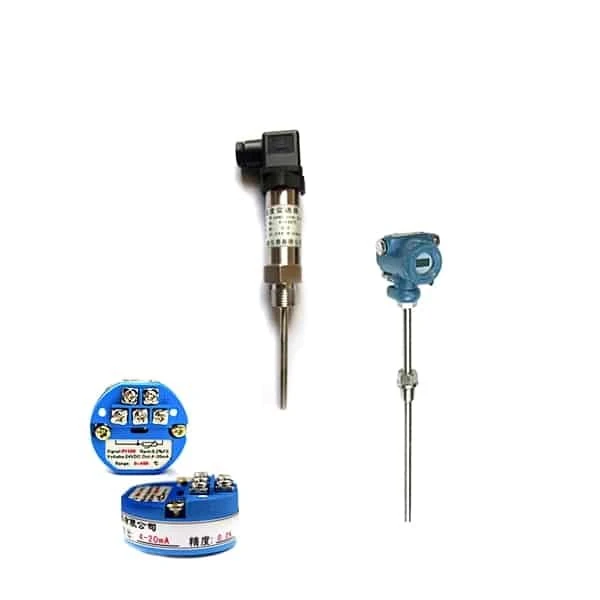 Temperature Transmitter
When the reading must reach the control system as 4-20 mA.
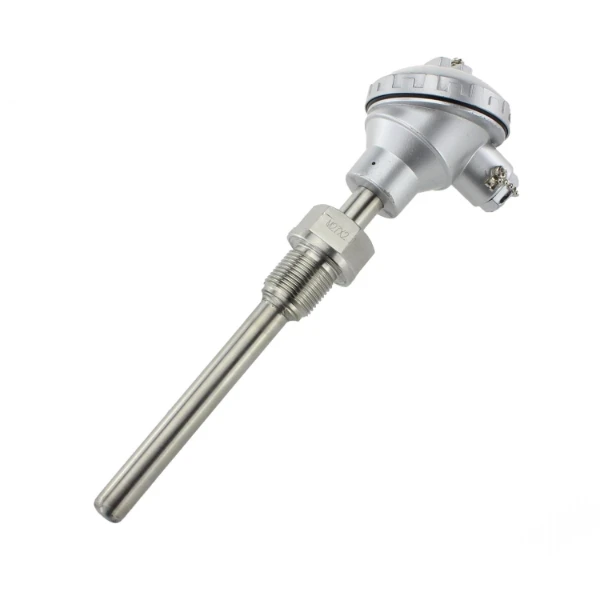 RTD Temperature Sensor (Pt100)
Accurate electrical sensing for remote, logged measurement.
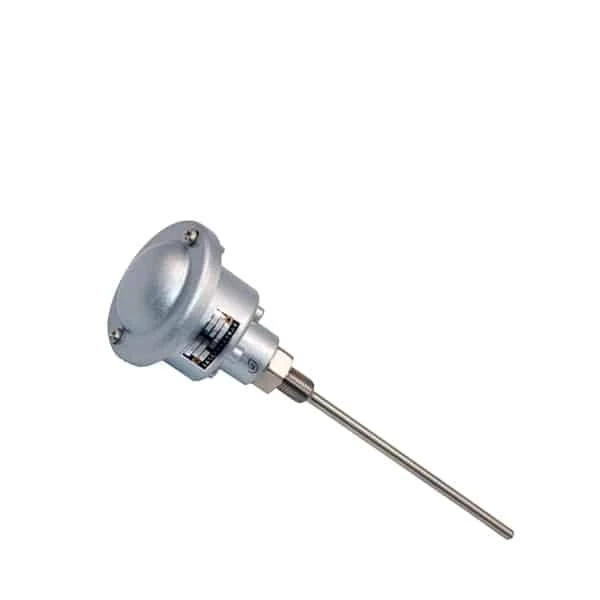 Thermocouple
For high heat beyond a bimetal dial’s range.
Browse all temperature instruments →
FAQ
What is a bimetal thermometer?
It is a mechanical dial thermometer that measures temperature with a coiled bimetallic strip. As the strip heats, it twists and turns a pointer over a dial, giving a local reading with no power or wiring. It is the common local gauge on pipes and tanks from -80 to +500 °C.
How does a bimetal thermometer work?
Two bonded metals expand at different rates, so a strip of them bends with temperature. Wound into a coil and fixed at one end, that bending becomes rotation that drives the pointer. The dial is scaled so the pointer angle reads directly in degrees.
How do you calibrate a bimetal thermometer, and to what temperature?
Use the ice point. Immerse the stem in a stirred mix of crushed ice and water; a correct gauge reads 0 °C (32 °F). If it is off, turn the calibration nut on the back until it reads zero. Boiling water (100 °C / 212 °C at sea level) gives a second check.
What is the range and accuracy of a bimetal thermometer?
The WSS series covers -80 to +500 °C in spans, on 60, 100, or 150 mm dials, at Class 1.0 or 1.5 (percent of span). For tighter accuracy or a remote signal, use an RTD or thermocouple with a transmitter.
Request a quote
Send the range and scale, the dial size, the connection type, the stem length, and the thread (plus any thermowell or contacts), and our application engineers will build the bimetal thermometer for the point.