Home › Pressure Switches › High Temperature Pressure Switch
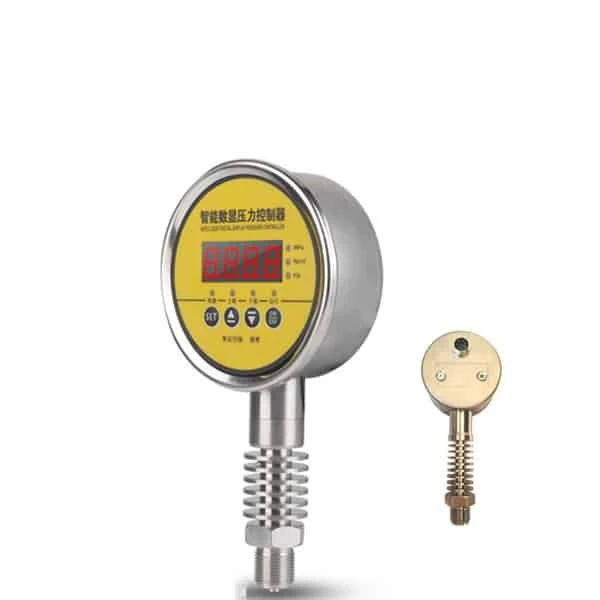
High Temperature Pressure Switch
A fully electronic switch for hot process media. An oil-filled isolation diaphragm at the front keeps the heat away from the electronics, so it reads, displays, and trips reliably on media up to 300 °C, with four switch outputs, an analog output, and RS485 in one unit.
- Media temperature: up to 300 °C
- Sensor: oil-filled piezoresistive, isolation diaphragm
- Outputs: four switch + one analog + RS485
- Range: configurable, micro-kPa to high MPa
- Display: on-site digital
Hot media break ordinary switches. The heat conducts back from the process into the sensing element and the electronics, and the signal drifts or the parts fail. The high temperature pressure switch solves that at the front end: an oil-filled isolation diaphragm transmits the pressure through a fill fluid while it blocks the direct heat path, so the electronics behind it stay in their working range even when the process runs at 300 °C. On top of that hot-media front end it keeps a full digital feature set, a display, four switch outputs, an analog output, and RS485.
Overview
This is a fully electronic pressure switch built for high-temperature, high-pressure service. The front end is an oil-filled piezoresistive sensor with an isolation diaphragm; behind it, high-precision A/D conversion and a microprocessor drive an on-site display and the outputs. It carries four switch points for staged interlocks, one analog output for continuous reporting, and an RS485 link for digital integration. The pressure range is configured to the application, from micro-pressure in kilopascals up to high megapascal spans. Where you need a continuous transmitter rather than a switch for hot media, see the high temperature pressure transmitter.
Handling the heat
The isolation diaphragm is the key. Process pressure pushes on a thin metal diaphragm; a fill fluid behind it carries that pressure to the piezoresistive element, which sits set back from the hot face. The fill fluid passes the pressure but the long, narrow path and the standoff slow the heat, so the sensing element and the electronics behind it run far cooler than the medium. That thermal separation is what lets the unit hold its reading on a 300 °C process where a flush, unisolated sensor would drift or fail. For very hot lines you extend the same idea with a cooling element or a longer standoff to keep the electronics in range.
Technical specifications
Representative specifications; range and the high-temperature build are configured per application.
| Parameter | Specification |
|---|---|
| Media temperature | Up to 300 °C |
| Sensing element | Oil-filled piezoresistive, with isolation diaphragm |
| Conventional range | Steps from 0.1 MPa up through 160 MPa (configured to order) |
| Micro-pressure range | 0 to 1, 2, 5, 10, 25, 40, 60, 100 kPa |
| Outputs | Four switch points + one analog + RS485 |
| Signal processing | High-precision A/D, microprocessor |
| Display | On-site digital |
| Structure | Fully electronic |
Outputs and range
Two things make this unit do more than trip. The four switch outputs let one device run a staged scheme on a hot line, a low warning, a high warning, and trips, each set from the front. The analog output and RS485 then report the same pressure: the analog feeds a controller, while RS485 lets the unit sit on a digital bus with other instruments. On range, it is configured to the application rather than fixed. Micro-pressure builds start at 0 to 1 kPa for low hot-gas service; conventional builds step up through the standard spans toward high megapascal service, with the exact ceiling for a given temperature set at the factory. Tell us the medium, its temperature, and the span, and we confirm the build.
Applications
The high temperature pressure switch suits hot-media control and protection:
- Steam and hot-water systems and headers
- Thermal oil and heat-transfer-fluid circuits
- Hot process gas and exhaust lines
- Furnace, boiler, and drying-plant pressure interlocks
FAQ
What is a pressure switch used for?
A pressure switch opens or closes a contact when pressure reaches a set point, to start or stop equipment, raise an alarm, or interlock a process. A high-temperature model is used where the medium itself is hot, such as steam lines, thermal-oil systems, and furnace or autoclave service. This unit keeps its electronics safe from that heat with an oil-filled isolation diaphragm, and offers up to four independent set points plus an analog output and RS485 from one device.
What psi should my pressure switch be set at?
There is no universal value; you set it for the process. Choose a trip point below the safe limit of the equipment, with enough margin that normal swings do not nuisance-trip it, and set the reset point so the contact recovers cleanly. With four independent set points on this switch you can stage several actions, for example an early warning, a control action, and a high-high trip, each at its own pressure. Note that you set pressure, not temperature; the high-temperature rating only describes the medium it can sit on.
Does a pressure switch require power?
A plain mechanical switch needs none, but this high-temperature unit is electronic: it needs a supply to run its display, its four set-point relays, the analog output, and the RS485 link. Power flows through the switched contacts to your control circuit as usual. The benefit of the powered design is multiple programmable trip points and a digital reading from a single instrument mounted on a hot line.
Request a quote
For a hot-media unit, tell us:
- Medium and its temperature at the tapping point
- Pressure span (micro-kPa or a conventional MPa range)
- Setpoints needed (up to four) and the interlock logic
- Outputs you will use (switch, analog, RS485)
- Process connection and any cooling-standoff need
Ordering example: high temperature pressure switch, steam at 250 °C, 0 to 2.5 MPa, two trips plus a high-high, analog and RS485, with a cooling standoff.
Tell us the application and we configure one unit, not a shelf part. Have a hot line we have not covered? Reach our application engineers.