Home › Pressure Switches › Hydraulic Pressure Switch Y-505
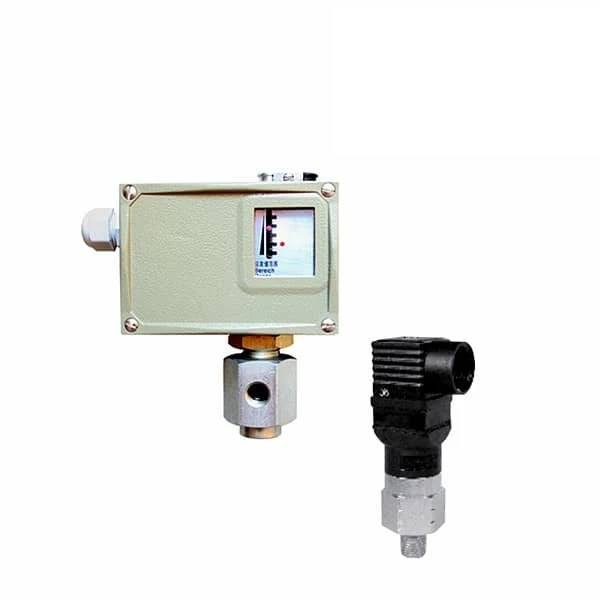
Hydraulic Pressure Switch Y-505
A mechanical, bellows-actuated pressure switch for high-pressure hydraulic and pneumatic systems. Adjustable up to 40 MPa, no power needed, with a normally-open and normally-closed contact and a choice of housing material to suit the medium.
- Adjustable range: 0.3 to 40 MPa
- Sensing element: bellows
- Repeatability: ≤ 2.5%
- Housing: galvanized steel, brass, or brass with Viton
- Protection: IP65 (O-ring) or IP54 (groove seal)
- Versions: standard and explosion-proof
A hydraulic system needs a switch that holds its point under pressure and shrugs off pulsation. The Y-505 uses a bellows element, which is stiff enough to work cleanly across the megapascal range and stand up to the pressure spikes a pump produces. It is a purely mechanical hydraulic pressure switch: no power supply, one normally-open and one normally-closed contact, an adjustable alarm point, and a long mechanical life. Three housing materials let you match it to oil, water-oil emulsion, or a more aggressive medium.
Overview
The Y-505 is adjustable from 0.3 MPa up to 40 MPa, so one model covers most hydraulic and high-pressure pneumatic control. Repeatability is 2.5%, the contacts carry AC 220 V at 6 A, and the seal choice sets the rating: an O-ring build gives IP65, a groove seal gives IP54. An explosion-proof version is available for classified areas. It suits compressed air carrying oil mist, hydraulic oil, water-oil emulsion, and neutral liquids with good lubricity. For low-pressure points below a few hundred kilopascals, use the diaphragm Y-500 pressure switch instead.
Working principle
Process pressure compresses a bellows against an adjustable range spring. You set the trip point by changing the spring tension; when pressure pushes the bellows past that point, a snap-action micro-switch flips and both contacts change state together. As pressure falls below the reset point, the spring extends the bellows and the contacts revert. The bellows is the right element for high pressure because it stays stiff and repeatable where a diaphragm would be overstretched, and it tolerates the pulsing of a hydraulic pump.
Technical specifications
Representative specifications; confirm the exact build per datasheet.
| Parameter | Specification |
|---|---|
| Adjustable range | 0.3 to 40 MPa |
| Sensing element | Bellows |
| Repeatability | ≤ 2.5% |
| Contact form | One normally-open, one normally-closed |
| Contact rating | AC 220 V 6 A; DC 250 V 0.25 A |
| Ambient temperature | -20 to +40 °C |
| Medium temperature | 0 to +100 °C (0 to +120 °C on Ex version) |
| Vibration resistance | 40 m/s² standard, 20 m/s² Ex |
| Protection | IP65 (O-ring) or IP54 (groove seal) |
| Versions | Standard and explosion-proof |
Housing materials
The housing is where you match the Y-505 to the medium. Pick the variant by what the wetted parts will see:
| Housing | Material | Use it for |
|---|---|---|
| A | Galvanized steel | General hydraulic oil and air, dry indoor plant |
| B | Brass | Damp or mildly corrosive surroundings |
| C | Brass with Viton bellows | Media that need a Viton-compatible seal |
Adjusting the setpoint
You set the Y-505 by turning the range adjustment, which changes the spring tension behind the bellows. Two habits keep a hydraulic switch reliable. First, set the trip with margin below the system relief setting, so the switch acts before the relief valve and is never pinned at full pressure. Second, account for the reset gap: the contacts reset a little below the trip point, so on a pulsing pump line set the trip high enough that normal ripple does not clip it and cause chatter. On a snubbed port, a switch set this way will run for years. Where you also need to read or trend the pressure, add one of our pressure transmitters, or step up to the electronic YX-18 for a display and an analog output in the switch itself.
Applications
The Y-505 fits high-pressure control on hydraulic and pneumatic plant:
- Hydraulic power units, presses, and clamping circuits
- Pump start, stop, and over-pressure protection
- Oil-mist compressed-air and pneumatic lines
- Water-oil emulsion systems and lubrication skids
The choice between the two contact forms, and when each fails safe, is covered in our guide to normally open and normally closed switching.
Where the circuit also needs a local dial next to the switch, our hydraulic pressure gauge guide explains range and snubber selection.
FAQ
What does a hydraulic pressure switch do?
A hydraulic pressure switch monitors the pressure in a hydraulic circuit and opens or closes an electrical contact when it reaches a set value. That lets it start or stop a pump, signal a controller, or trip a safety interlock when pressure climbs too high or falls too low. The Y-505 uses a bellows element rated for the high pressures of hydraulic systems, up to 40 MPa.
How to set a hydraulic pressure switch?
Apply a known pressure at your target trip point, then turn the range adjusting screw until the switch just changes state there, confirmed with a test gauge and a meter on the contacts. If your model has a separate deadband or reset adjustment, set how far the pressure must fall before the contact returns. Make small changes, cycle the pressure each time to check repeatability, and lock the adjustment once it holds. Always stay within the rated range of the unit.
How do I tell if my pressure switch is bad?
Common signs are a contact that no longer changes state at the set point, switching that wanders or chatters, or a unit that trips early or late. Check first that the set point and wiring are correct and that the bellows and connection are not leaking. With a meter, watch the contact while you raise pressure: if it does not switch cleanly at the set value or sticks, the element or the microswitch has likely worn and the switch should be replaced.
Request a quote
Tell us five things and we set the unit for your system:
- Trip pressure and the system relief setting above it
- Medium (hydraulic oil, air, emulsion) and its temperature
- Housing need (general, damp, or Viton-compatible)
- Contact wiring and the voltage you switch
- Area (standard or explosion-proof)
Ordering example: Y-505, trip at 16 MPa rising, hydraulic oil, housing A, IP65, standard area, normally-open for a high-pressure trip.
Tell us the application and we configure one unit, not a shelf part. Have a circuit we have not covered? Reach our application engineers.