Home › Pressure Switches › Diaphragm Pressure Switch Y-500
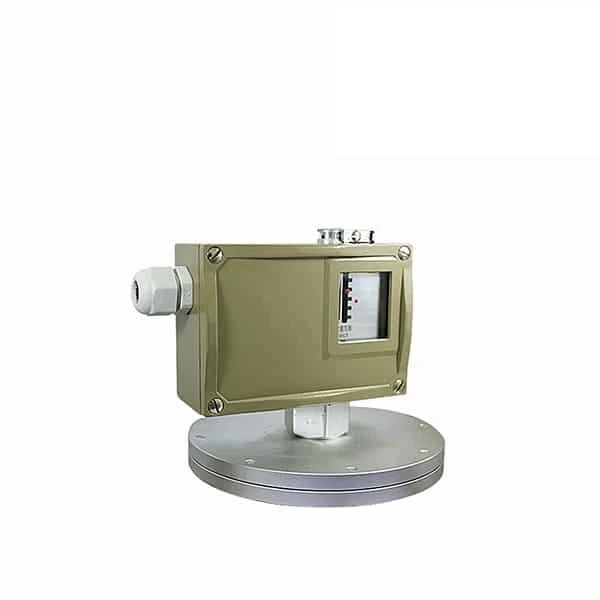
Diaphragm Pressure Switch Y-500
A mechanical, diaphragm-actuated pressure switch for low-pressure control. The diaphragm gives it the sensitivity to set a reliable trip point down in the kilopascal range, where a bellows or piston switch is too coarse. No power needed, with a fixed normally-open and normally-closed contact.
- Adjustable range: -16 kPa to 2.5 MPa
- Sensing element: diaphragm
- Repeatability: ≤ 1.5%
- Contacts: AC 220 V 6 A / DC 250 V 0.25 A
- Protection: IP65 (IP54 on Ex version)
- Versions: standard and explosion-proof
Low-pressure control is where the choice of sensing element matters most. A diaphragm has a large area, so a small pressure moves it a useful amount; that is what lets the Y-500 hold a repeatable trip point at a few kilopascals, the kind of low setting a stiff bellows or piston cannot resolve. It is a purely mechanical diaphragm pressure switch: no power supply, one normally-open and one normally-closed contact, and an adjustable setpoint you dial in by hand.
Overview
The Y-500 covers an adjustable band from -16 kPa up to 2.5 MPa, so it handles both light vacuum and modest positive pressure. Repeatability is 1.5%, the contacts carry AC 220 V at 6 A, and the standard housing is IP65. An explosion-proof version is available for classified areas (IP54). It works with neutral gases such as air and with liquids that do not attack the wetted parts: water, hydraulic oil, lubricating oil, and light fuel oil. For higher pressures up to 40 MPa, use the bellows-actuated Y-505 hydraulic pressure switch instead.
Working principle
Process pressure acts on a diaphragm. As pressure rises, the diaphragm deflects against a calibrated spring; the spring tension is what you adjust to set the trip point. When the deflection reaches the set value, a snap-action micro-switch flips, changing the normally-open and normally-closed contacts together. When pressure falls back below the reset point, the spring returns the diaphragm and the contacts revert. Because the large diaphragm area converts a small pressure into a clear movement, the switch stays repeatable at low settings.
Technical specifications
Representative specifications; confirm the exact build per datasheet.
| Parameter | Specification |
|---|---|
| Adjustable range | -16 kPa to 2.5 MPa |
| Sensing element | Diaphragm |
| Repeatability | ≤ 1.5% |
| Contact form | One normally-open, one normally-closed |
| Contact rating | AC 220 V 6 A; DC 250 V 0.25 A |
| Ambient temperature | -20 to +50 °C |
| Medium temperature | 0 to +120 °C |
| Vibration resistance | 40 m/s² (ZNC-Y500) |
| Protection | IP65 (IP54 on explosion-proof version) |
| Versions | Standard and explosion-proof |
Setting the range
The setpoint is adjustable across the whole band, and you tune it against the calibrated spring rather than a gauge. Two points matter when you pick a setting. First, leave headroom: set the trip with margin below the maximum so the diaphragm is not run hard against its stop. Second, mind the hysteresis: the reset point sits a little below the trip point, so a switch set near the bottom of its band gives the widest usable gap between trip and reset. For a low-pressure protection point on air or water, the Y-500 reaches down far enough that you rarely need a separate low-range model. Where you also want to read the pressure, not just trip on it, pair it with one of our pressure transmitters.
Applications
The Y-500 fits low-pressure control and protection on clean media:
- Low-pressure protection on air and compressed-air lines
- Water systems, pumps, and purifier plant
- Lubrication and light fuel-oil circuits
- Fan, blower, and ventilation pressure proving
Unsure which of the two contacts to wire for your circuit? See normally open vs normally closed on pressure switches.
FAQ
What is a diaphragm pressure switch?
A diaphragm pressure switch uses a flexible membrane as its sensing element. Process pressure pushes on the diaphragm, and once it reaches the set point the diaphragm moves enough to flip a snap-action contact. Because the membrane has a large area it responds to low pressures, which is why the Y-500 covers ranges from a slight vacuum up to a few megapascal, where a stiffer bellows or piston would be too coarse.
How does a diaphragm switch work?
The membrane is loaded against an adjustable spring. Pressure on one side builds until its force overcomes the spring setting, at which point a lever trips a microswitch and the contact changes state. When the pressure falls, the spring pushes the diaphragm back and resets the contact after a built-in deadband. You set the trip point by adjusting the spring; the larger the diaphragm, the lower the pressure it can sense reliably.
Does a pressure switch require power?
The Y-500 is a mechanical switch, so the sensing side needs no power: the diaphragm and spring do the work. Power only flows through the contacts you wire it to, so it can directly make or break a control circuit. That keeps it simple and dependable for pump, fan, and alarm control, with nothing to fail if the supply drops.
Request a quote
Tell us five things and we set the unit for your point:
- Trip pressure and whether it is vacuum, positive, or compound
- Medium (air, water, oil) and its temperature
- Contact wiring and the voltage you switch
- Process connection thread
- Area (standard or explosion-proof)
Ordering example: Y-500, trip at 30 kPa rising, air, IP65, standard area, with a normally-open contact for a low-pressure alarm.
Tell us the application and we configure one unit, not a shelf part. Have a control point we have not covered? Reach our application engineers.