Products › Pressure instruments › SI-51 Miniature Pressure Sensor
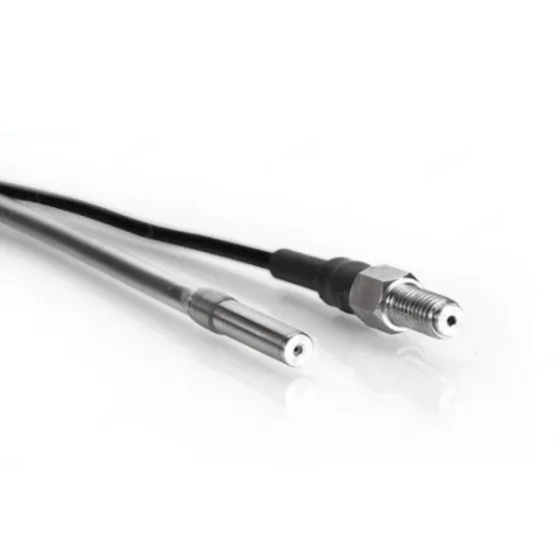
SI-51 Miniature Pressure Sensor
A MEMS miniature pressure sensor in a one-piece stainless package as small as a few millimeters across. For OEM builds and tight installations that still need a calibrated 4-20 mA, voltage, mV or RS485 output.
- Ranges: -100 kPa up to 60 MPa
- Accuracy: 0.1%, 0.25% or 0.5% FS
- Package: Phi 3, Phi 5, M6, M8, M10 (custom)
- Output: 4-20 mA, 0-5 / 1-5 / 0-10 V, mV, RS485
- Temperature: -40 to 85 C operating
Overview
The SI-51 is a miniature pressure sensor that packs a calibrated transducer into a body small enough to thread into an M6 boss or a Phi 3 port. It is built for designers who have run out of panel space: portable instruments, medical and lab equipment, robotics, pneumatic manifolds and any OEM machine where a full-size transmitter will not fit but a raw sensor chip is too much integration work.
Unlike a bare MEMS die, the SI-51 is a finished, temperature-compensated unit in a one-piece stainless package, so you get a stable output without designing your own amplifier and compensation. For high-volume designs that also want factory-locked zero and span, compare the industrial OEM transducer line.
Working principle
A MEMS silicon sensing element behaves as a piezoresistive Wheatstone bridge: pressure strains the micromachined diaphragm and unbalances the bridge. The element is integrated into a one-piece 316-compatible stainless package and paired with signal conditioning that compensates zero and sensitivity over temperature. The small, stiff diaphragm gives a high natural frequency, from about 10 kHz to 1 MHz depending on range, so the SI-51 follows fast pressure changes that a large-diaphragm transmitter would smear.
Technical specifications
| Parameter | Specification |
|---|---|
| Measuring range | -100 kPa to 0-10 kPa, up to 1 MPa to 60 MPa |
| Measuring medium | Gases or liquids compatible with 316 stainless steel |
| Static accuracy | 0.1%, 0.25% or 0.5% FS |
| Package / thread | Phi 3, Phi 5, M6, M8, M10 (customizable) |
| Natural frequency | 10 kHz to 1 MHz (range dependent) |
| Output / supply | 4-20 mA, 0-5 / 0-10 / 1-5 V, mV, or RS485; 12-36 VDC (24 VDC typical) |
| Operating temperature | -40 to 85 C |
| Compensated temperature | -10 to 60 C |
| Storage temperature | -40 to 100 C |
| Long-term stability | Typical 0.1% FS/year; max 0.2% FS/year |
| Temperature drift (zero / span) | Typical 0.02% FS/C; max 0.05% FS/C |
| Overload | 2x full scale, or 110 MPa max (whichever is lower) |
| Cycle life | Greater than 1,000,000 pressure cycles (10-90% FS) |
| Vibration | 20 g per IEC 60068-2 |
Representative specifications, at room temperature and rated supply unless stated. Values typical; confirm the exact build per datasheet.
Output options
The SI-51 is a split-type design: the sensing head and the conditioning can be specified together for a finished signal. Four output families cover most builds. A raw mV bridge output (driven from a constant-voltage or constant-current source) hands calibration to your own electronics and keeps the head smallest. A 4-20 mA or voltage output gives a ready-to-read analog signal. RS485 delivers a digital reading straight to a controller. Pick the output by what your system already speaks, then the package size by the space you have.
Models and ordering
Quote checklist: send these five points and we configure one unit, not a shelf part.
- Pressure range and reference (gauge, absolute, or compound down to -100 kPa)
- Output: mV, 4-20 mA, a voltage range, or RS485
- Accuracy class: 0.1%, 0.25% or 0.5% FS
- Package and thread: Phi 3, Phi 5, M6, M8, M10, or your interface
- Temperature range and any space or weight limit on the head
Ordering example: SI-51, 0 to 10 MPa gauge, mV bridge output, 0.25% FS, M10 thread for an OEM hydraulic handpiece.
Applications
- OEM machines and instruments with tight installation space
- Portable and handheld pressure equipment
- Pneumatic manifolds and small hydraulic blocks
- Medical, laboratory and test-bench devices
- Robotics and automation end-effectors
Application example
OEM instrument manufacturing. An OEM building a compact pressure instrument needed a calibrated transducer that would fit an M10 boss and ship in volume with consistent zero and span. The one-piece stainless head removed a separate amplifier from their board and held calibration across the production run, at an annual volume of around 22,000 units.
Related products
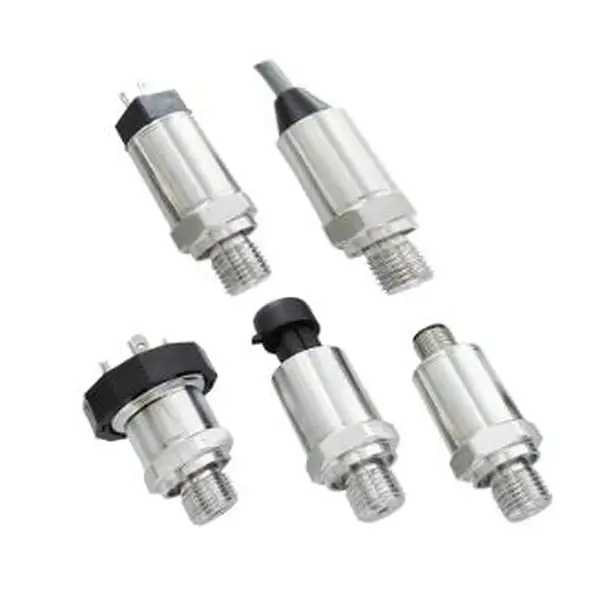 Industrial Pressure Transducers
OEM transducers with factory-locked zero and span.
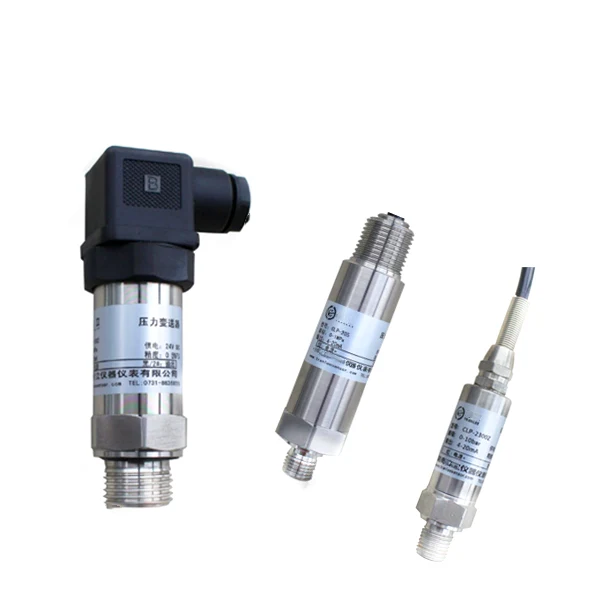 Pressure Transmitters
General-purpose gauge, absolute and differential transmitters.
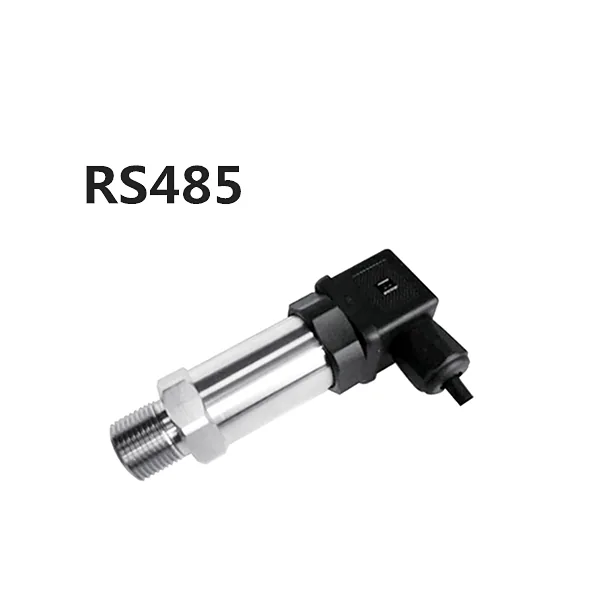 Digital Pressure Sensor
RS485 Modbus output for PLC and SCADA.
Browse all pressure instruments →
FAQ
What does a pressure sensor do?
It converts pressure into an electrical signal. A miniature pressure sensor packs that function into a small body for tight installations and OEM builds, outputting 4–20 mA or a voltage proportional to pressure.
What happens if a pressure sensor is bad?
It drifts, sticks at a value, or loses output. A sealed miniature sensor with a stable element resists this; if you suspect it, compare the reading against a known reference and check the zero.
What are the types of pressure sensors?
By sensing technology: piezoresistive (diffused silicon), ceramic, capacitive, and strain gauge; by reference, gauge, absolute, and differential. A miniature pressure sensor usually uses a compact piezoresistive silicon element.
Where is a pressure sensor located?
At the process tapping point. The miniature size lets it fit where a standard transmitter will not, such as small manifolds, test rigs, and compact OEM equipment, through its process connection.
Request a quote
Send the five points in the checklist above and our application engineers will configure an SI-51 for your space, range and output. Reach our application engineers.